

If your Amazon ACoS has been creeping upward lately, you are not alone. CPCs are higher, competition is tighter, and Amazon’s ad auction is far less forgiving than it was even two years ago.
Most sellers react the same way when they see ACoS spike:
They cut the budget.
And almost every time, that creates a second problem.
Sales velocity drops. Organic rank softens. Competitors take the placements you vacated. Then the next few weeks are spent trying to recover the visibility you already paid to build.
The frustrating part is that high ACoS is usually not a budget problem.
It is an efficiency problem.
Lowering ACoS without cutting your budget comes down to one thing: spending the same amount more efficiently. That means eliminating wasted clicks, improving conversion rate, and shifting budget toward the keywords and ASINs that actually generate profitable sales. Sellers who consistently do this often operate in the 15 to 26% ACoS range without reducing spend at all.
According to recent Amazon advertising benchmark reports from Marketplace Pulse and Teikametrics, CPCs have continued rising as more sellers compete for limited ad placements, making profitability and ACoS control significantly harder in 2026.
But the good news is this:
Most Amazon accounts still leak money in predictable places.
And that means there are predictable fixes.
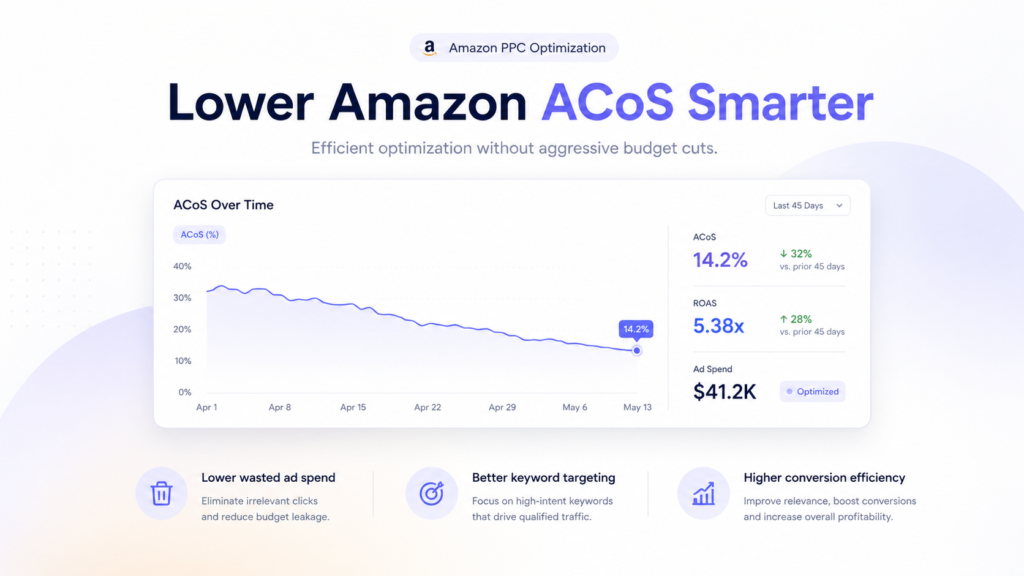
In this guide, we are going deep into eight specific tactics that experienced Amazon operators use to reduce ACoS without shrinking ad spend. No vague theory. No recycled “optimize your campaigns” advice. Just practical changes inside Seller Central that move the number in the real world.
Before You Optimize Anything: Know Your Real Target
ACoS by itself is meaningless until you know your break-even point.
A 35% ACoS can be excellent for one product and disastrous for another.
This is where most Amazon PPC advice falls apart. Sellers chase arbitrary ACoS targets without understanding whether the campaigns are actually profitable.
Before touching bids, keywords, or budgets, calculate your break-even ACoS.
How to Calculate Your Break-Even ACoS
Your break-even ACoS is simply your net margin before advertising.
Formula
Break-even ACoS = Net margin percentage after COGS, FBA fees, and referral fees
Here is a simple example.
- Product price: $35
- COGS: $8
- FBA fees: $7
- Amazon referral fee (15%): $5.25
Your remaining margin before ads:
$35 − $8 − $7 − $5.25 = $14.75
Now divide that margin by the selling price:
$14.75 ÷ $35 = 42%
That means:
- Any ACoS below 42% is profitable
- Any ACoS above 42% loses money
This single calculation changes how you view your campaigns.
A seller panicking over a 30% ACoS may actually be highly profitable. Another seller celebrating 22% may quietly be underwater because margins are thin.
Calculate this for every ASIN you advertise.
Not once.
Every time pricing, sourcing, or fees change.
What a Good ACoS Looks Like in 2026
There is no universal “good” ACoS.
The right number depends on where the product sits in its lifecycle.
| Seller Stage | Target ACoS Range |
| New product launch | 30 to 60% |
| Growing brand, established listing | 20 to 35% |
| Mature product, profit-focused | 10 to 25% |
| Top-performing sellers | 15 to 23% |
| Amazon’s average in 2026 | 32.48% |
One important nuance most articles miss is that category matters massively.
CPCs in Books can still sit under $0.50, while Beauty and Supplements regularly exceed $2.00 per click.
Comparing your supplement brand against the average ACoS of all Amazon sellers is useless. Benchmark against your own category instead.
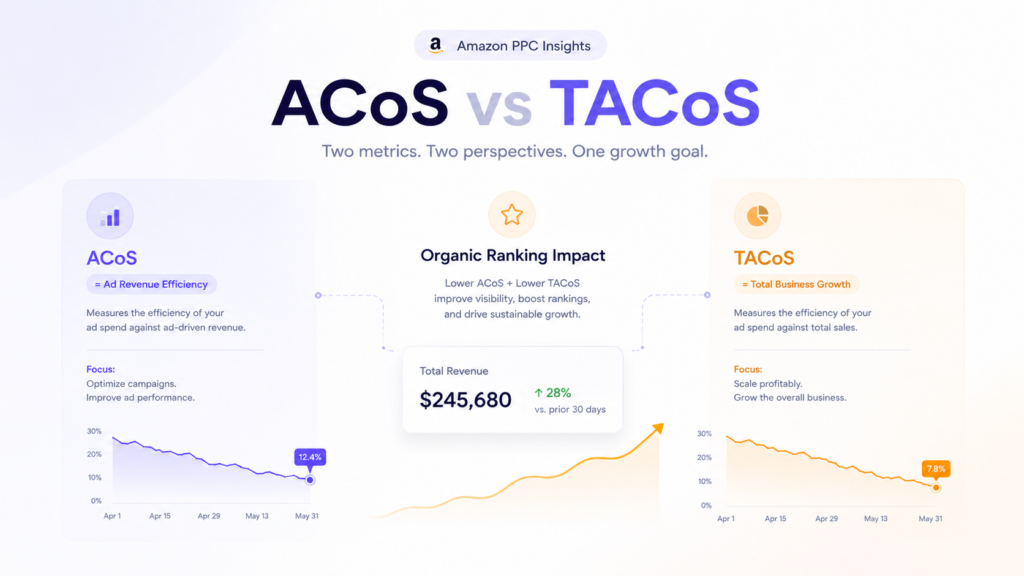
ACoS vs TACoS: Why Smart Sellers Track Both
ACoS only measures ad-attributed sales.
TACoS measures total business impact.
Formula
TACoS = Total ad spend ÷ Total revenue × 100
That includes organic sales too.
This distinction matters more than most sellers realize.
Imagine this scenario:
- ACoS = 35%
- TACoS = 12%
That usually means ads are helping build organic rank successfully.
Now compare that to:
- ACoS = 35%
- TACoS = 35%
That is a warning sign.
It means your business depends entirely on paid traffic with little organic lift.
Healthy Amazon brands gradually see TACoS decrease over time as organic ranking strengthens.
That is the long game.
8 Proven Ways to Lower Amazon ACoS Without Cutting Budget
1. Negative Keywords: The Fastest ACoS Fix Most Accounts Need
Negative keywords are one of the fastest ways to improve ACoS.
Many Amazon accounts unknowingly waste 20% to 40% of ad spend on search terms that never convert.
That is not optimization.
That is leakage.
Start by downloading your Search Term Report from the last 60 days.
Sort by spend and identify search terms consuming significant budget without generating sales.
A practical rule many PPC managers follow:
If a keyword spends the equivalent of your target CPA without producing a sale, it should already be under review.
If a keyword reaches three to five times your target CPA with zero conversions, it usually needs to be negated.
There are two major types of negative keywords sellers should monitor regularly.
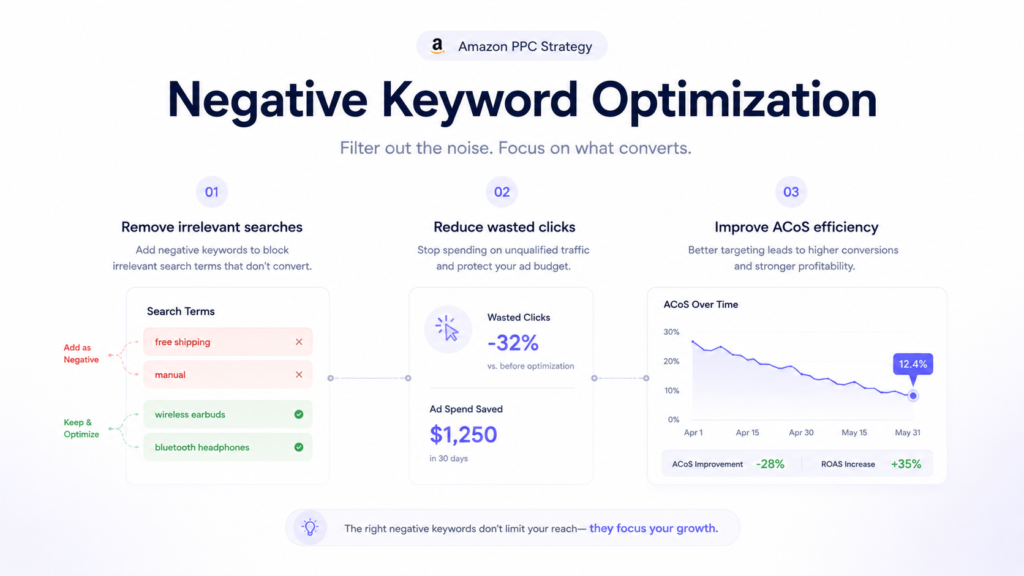
Irrelevant Search Terms:
These are clearly unrelated searches.
For example, if you sell hair oil but Amazon matches your ads against:
- Cooking oil
- Engine oil
- Massage oil
Those searches should be blocked immediately.
Relevant But Unprofitable Terms:
Some keywords technically match your product but still perform poorly.
If a keyword consistently spends money without converting profitably, it becomes a liability regardless of relevance.
Weekly negative keyword reviews usually outperform monthly reviews because wasted spend compounds quickly.
Many unaudited accounts see noticeable ACoS improvement simply by cleaning up non-converting traffic.
2. Move Winning Keywords Out of Auto Campaigns
Auto campaigns are useful for discovery.
They are not the ideal place for profitable keywords in the long term.
One common mistake is leaving converting search terms trapped inside auto campaigns indefinitely. That gives Amazon too much control over bidding and traffic quality.
Once a keyword proves itself, take ownership of it.
A practical rule:
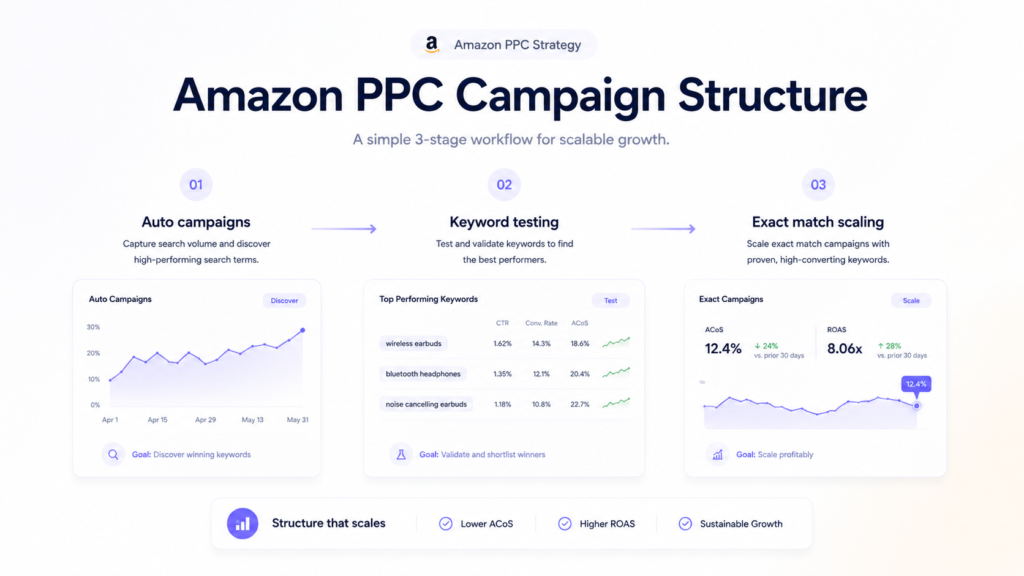
If a search term converts consistently inside an auto campaign, move it into an exact-match manual campaign.
A strong campaign structure usually looks like this:
- Auto campaigns for discovery
- Broad and phrase campaigns for testing
- Exact campaigns for scaling proven terms
Typical workflow:
- Review Search Term Reports weekly
- Identify converting keywords
- Move them into exact-match campaigns
- Adjust bids based on target ACoS
- Add those same keywords as negatives in auto campaigns
That final step is important because it prevents campaign overlap and inflated CPCs.
This structure reduces exploratory waste and gives sellers more control over profitable traffic.
3. Improve Your Listing Conversion Rate
Many sellers try to solve high ACoS by changing bids.
But the real issue is often the listing itself.
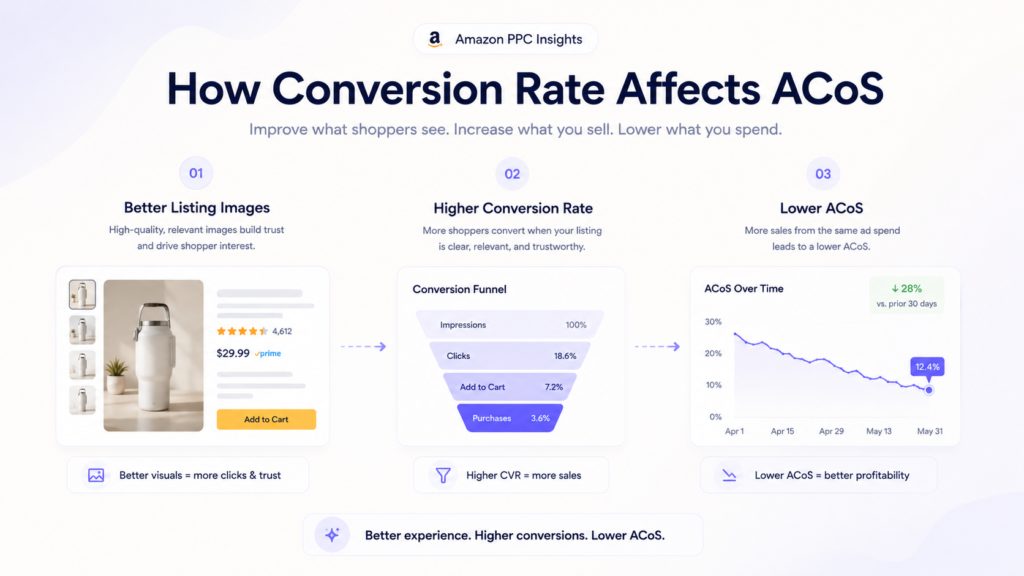
Your conversion rate affects every campaign simultaneously. Improving it increases revenue without increasing clicks, which naturally lowers ACoS.
ACoS Formula
ACoS = Ad Spend ÷ Ad Revenue
Revenue depends on:
- Clicks
- Conversion rate
- Price
If the conversion rate improves while traffic remains stable, ACoS usually improves automatically.
Average Amazon conversion rates in 2026 sit around 10%.
Strong listings often exceed 15%.
If your listing converts below 7%, the listing itself may be the biggest issue affecting profitability.
Several factors influence conversion rate heavily.
Product Images:
Listings with strong image stacks consistently outperform weaker visuals.
High-performing listings often include:
- lifestyle photos
- size comparisons
- infographics
- close-up detail shots
- real-world usage examples
Strong imagery improves buyer confidence immediately.
Product Titles:
Keyword-stuffed titles are becoming less effective.
Readable titles that clearly communicate product purpose and customer benefit usually perform better.
Bullet Points:
Feature-heavy copy often underperforms compared to benefit-focused copy.
Example:
Instead of:
“Waterproof material”
Use:
“Helps keep belongings dry during rain, travel, and outdoor use.”
The second version explains the real-life benefit.
Reviews:
Products with stronger review profiles almost always convert better.
A listing with 250 reviews and a 4.6-star rating usually outperforms a listing with 18 reviews and a 4.1-star rating, even if the PPC structure is identical.
Pricing:
Pricing outside category expectations can damage the conversion rate quickly.
Even small pricing mismatches can increase ACoS because lower conversion rates make every click more expensive.
Weak conversion rates also hurt organic ranking over time.
Amazon rewards listings that convert consistently.
That creates a cycle where poor conversion leads to weaker rankings, higher PPC dependence, and rising ACoS.
Fixing the listing often breaks that cycle.
If your product struggles with visibility before conversion even becomes the problem, read our guide on Why Your Amazon Listing Gets Zero Views: Nobody Tells You These Hidden Errors. Many sellers focus entirely on PPC while missing indexing and discoverability issues that quietly suppress traffic.
4. Use Dayparting to Control Low-Quality Traffic
Most Amazon campaigns run continuously throughout the day.
But buyers do not convert equally during every hour.
Some time periods produce profitable sales. Others quietly drain the budget.
Dayparting helps identify those patterns.
Review campaign performance by:
- hour
- day of week
Look for periods where clicks remain high, but conversions collapse.
Late-night traffic often performs poorly in many categories.
Instead of pausing campaigns completely, many sellers reduce bids during weaker hours while increasing aggressiveness during stronger conversion windows.
A simple strategy:
- Reduce bids during weak-performing periods
- Shift the budget toward peak conversion hours
The goal is not to spend less overall.
The goal is to spend more efficiently.
5. Optimize Placements Based on Performance
Not all Amazon ad placements perform equally.
Inside Campaign Manager, review performance across:
- Top of Search
- Product Pages
- Rest of Search
Many sellers discover huge performance differences between placements.
Example:
- Top of Search: 24% ACoS
- Product Pages: 110% ACoS
If one placement consistently performs better, budget allocation should reflect that.
Increase modifiers where conversion quality is strong.
Reduce spend where placements consistently waste budget.
One important warning:
Placement multipliers combined with dynamic bidding can increase CPCs dramatically.
A moderate base bid can quietly turn into a very expensive click once placement adjustments stack together.
Always review actual CPC data after making placement changes.
6. Focus Budget on Strong ASINs
Not every ASIN deserves aggressive advertising.
Many sellers spend heavily on weak listings, hoping ads will compensate for poor conversion.
Usually, established winners generate lower ACoS because trust and conversion momentum already exist.
Listings with:
- Strong review profiles
- Higher conversion rates
- Established organic rankings
Typically require fewer clicks to generate sales.
Inside Brand Analytics, review metrics like Unit Session Percentage and prioritize spend toward listings already converting efficiently.
That does not mean abandoning weaker products completely.
But weaker ASINs usually need:
- Tighter targeting
- Lower exploratory spend
- Stronger negative keyword control
Ads amplify listing quality.
They rarely fix weak listings on their own.
This is also why many growing brands eventually move toward operational support instead of trying to manage every PPC, listing, inventory, and customer service task internally. If you are evaluating scaling support, our breakdown on Amazon Virtual Assistant vs Amazon Automation Service: What’s Better for Your Amazon Business? explains the differences clearly.
7. Long-Tail Keywords Usually Convert Better
Broad keywords attract massive competition.
Long-tail keywords often produce stronger purchase intent at lower CPCs.
Examples:
- Running shoes for flat feet women
- Protein powder for a sensitive stomach
- Waterproof hiking backpack carry-on size
Long-tail searches usually:
- Cost less
- Convert better
- Attract buyers closer to purchase
The easiest place to find long-tail opportunities is your own Search Term Report.
Look for:
- Modifier-heavy phrases
- “For” searches
- Problem-solving searches
- Highly specific intent phrases
Then move those keywords into dedicated exact-match campaigns.
Long-tail traffic may not look glamorous, but it is often far more profitable.
8. Protect Your Branded Keywords
Branded campaigns are defensive campaigns.
If shoppers search your brand name, they are already high-intent buyers.
Those clicks usually convert at the lowest ACoS in the account.
If competitors bid aggressively on your branded terms and you do not defend them, they can intercept traffic you already earned through reviews, ranking, and customer trust.
Always separate:
- Branded campaigns
- Non-branded campaigns
Combining them creates misleading reporting and hides the real performance of your acquisition campaigns.
Keep reporting clean and measurable.
Common Mistakes That Keep ACoS High
1. Leaving Auto Campaigns Unmanaged:
Auto campaigns should continuously feed profitable keywords into manual campaigns.
Without harvesting and negatives, Amazon keeps spending on exploration indefinitely.
2. Ignoring Bid Changes for Months:
Amazon auctions change constantly.
A bid that worked three months ago may now be completely inefficient.
Regular bid reviews matter.
3. Cutting Budget Instead of Improving Efficiency:
Reducing the budget often lowers sales velocity, weakens ranking, and increases dependence on ads later.
Improving efficiency usually works better than simply spending less.
4. Focusing Only on PPC While Ignoring Conversion:
Weak images, poor reviews, weak copy, and pricing issues increase ACoS no matter how advanced the campaign structure becomes.
5. Mixing Branded and Non-Branded Campaigns:
This creates confusing data and makes optimization harder.
Keep them separate.
6. Scaling Weak Listings:
If a product has poor reviews, weak conversion, or poor visuals, increasing ad spend usually scales inefficiency rather than profits.
Fix the listing first.
Then scale traffic.
As more sellers delegate PPC management, account access, and operational structure become increasingly important. Before handing over campaign permissions or Seller Central access, read How to Hire the Right Amazon Virtual Assistant (Without Risking Your Account) to avoid common security and management mistakes.
What Results Should You Realistically Expect?
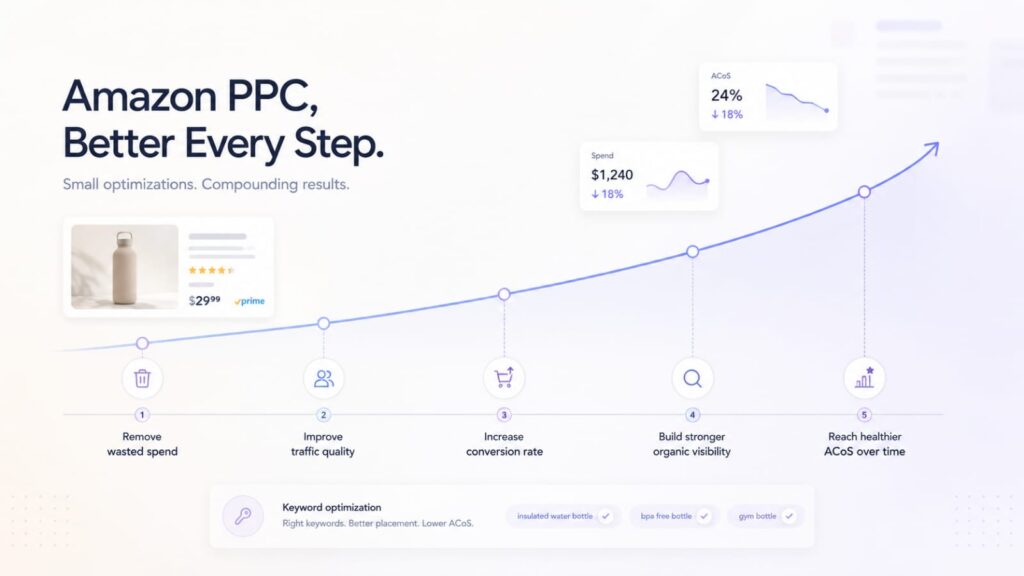
PPC optimization compounds over time.
You should not expect perfect results overnight.
However, most accounts begin seeing measurable improvements fairly quickly.
1. Weeks 1 to 2
Negative keyword cleanup usually reduces obvious waste first.
2. Weeks 2 to 4
Keyword harvesting and campaign restructuring improve traffic quality.
3. Months 1 to 2
Listing improvements begin compounding:
- higher conversion rates
- stronger organic visibility
- lower dependence on PPC
4. Months 2 to 3
Established products applying these optimizations consistently can realistically move toward the 15% to 26% ACoS range.
New product launches usually take longer because ranking investment naturally requires more aggressive spending early on.
One important mindset shift:
Do not evaluate Amazon PPC based on daily fluctuations.
Measure trends over rolling 30-day windows instead.
Final Thoughts
Lowering Amazon ACoS is rarely about spending less.
In most cases, it comes down to improving efficiency inside the account.
Cleaner search terms, stronger listings, smarter campaign structure, better keyword targeting, and disciplined optimization usually make a far bigger difference than simply reducing budget.
The sellers consistently maintaining profitable ACoS are not always the ones spending the least.
They are usually the ones managing their campaigns more strategically.
And as Amazon advertising becomes more competitive in 2026, that gap matters more than ever.
If your campaigns are consuming budget without producing profitable growth, it may be time for a deeper account audit.
Our team helps Amazon sellers identify wasted ad spend, improve PPC efficiency, optimize listings, and scale campaigns without sacrificing profitability.
Book a free consultation to uncover where your Amazon campaigns may be leaking budget and what can realistically be improved.
1. What is a good Amazon ACoS in 2026?
Average Amazon ACoS in 2026 sits around 32.48%, but ideal ACoS depends on margins, category competition, and product stage. Mature products often target 10% to 25%, while new launches may intentionally run much higher.
2. Why is my Amazon ACoS so high?
High ACoS usually comes from wasted ad spend, weak conversion rates, poor campaign structure, or unoptimized listings. Many sellers focus only on bids while ignoring traffic quality and conversion problems.
3. What is the difference between ACoS and TACoS?
ACoS measures ad spend against ad-attributed sales only. TACoS measures ad spend against total revenue, including organic sales. TACoS gives a better long-term picture of overall account health.
4. Do negative keywords really lower ACoS?
Yes. Negative keywords remove wasted spend from non-converting traffic and often improve efficiency faster than almost any other PPC adjustment.
5. Should I reduce ad budget when ACoS rises?
Usually no. Reducing the budget can weaken ranking and sales velocity. Improving traffic quality and conversion rate is often a better long-term strategy.