


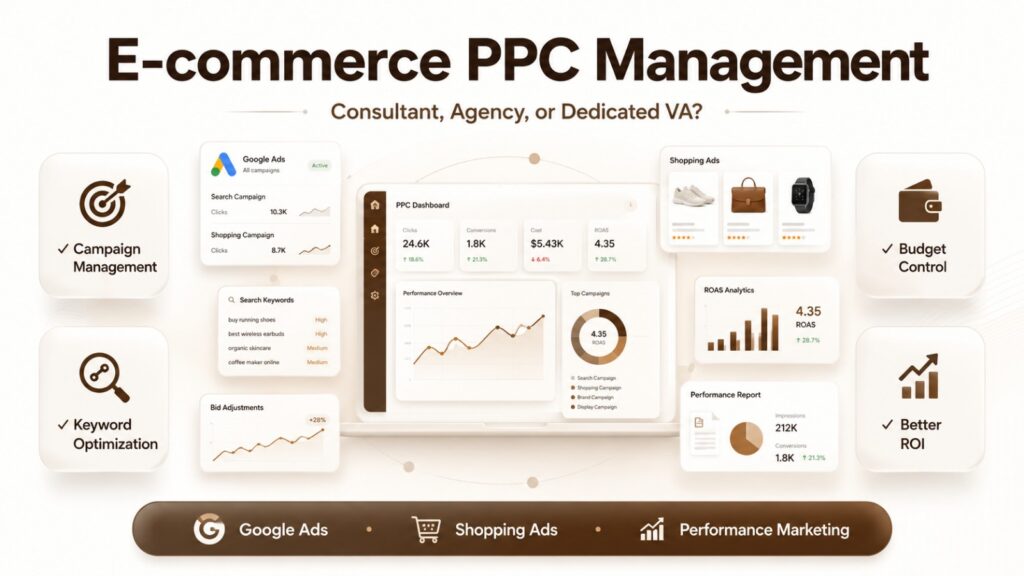
Quick answer: Ecommerce PPC management means someone is actively running your paid ad campaigns, keyword research, bid adjustments, budget pacing, and reporting, so your ad spend actually turns into sales instead of just clicks. You can get this done through an independent consultant, a full-service agency, or a dedicated PPC virtual assistant. Each option comes with a different price tag and a different level of hands-on attention, and picking the wrong one is usually more expensive than picking none at all.
The Google Ads Account Nobody’s Really Watching
Most ecommerce stores start their Google Ads account the same way. Someone sets it up on a Saturday afternoon, picks a few keywords that seem obvious, sets a daily budget, and moves on to the hundred other things running a store demands. A few months later, that same person is staring at a bill, wondering where all the money went and why sales didn’t move nearly as much as spending did.
This isn’t a rare story. It’s practically the default experience for anyone running paid ads without dedicated management behind them, regardless of how good the store or the products actually are. And it’s exactly why so many store owners end up typing some version of “ecommerce ppc management” into Google, trying to figure out whether they need a consultant, an agency, or something else entirely.
This guide walks through all three options honestly, what each one actually does, what it costs, and how to tell which one fits a store at its current size, so the decision feels less like a guess and more like a plan. By the time you finish reading, the choice should feel a lot more obvious than it probably does right now.
Why Managed PPC Beats the “Set It and Forget It” Approach
Here’s something worth sitting with for a second. Research from WordStream, reported by Search Engine Land, found that small businesses waste roughly a quarter of their paid search budgets due to managerial and strategic errors. Not because the ads are bad, but because nobody’s actively watching them. Fewer than half of the accounts studied even had proper conversion tracking installed, which means a huge share of businesses genuinely have no idea which of their ad dollars are working.
Think about what that means in real numbers. A store spending three thousand dollars a month on ads could be losing seven hundred and fifty dollars of that to nothing but inactivity. Not bad targeting exactly, just nobody home to catch the small, boring, unglamorous problems, like a keyword-eating budget with zero conversions, or a campaign that never got the negative keywords it desperately needed.
This is the whole case for managed PPC in one sentence. It’s not about running smarter ads than everyone else. It’s about someone actually being there to catch the leaks before they drain the whole tank.
Three Ways to Get Ecommerce PPC Managed
There isn’t one single path here, and honestly, that’s part of why this decision feels confusing. Each option solves the problem differently.
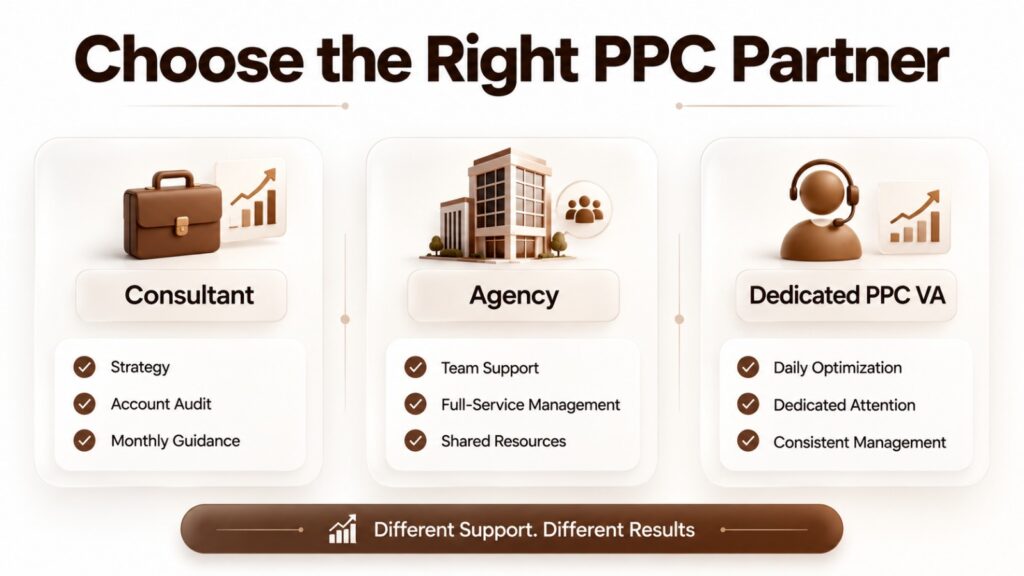
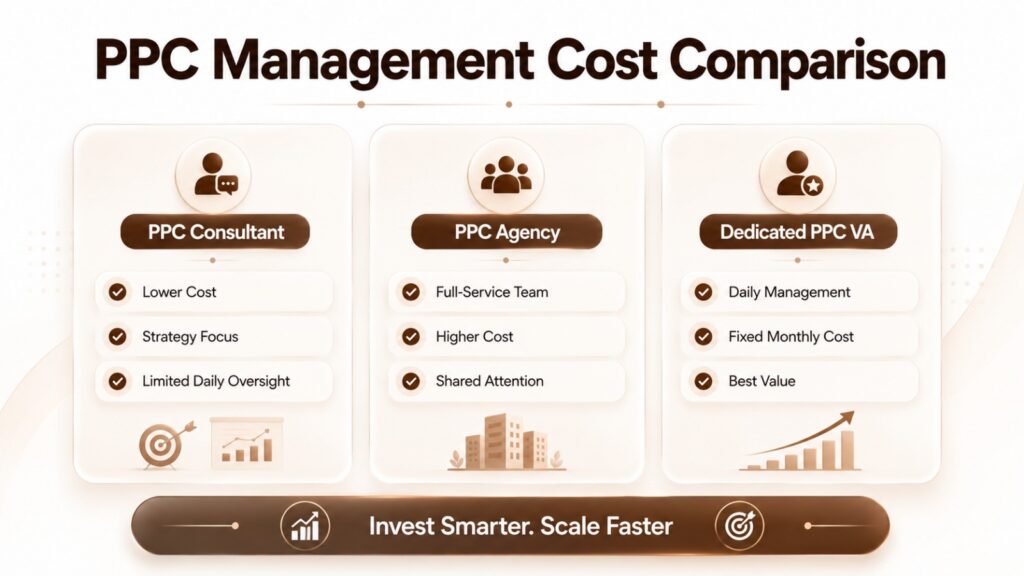
An ecommerce PPC consultant is typically a solo expert brought in for strategy and direction. They’ll audit an account, set up a framework, and maybe check in monthly. Great for a business that wants expert eyes without daily hand-holding, but consultants usually aren’t the ones actually logging in and adjusting bids every day. That gap has to get filled by someone else.
An e-commerce PPC management company or agency offers full-service execution, strategy, plus daily management, usually through a small team assigned to the account. This tends to be the most expensive option and the least personal, since agencies are juggling multiple clients and a store’s account might get real attention twice a week rather than every day.
A dedicated PPC virtual assistant sits in a different spot entirely. One person, fully focused on a single account, backed by a company that handles hiring, training, and quality control. Less overhead than an agency, more daily attention than a consultant typically provides, and usually priced well below both. For a lot of growing stores, this ends up being the option that actually matches how often PPC really needs eyes on it, which is to say, often.
None of these is universally “the best” option. It genuinely depends on account size, budget, and how much oversight a store owner wants to keep for themselves. The right fit usually reveals itself pretty quickly once these three are laid out side by side instead of researched one at a time in separate browser tabs.
What Ecommerce PPC Management Actually Includes
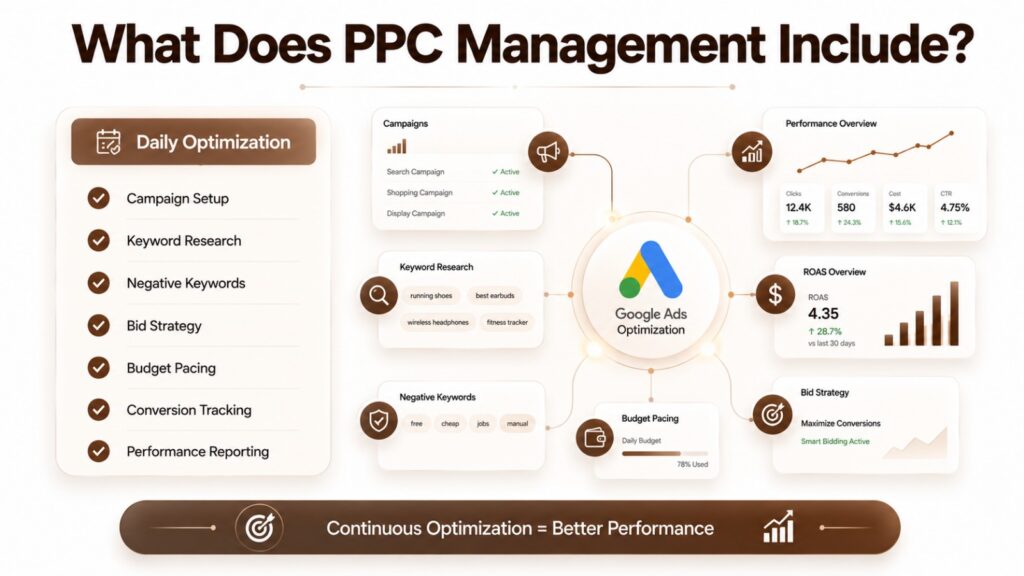
It helps to know exactly what should be happening behind the scenes, regardless of which option gets chosen. Real ecommerce PPC management services typically cover:
- Campaign structure and setup, organizing Search, Shopping, and Performance Max campaigns so results are actually readable
- Keyword research and negative keywords, finding profitable search terms and cutting the ones quietly burning the budget
- Bid strategy management, choosing and adjusting between Target ROAS, Target CPA, and other Smart Bidding approaches based on what the account’s actual goals are
- Budget pacing, making sure spend doesn’t run out mid-day or sit unused because targets are set too conservatively
- Conversion tracking audits, since Google’s own guidance makes clear that Smart Bidding strategies depend heavily on accurate, clean conversion data to work properly at all
- Weekly or biweekly reporting, plain language updates on what changed and why, not a spreadsheet nobody has time to read
Any provider who can’t clearly walk through most of this list is probably offering less oversight than the price tag suggests.
What It Actually Costs Across Each Option
Pricing varies a lot depending on the path chosen, and it’s worth laying out honestly rather than dancing around it.
| Option | Typical Structure | Rough Monthly Cost |
| PPC Consultant | Hourly or project-based, periodic check-ins | Lower end, but limited daily oversight |
| PPC Agency | Monthly retainer, team-managed | Highest, often with setup fees |
| Dedicated PPC VA | Fixed monthly rate, daily hands-on management | Mid-range, closest to full-time attention for the price |
The honest way to think about cost here isn’t just “what am I paying?” it’s “what am I getting for it?” A cheap consultant who checks in once a month isn’t actually cheaper than a dedicated VA if the account bleeds money every week, nobody’s watching it. And an expensive agency isn’t automatically better if the account gets split attention across a dozen other clients.
Wondering what managed PPC would actually cost for your store? Get transparent pricing for a dedicated Google Ads specialist, see exactly what’s included, and compare it against agency fees before making a decision.
E-commerce PPC and Amazon PPC Are Not the Same Job
This trips up a lot of sellers who operate on both a website and a marketplace. Ecommerce PPC management, the kind covered in this guide, refers to ads run through Google, on Search, Shopping, and Display placements, pointing traffic to a store’s own website.
Amazon PPC is a completely separate ecosystem, run entirely inside Amazon’s own advertising platform, governed by different rules, different bidding logic, and different metrics like ACOS. Someone skilled at managing Google Ads for a Shopify store isn’t automatically equipped to manage Sponsored Products campaigns on Amazon, and vice versa. There’s a full breakdown of what dedicated Amazon PPC management actually involves, worth reading separately if a chunk of sales comes through Amazon specifically. Trying to find one generalist to handle both well is usually where accounts start underperforming on one platform or the other.
Red Flags When Choosing a PPC Management Provider
Since a PPC manager gets direct access to real ad spend, a bit of healthy skepticism goes a long way before signing anything.
No willingness to share real dashboards. Anyone managing an account should be comfortable showing actual performance data, not just talking around it in vague terms.
Fuzzy answers about conversion tracking. If a provider can’t clearly explain how conversions are being tracked and attributed, that’s a serious problem, not a minor detail.
No conversation about Quality Score or ad relevance. These directly affect cost per click, and a provider who never brings them up may not be looking closely enough.
Reluctance to start smaller. A confident, experienced PPC manager has no issue proving results with a trial budget before scaling up spend.
Vague reporting cadence. Weekly or biweekly updates should be the standard, not something that has to be requested and chased down every time.
No clear answer on who’s actually doing the work. Some agencies sell a senior strategist on the pitch call, then quietly hand the account to a junior team member for day-to-day execution. It’s a fair question to ask directly, and a fair one to expect a straight answer to.
Any hesitation around these points is worth taking seriously before handing over account access and a monthly ad budget. Trust here gets built through specifics, not confidence alone.
Signs It’s Time to Bring In Managed PPC Help
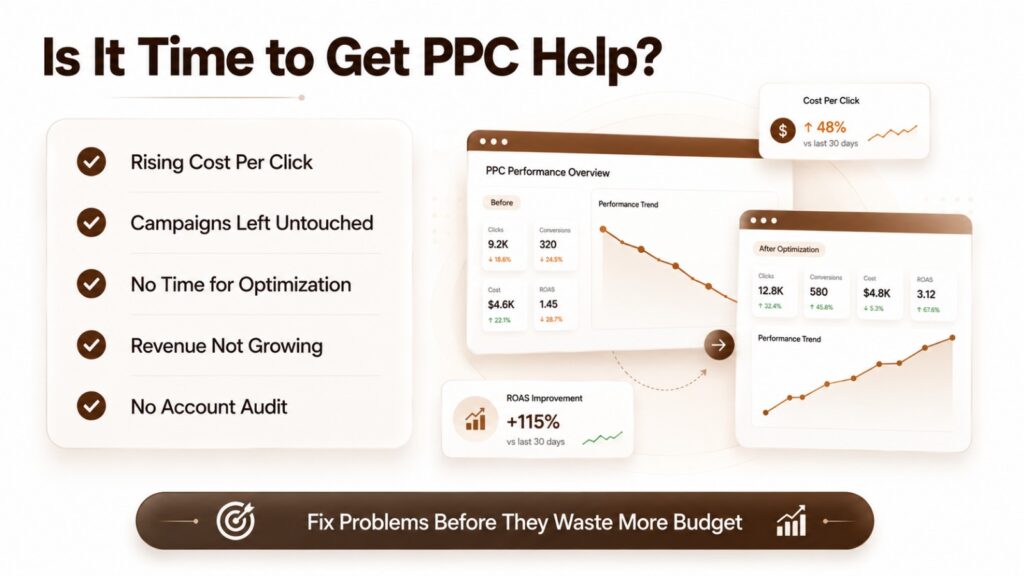
A few patterns tend to show up right before store owners finally decide to outsource this work:
- Cost per click keeps climbing, and nobody can explain exactly why
- Campaigns haven’t been touched or reviewed in weeks
- There’s genuinely no time left to test new keywords or ad copy
- Ad spend is increasing faster than actual revenue
- The account has never had a real audit since the day it was created
If a few of these sound familiar, that’s usually the moment worth acting on rather than waiting for the numbers to get worse. An experienced e-commerce virtual assistant agency can usually spot exactly which of these patterns is dragging an account down within the first week of reviewing it, often before the store owner even fully understands what’s been going wrong.
What a Well-Managed Account Actually Looks Like Week to Week
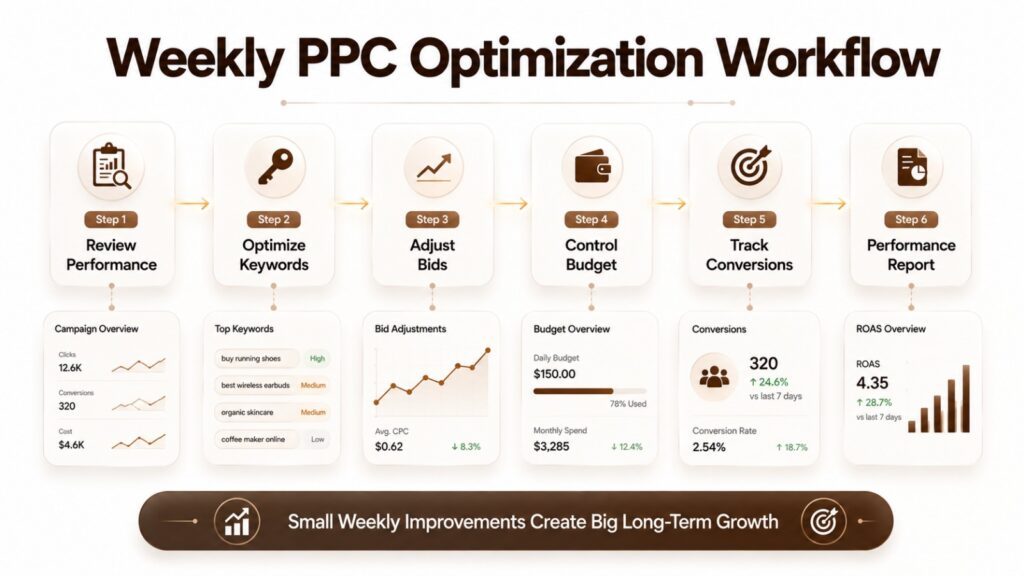
“Active management” can sound vague until it’s broken down into something concrete. Here’s roughly what a properly managed ecommerce PPC account experiences in a normal week.
Early in the week, whoever’s managing the account reviews weekend performance, since shopping behavior on Saturdays and Sundays often looks different from weekdays. Bids get adjusted based on what actually happened, not just what was expected to happen.
Midweek, the search terms report gets pulled apart. New keywords worth chasing get added. Wasted spend on irrelevant searches gets cut through negative keywords before it adds up to real money. Budget pacing gets checked against the month’s targets to make sure nothing’s about to run dry too early or sit unspent.
Toward the end of the week, a plain-language update goes out covering what changed, what’s working, and what’s being tested next. No jargon, no forty-tab spreadsheet dropped in an inbox with zero explanation.
Every single day, someone’s at least glancing at the account for anything urgent, a campaign that suddenly stops spending, a competitor undercutting on a key term, a conversion tracking issue that just appeared out of nowhere. This daily thread is really the whole point. It’s the difference between a PPC account that slowly bleeds money for weeks before anyone notices, and one where problems get caught within a day or two.
Questions Worth Asking Before Signing Anyone
Before committing to a consultant, agency, or dedicated VA, a short list of questions tends to separate the providers who know what they’re doing from the ones who just talk a good game.
Ask how often bids actually get reviewed and adjusted, not just how often reports get sent. Ask how they’d handle a campaign that suddenly stops converting. Ask what their process looks like for testing new ad copy or landing pages. And ask, directly, what access they’ll need and how that access gets protected.
The answers matter less as a pass-or-fail test and more as a way to gauge whether someone’s actually done this work before or is describing it in theory. A provider who’s managed real accounts tends to answer these questions specifically and quickly, since they’ve lived through the exact scenarios being asked about.
Ready to Stop Guessing Where Your Ad Budget Is Going?
Every week an account goes unmanaged is another week of wasted clicks, missed sales, and budget that’s harder to recover. A few small optimisations can make a surprisingly big difference when someone is actively watching your campaigns every day.
Explore how dedicated ecommerce PPC management works, see transparent pricing, and find out what daily optimisation actually looks like. If you’d rather talk through your account first, book a no-pressure consultation and get honest recommendations before spending another dollar on ads.