


Product uploading takes time because it involves multiple steps like writing SEO product descriptions, formatting images, managing variants, assigning categories, and adapting listings for different e-commerce platforms, all of which require manual effort, accuracy, and consistency.
If you run an e-commerce store, you already know this feeling.
You sit down to upload a few products. It should take 10 minutes, right?
But one product turns into 30 minutes. Then another. Then another. Before you realize it, half your day is gone… and you’ve barely made progress.
This is one of the most common bottlenecks for e-commerce businesses in the USA.
Product uploading looks simple on the surface. But in reality, it involves multiple steps, decisions, and small details that take time and focus.
And when this task repeats daily or weekly, it slowly eats into the time you should be spending on growth.
That is exactly why many businesses now rely on an e-commerce virtual assistant to handle product uploading services efficiently. If you’re new to this, here’s a detailed guide on what an e-commerce virtual assistant is and how it helps online stores grow.
In this guide, we’ll break down:
- Why does product uploading take so much time
- What most store owners underestimate
- How e-commerce virtual assistant services solve this problem
- And how you can streamline your workflow
Key Takeaways
- Product uploading involves multiple hidden steps, not just adding products
- Small errors in listings can affect conversions and customer experience
- Repetitive tasks consume hours every week
- An e-commerce virtual assistant can handle uploads faster and more accurately
- Outsourcing product uploading helps businesses scale without operational stress
Top Reasons Why Product Uploading Takes So Much Time
When you break it down, the delay is not caused by a single factor. It’s a combination of small, repetitive steps that add up.
1. Multiple Steps for Every Product Listing
Uploading a product is not just filling a form.
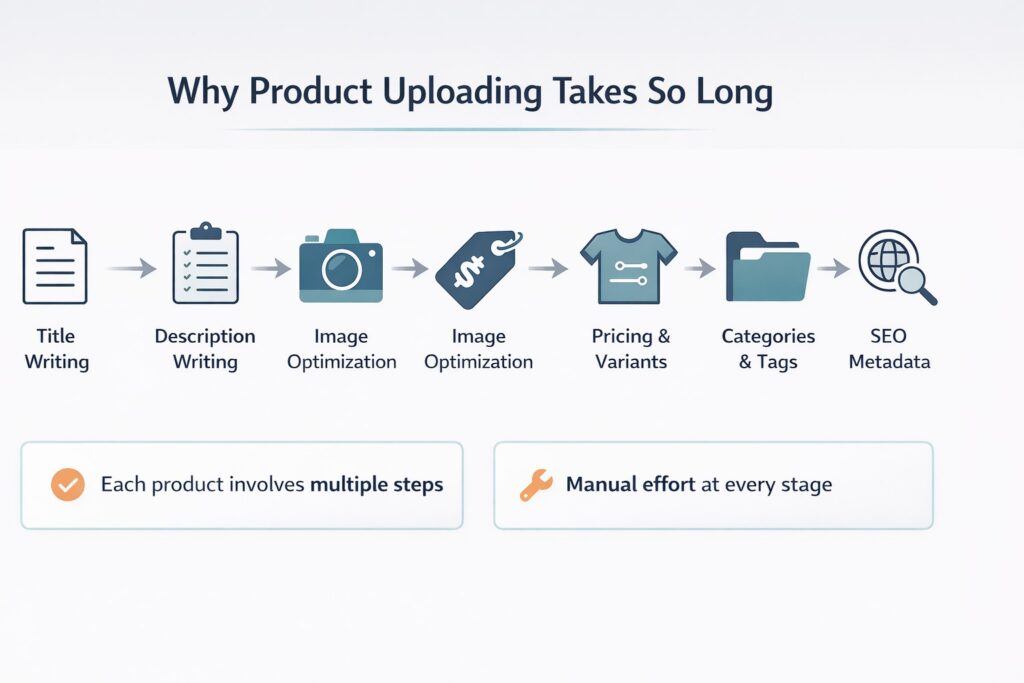
You go from title → description → images → pricing → variants → categories → tags → SEO.
Each step needs to be done properly because it directly impacts your product listing optimization and conversions.
2. Writing SEO Product Descriptions Takes Time
A simple description is easy to write.
But a good one, the kind that helps in e-commerce product SEO and conversions, takes effort.
You’re trying to:
- Explain the product clearly
- Make it sound convincing
- Naturally include keywords
- Keep it readable and structured
Doing this once is fine. Doing it for 50+ products becomes a serious time investment.
3. Image Formatting and Optimization Slows Things Down
Images are critical for conversions, but they require preparation.
You’re often adjusting:
- Size and resolution
- Background consistency
- Variant matching
- Mobile responsiveness
This is why e-commerce product upload is not just uploading files, it’s optimization work.
4. Variant and Inventory Management Is Detailed Work
If your product has sizes, colors, or styles, the complexity increases.
You need to:
- Map variants correctly
- Assign SKUs
- Track inventory
Even a small mistake here can create operational issues later.
5. Platform-Specific Requirements Add Complexity
A Shopify product upload is different from an Amazon product listing service workflow.
Each platform has:
- Different formats
- Different fields
- Different SEO requirements
If you sell across platforms, you are repeating and adapting the same work.
What Tasks Are Involved in Product Uploading?
To understand why this takes so much time, it helps to see the full picture.
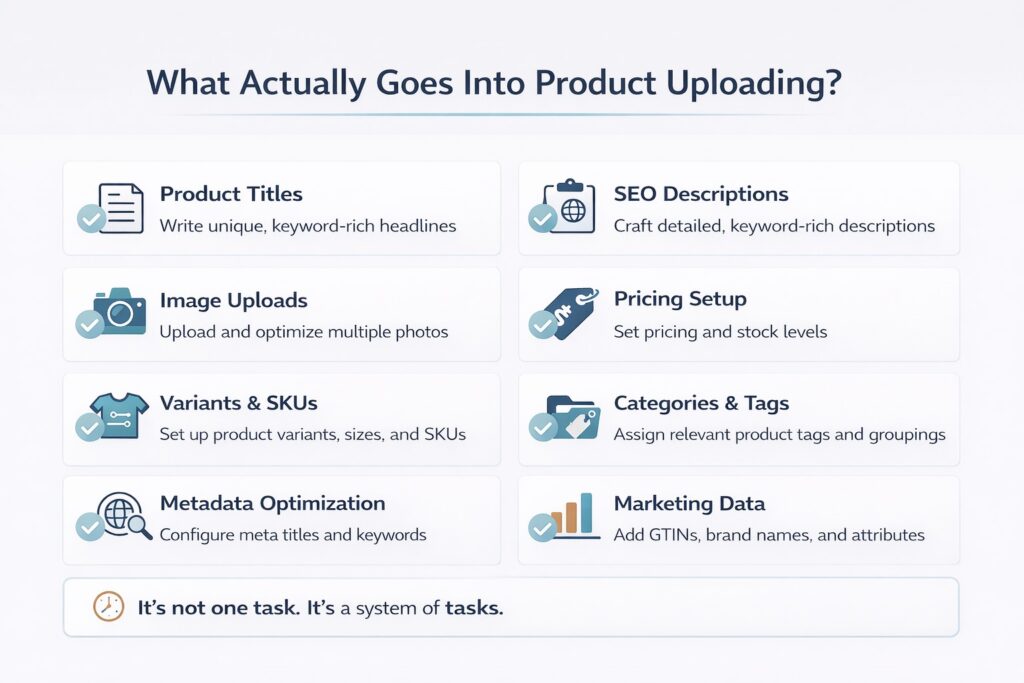
A typical product upload includes:
- Writing keyword-rich titles
- Creating SEO product descriptions
- Uploading and optimizing images
- Setting pricing and discounts
- Managing variants and attributes
- Assigning categories and tags
- Adding metadata for search visibility
This is why it turns into a manual product upload process instead of a quick task.
Why Product Descriptions Slow Down Product Uploading
This is usually the biggest time drain.
You’re not just writing, you’re balancing multiple things at once.
A strong product description needs to:
- Answer what the product is
- Explain why it’s useful
- Include keywords for visibility
- Be easy to scan
- Match your brand voice
That’s why many businesses eventually look for a virtual assistant to manage their e-commerce store consistently.
How Image Optimization Increases Product Upload Time
Images directly affect whether someone buys or not.
But preparing them takes time.
You’re checking quality, aligning them with variants, making sure they load fast, and ensuring they look good across devices.
It’s detail-heavy work that slows down the overall process.
How Multi-Platform Selling Makes Product Uploading Slower
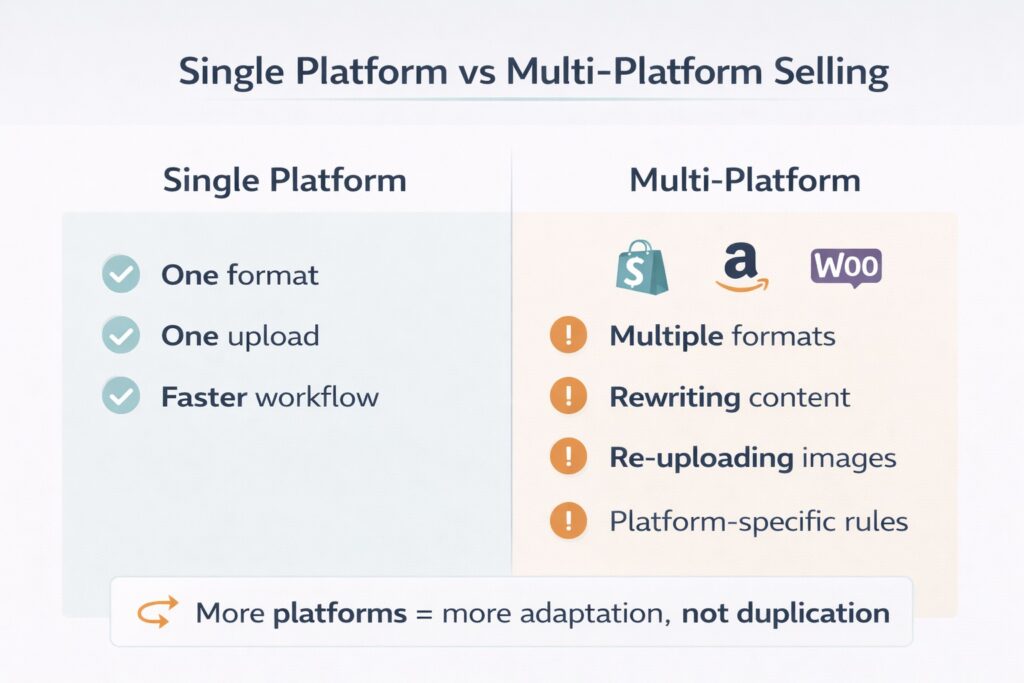
If you’re selling on just one platform, product uploading is manageable.
But the moment you expand to multiple channels, things change quickly.
Now you’re not just uploading products, you’re adapting them.
You might be managing:
- Shopify
- Amazon
- WooCommerce
- Walmart
And each platform has its own structure, rules, and expectations.
For example, a Shopify product upload focuses more on collections, tags, and store design.
An Amazon product listing requires backend keywords, bullet points, strict formatting, and compliance with category guidelines.
WooCommerce often needs custom attributes, while Walmart has structured data requirements.
So what happens in reality?
You end up doing the same work multiple times but slightly differently each time.
You rewrite titles. You adjust descriptions. You re-upload images. You fix formatting.
It’s not duplication. It’s an adaptation.
And that’s where most of the time goes.
This is one of the biggest reasons why businesses experience e-commerce workflow inefficiencies as they scale.
Because what looked like “more sales channels” turns into “more operational workload.”
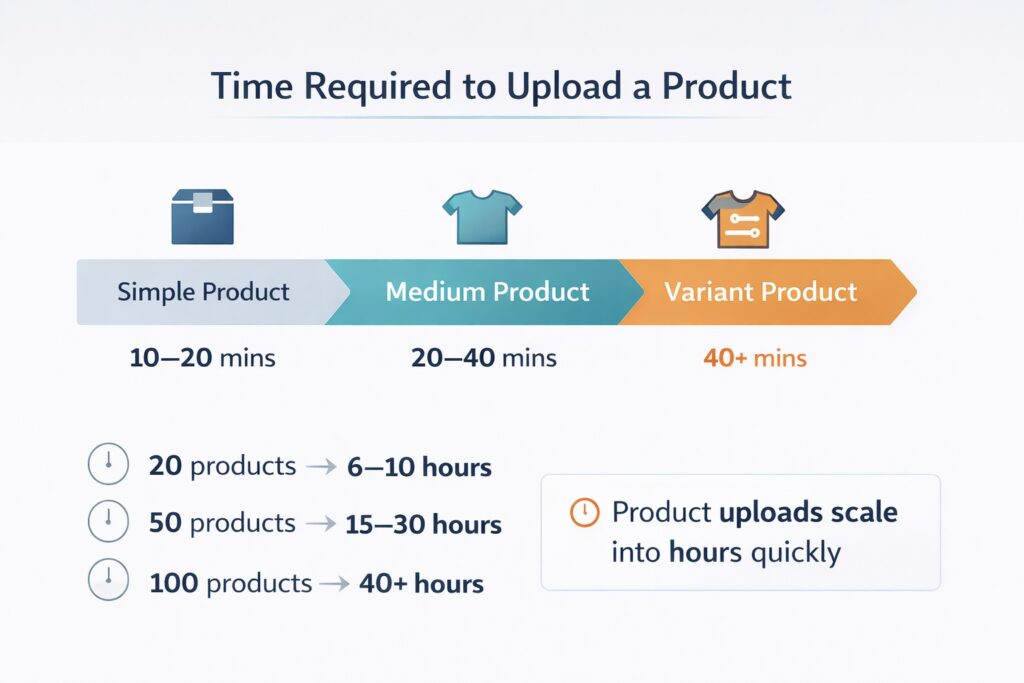
How Long Does Product Uploading Take Per Product?
Product uploading typically takes 10 to 40 minutes per product, depending on complexity. Simple products take less time, while products with multiple variants, detailed descriptions, and optimized images take longer. When uploading in bulk, this can add up to several hours or even days of work.
On average:
- Simple product: 10 to 20 minutes
- Medium complexity: 20 to 40 minutes
- Variable product (sizes, colors, variants): 40+ minutes
Now, this might not sound like much at first.
But let’s make it real.
If you upload:
- 20 products → 6 to 10 hours
- 50 products → 15 to 30 hours
- 100 products → easily 40+ hours
And that’s assuming everything goes smoothly, no errors, no rework, no formatting issues.
In reality, it often takes longer because you:
- Fix mistakes
- Update missing data
- Rework descriptions
- Adjust images
That’s why many e-commerce businesses end up spending 10–20 hours per week just managing product uploads.
Not growing. Not selling. Just maintaining listings.
Should You Outsource Product Uploading Services?
You should outsource product uploading when it starts taking too much time, delays product launches, or affects listing quality. Outsourcing helps improve efficiency, maintain consistency, and allows you to focus on growing your e-commerce business instead of handling repetitive tasks.
You should seriously consider outsourcing when:
- Product uploads are getting delayed regularly
- Your listings look inconsistent across products
- You’re adding products faster than you can upload them
- You want to improve e-commerce efficiency
- You’re spending more time on backend work than on growth
At this stage, continuing to do everything yourself actually slows your business down. Many businesses start by identifying the top tasks you should outsource to an e-commerce virtual assistant, and product uploading is usually one of the first.
Outsourcing is not about “not doing the work.”
It’s about freeing yourself from repetitive ecommerce tasks so you can focus on decisions that move the business forward.
That’s why many brands eventually choose to outsource product uploading services not as a cost-saving move, but as a scaling decision.
How an E-commerce Virtual Assistant Helps With Product Uploading
This is where things start to feel lighter.
Instead of juggling multiple small tasks all day, you pass the entire process to someone who already knows how to handle it.
An e-commerce virtual assistant doesn’t just “help”; they take ownership of the workflow.
They understand:
- How listings should be structured
- How to maintain consistency
- How to follow platform-specific requirements
- How to avoid common mistakes
And most importantly, they bring process and structure into something that usually feels messy and repetitive.
That’s what actually saves time, not just delegation, but systematic execution.
How Does an E-commerce Virtual Assistant Save Time?
An e-commerce virtual assistant saves time by managing repetitive, detail-heavy tasks like product uploads, SEO descriptions, image formatting, and categorization, allowing business owners to step away from manual work and focus on growth.
But the real benefit goes deeper than just saving hours.
They reduce:
- Constant task-switching
- Mental fatigue
- Rework caused by mistakes
Instead of you doing 10 small tasks repeatedly, the VA handles them in a streamlined workflow.
That’s how you increase product listing speed without compromising quality.
What an E-commerce Virtual Assistant Handles
Once you delegate product uploading, you’ll notice how many moving parts are involved.
A trained VA typically manages:
- Product listing creation across platforms
- Writing and formatting SEO product descriptions
- Uploading and optimizing images
- Assigning categories, tags, and attributes
- Managing SKUs and inventory tracking
They don’t just complete tasks; they follow a repeatable system.
Which means:
- Your listings look consistent
- Your product listing optimization improves
- Your error rate drops significantly
Over time, this consistency directly impacts your conversions and store performance.
Cost of Hiring an E-commerce Virtual Assistant for Product Uploading
One of the biggest concerns is cost, but this is where things become practical.
Hiring in-house means:
- Fixed salary
- Training time
- Management overhead
With an e-commerce VA:
- You can start quickly
- You pay based on workload
- You scale up or down as needed
For most businesses, this turns into a much more flexible and cost-effective model.
Instead of increasing fixed expenses, you’re investing in a system that helps you scale ecommerce operations efficiently.
And when you compare it to the hours saved, the value becomes clear.
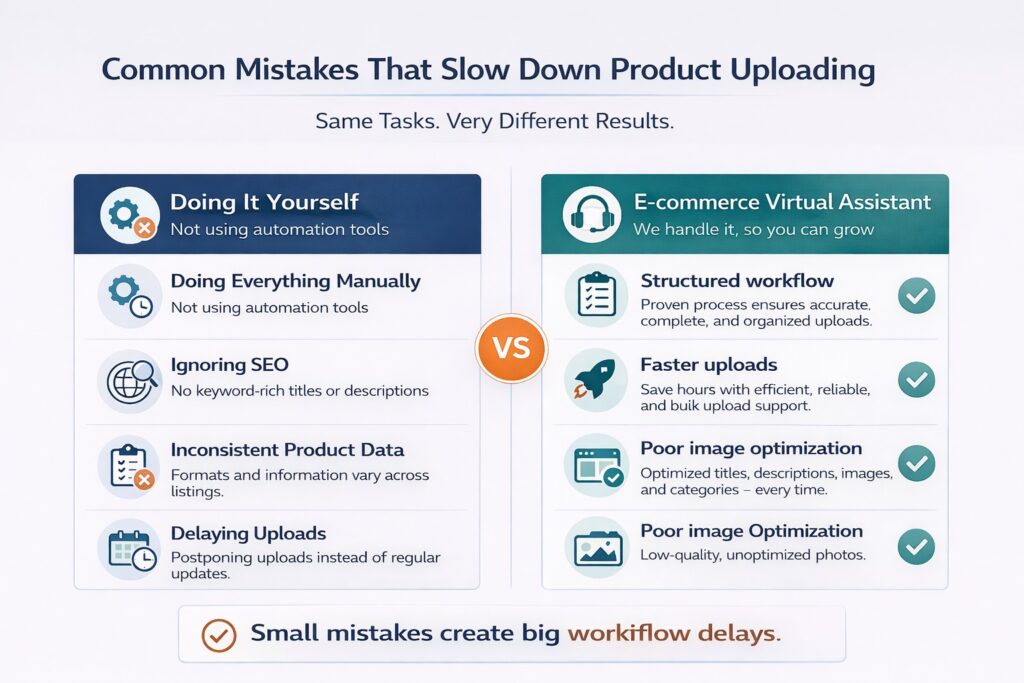
Common Mistakes That Slow Down Product Uploading
A lot of delays are not because the task is complex, but because of how it’s handled.
Some common mistakes include:
- Trying to do everything yourself instead of delegating
- Ignoring SEO while creating listings
- Using inconsistent product data across listings
- Delaying uploads because the task feels overwhelming
These might seem small, but they create friction in your workflow.
Fixing these doesn’t just save time; it makes the entire process smoother and more predictable.
Does Product Uploading Affect SEO Rankings?
Yes, and more than most people realise.
Product uploading is not just an operational task. It’s the foundation of your store’s visibility.
Well-optimized listings help you:
- Rank better on Google search
- Appear in product-based queries
- Improve click-through rates
- Increase conversions
When your titles, descriptions, images, and categories are optimized properly, your products become easier to find and more appealing to click.
That’s why optimizing product pages for conversions doesn’t start after uploading; it starts during the upload itself.
And this is exactly where many businesses either gain an advantage… or fall behind.
Conclusion
Product uploading doesn’t feel like a big task in the beginning.
But over time, it quietly takes over your schedule, filling your day with repetitive work instead of real growth.
And that’s the shift most store owners eventually realise.
It’s not about working faster. It’s about not doing everything yourself.
If product uploading is taking hours every week, it’s probably time to change how you’re handling it.
Getting the right support can give you your time back so you can focus on scaling your store instead of just maintaining it.
Why does product uploading take so much time in e-commerce?
Product uploading takes time because it involves multiple steps, such as writing SEO descriptions, uploading images, managing variants, setting pricing, and assigning categories. Each step requires accuracy and consistency, making the process time-consuming when done manually.
What tasks are involved in product uploading?
Product uploading includes creating titles, writing descriptions, uploading and optimizing images, setting prices, managing inventory, adding variants, and assigning categories and tags. These combined tasks make it more than just basic data entry.
How long does it take to upload a product?
Uploading a product typically takes 10 to 40 minutes, depending on complexity. Simple products take less time, while products with multiple variants, detailed descriptions, and optimized images take longer.
Can an e-commerce virtual assistant upload products?
Yes, an e-commerce virtual assistant can handle complete product uploads, including listing creation, SEO descriptions, image uploads, pricing, and categorization across platforms like Shopify, Amazon, and WooCommerce.
How does a virtual assistant save time in e-commerce?
A virtual assistant saves time by handling repetitive tasks like product uploads, data entry, and listing optimization. This allows business owners to focus on marketing, strategy, and business growth instead of backend operations.
Is product uploading a one-time task?
No, product uploading is an ongoing process. Businesses need to regularly update listings, optimize descriptions, adjust pricing, and improve images based on performance and market changes.