

Most e-commerce businesses do not struggle because they lack ideas.
They struggle because there is simply too much to do.
Not glamorous work.
Not exciting growth experiments.
But constant operational work that never seems to end.
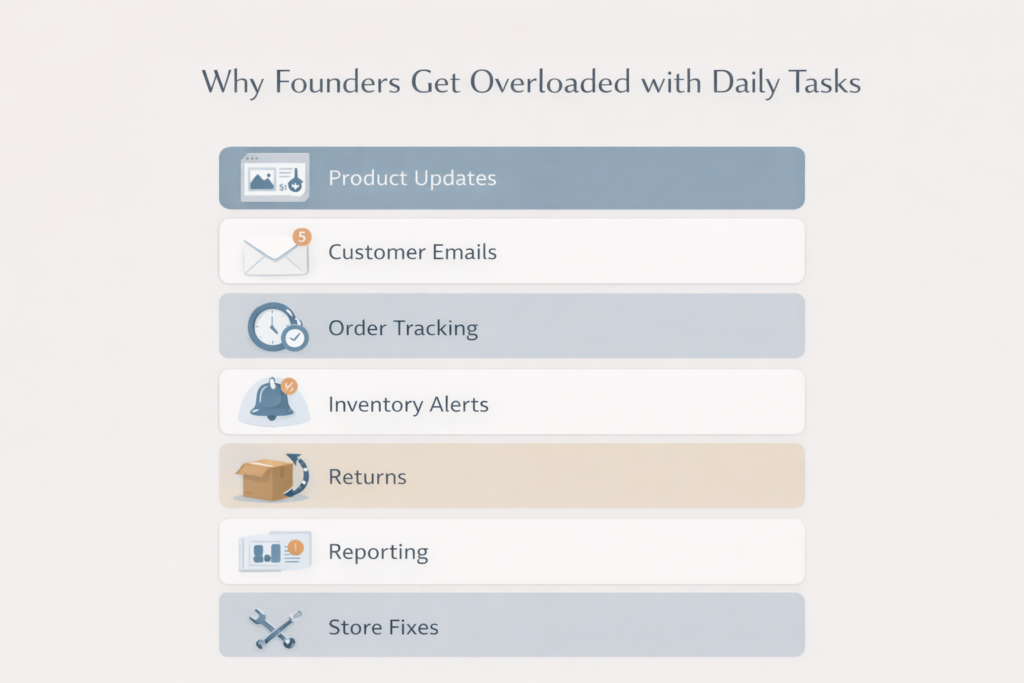
Every product update.
Every customer email.
Every order status check.
Every small fix inside the store.
When all of this lives on the founder’s plate, growth eventually slows. Not because demand disappears, but because capacity runs out.
At Crew27, we see this pattern every day.
Store owners who are doing “fine” on the surface, but quietly drowning in backend work. And once that happens, marketing stops working as well as it should, launches get delayed, and opportunities are missed.
That is why smart ecommerce brands outsource.
Not a strategy.
Not decision-making.
But operational, repeatable, time-consuming tasks.
This guide breaks down the most valuable tasks you should outsource to an e-commerce virtual assistant, why each one matters, and how outsourcing them creates space for real growth.
If your store serves customers across the United States or sells globally, this guide will help you decide where to start.
Why E-commerce Businesses Are Outsourcing More Than Ever
E-commerce has changed.
Customers expect fast answers.
Same-day fulfillment.
Accurate tracking.
Clean product pages.
Easy returns.
But it has become expensive to maintain full-time in-house staff.
If you factor in the true cost of salary, benefits, taxes, software, equipment, and management time, one full-time employee in the US can easily cost $4,000-$5,000 per month or more.
This is simply not an option for most small to mid-sized e-commerce companies.
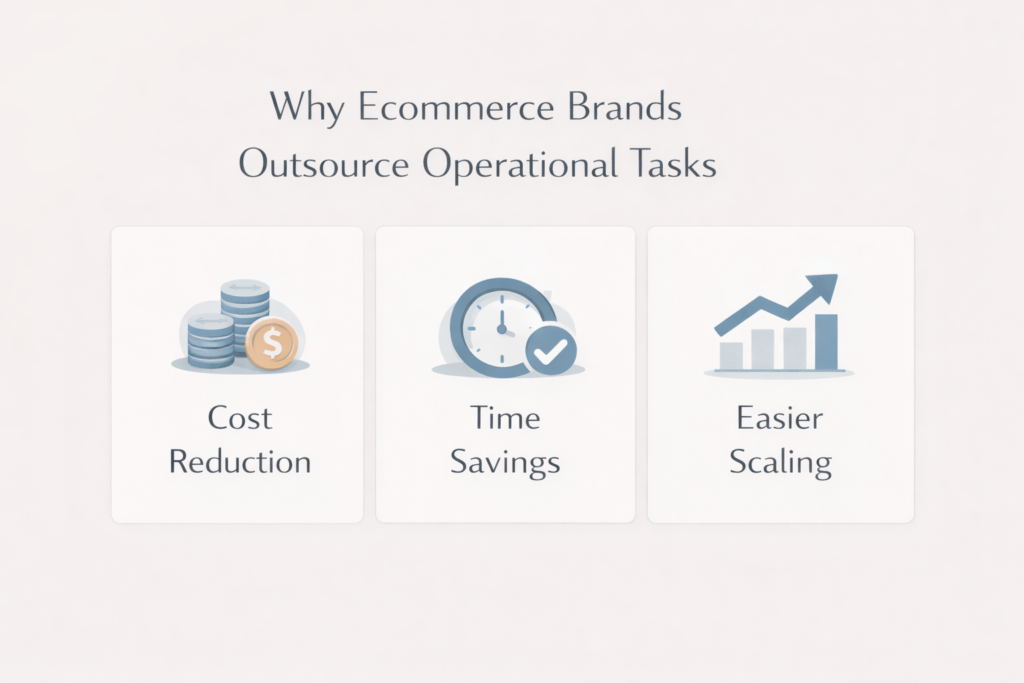
Outsourcing operational tasks solves three basic problems:
- It reduces personnel expenses
- It keeps founders and managers out of boring busywork
- It allows for scaling without the wait of hiring cycles
Instead of burdening in-house staff, companies can delegate certain tasks to ecommerce-savvy support experts who already understand ecommerce platforms, software, and processes.
The bottom line is more than just saved time.
It is improved operations, reduced mistakes, and happier customers.
What an E-commerce-Focused Support Professional Actually Does
An e-commerce-focused support professional handles the daily operational backbone of your store.
They are not responsible for brand vision, positioning, or high-level strategy.
They execute.
They maintain.
They protect your time.
At Crew27, we train our e-commerce virtual professionals specifically on major platforms like Shopify, Amazon Seller Central, Walmart Marketplace, WooCommerce, and Etsy so they can step into real workflows quickly.
Think of this role as your operational extension.
They work inside your existing systems, follow your SOPs, and keep everything moving.
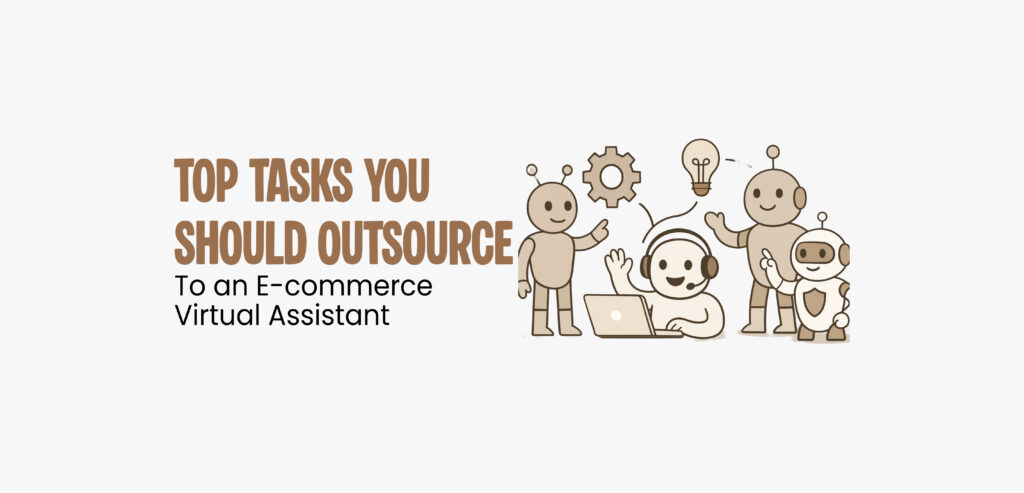
Top Tasks You Should Outsource to an E-commerce Virtual Assistant
Below are the core task categories where outsourcing delivers the highest impact.
1. Product Listing and Catalog Management
Product listings are the backbone of every e-commerce store.
However, they are also one of the most time-consuming aspects of running an e-commerce store.
Every product requires proper titles, descriptions, images, variations, prices, SKUs, and categorization. When all these tasks get accumulated, product listings become disorganized, errors start to creep in, and consumers get confused.
An e-commerce virtual assistant can completely handle the execution of product listings.
They can:
- Upload new products on all platforms
- Organize descriptions in a uniform manner
- Include proper variations (size, color, style)
- Categorize products under collections or categories
- Upload images and alt tags
- Make sure SKUs are properly mapped
Apart from uploading new products, they also handle existing product listings.
They repair broken images, correct errors, update prices, and update descriptions whenever products change.
When e-commerce stores have huge product catalogs, just handling this aspect can save dozens of hours every month.
2. Product Listing Optimization for Search and Conversion
Product upload is only the first step.
Product listings must be structured in a way that:
- Matches search behavior
- Effectively communicates value
- Overcomes purchase hesitation
An e-commerce virtual assistant trained in optimization strategies can help improve title clarity, restructure bullet points, structure descriptions for easy scanning, and integrate search keywords in the backend as required.
Small changes accumulate over time.
Optimized listings mean improved visibility and higher conversion rates.
This affects sales for US-based sellers in highly competitive marketplaces.
3. Order Processing and Fulfillment Coordination
When order volume increases, manual processing becomes risky.
Missed orders.
Wrong addresses.
Delayed shipments.
Each mistake damages trust.
An e-commerce virtual assistant acts as a control layer between your store and your fulfillment partners.
They monitor incoming orders, verify payment status, push orders to fulfillment or suppliers, upload tracking numbers, update order statuses, and flag exceptions.
This creates consistency.
It also ensures customers receive accurate shipping updates without you manually touching every order.
4. Inventory Monitoring and Stock Control
Overselling creates angry customers.
Running out of bestsellers kills momentum.
Inventory requires daily attention.
A virtual assistant for e-commerce businesses can monitor stock levels, set low-stock alerts, update quantities across platforms, coordinate with suppliers, and flag slow-moving SKUs.
This keeps availability accurate and prevents unpleasant surprises.
Over time, consistent stock monitoring also supports better purchasing decisions.
5. Customer Support (Email, Chat, and Helpdesk)
Customer messages never stop.
Order questions.
Shipping updates.
Product details.
Returns.
Complaints.
Trying to handle all of this while running the business leads to burnout.
An e-commerce virtual assistant can manage email tickets, live chat, contact forms, and basic social inbox messages using your tone and policies.
Great support does more than answer questions.
It reassures customers.
It reduces friction.
It protects your brand reputation.
Brands with fast, helpful support see higher repeat purchase rates and better reviews.
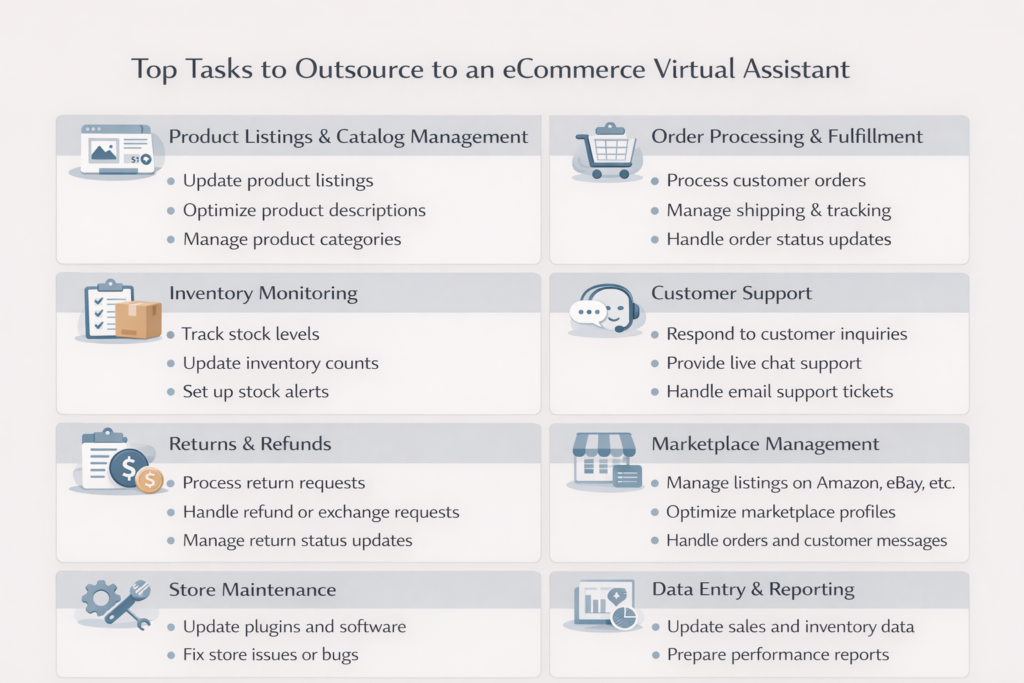
6. Returns, Refunds, and Exchange Processing
Returns are inevitable in online shopping.
The problem for the business is disorganized returns.
An e-commerce virtual assistant can handle return requests, check eligibility for a return, print return shipping labels, issue refunds, update order status, and provide notification of the timeline.
This keeps customers informed and avoids conflicts.
It also helps ensure that refunds are accurate and timely.
7. Marketplace Account Management
Selling on multiple marketplaces multiplies complexity.
Each platform has its own rules, dashboards, and listing structures.
An e-commerce virtual assistant can manage:
- Amazon Seller Central
- Walmart Marketplace
- eBay
- Etsy
- TikTok Shop
They handle listing uploads, updates, price changes, variation setup, category corrections, and basic compliance checks.
You gain one operational control point instead of juggling multiple dashboards.
8. Basic Marketing Support
Strategy should remain with the founders or marketing leads.
Execution can be outsourced.
An e-commerce virtual assistant can upload email campaigns, schedule promotions, create discount codes, update homepage banners, and set up bundles.
This allows your marketing brainpower to stay focused on planning and optimization while execution runs quietly in the background.
9. Store Maintenance and Admin Work
Every store needs constant small updates.
Navigation tweaks.
Collection changes.
Policy page edits.
Broken link fixes.
App installs and removals.
Individually small. Collectively exhausting.
An e-commerce virtual assistant keeps your store clean, functional, and up to date.
10. Data Entry and Simple Reporting
Founders should look at numbers, not compile them.
An e-commerce virtual assistant can update sales sheets, track daily orders, export platform data, and maintain product databases.
You receive organized information without manual effort.
11. Platform-Specific Support
Different platforms require different workflows.
A trained virtual assistant for e-commerce understands how the Shopify backend works, how Amazon listings are structured, how Walmart category mapping functions, and how WooCommerce products are configured.
This platform familiarity prevents costly mistakes and speeds up execution.
At Crew27, we train for this before placement.
Tasks You Should Not Outsource First
Some areas should stay internal:
- Brand positioning
- Pricing strategy
- Supplier negotiation
- Product selection
- Financial decisions
These shape the business.
Outsourcing works best when leadership retains strategic control.
How to Decide What to Outsource First
List everything you personally did in the last seven days.
Highlight:
- Tasks that repeat
- Tasks that require low creative input
- Tasks that drain energy
Those are your first outsourcing candidates.
Most e-commerce brands start with customer support, order processing, and product uploads.
Then expand gradually.
In-House Staff vs Outsourced E-commerce Support
In-house hiring comes with higher costs, longer recruitment cycles, and fixed schedules. Outsourcing offers lower monthly costs, faster onboarding, flexible hours, and easier scaling.
For many US ecommerce businesses, partnering with the best e-commerce virtual assistant in USA creates a practical middle ground between running everything solo and building a large internal team.
Why US E-commerce Brands Choose Specialized Providers
General virtual staffing agencies often lack e-commerce platform knowledge.
We built Crew27 specifically for e-commerce operations.
We recruit, train, and place support professionals who already understand store workflows.
That means faster ramp-up, fewer mistakes, and better long-term results.
When Is the Right Time to Bring in Help?
If emails pile up, orders occasionally slip, product uploads get delayed, or you are working nights and weekends, it is time.
Outsourcing is not a sign of weakness.
It is a growth strategy.
How We Support E-commerce Businesses at Crew27
We provide trained e-commerce operations support that integrates directly into existing workflows.
Our model focuses on:
- Platform-trained talent
- Quick matching
- Flexible plans
- Ongoing performance monitoring
We do not offer generic staffing.
We build operational support layers for e-commerce brands.
Final Thoughts
Growth in e-commerce rarely fails because of a lack of ideas.
It fails because founders become trapped in operations.
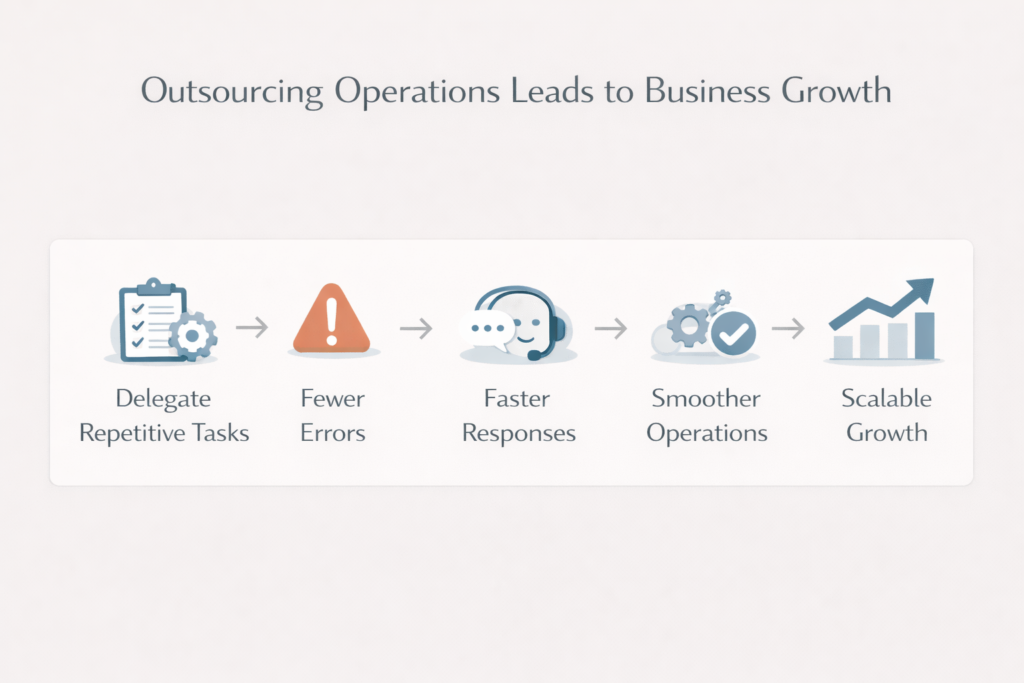
Outsourcing the right tasks creates breathing room.
Breathing room creates clarity.
Clarity creates growth.
For e-commerce businesses serving customers across the US and beyond, partnering with the best e-commerce virtual assistant in USA can become the operational support layer that unlocks your next stage of growth.
Are e-commerce virtual assistant services suitable for small businesses?
Yes. Small and mid-sized online stores widely use e-commerce virtual assistant services in America because they provide flexible, cost-effective support without the expense of hiring full-time in-house staff. This allows small businesses to scale operations faster and more efficiently.
How quickly can I hire an e-commerce virtual assistant in the USA?
Most providers can match and onboard an e-commerce virtual assistant within a few days once your requirements are finalized. In many cases, initial setup and system access can be completed within 24 to 72 hours.
How much do virtual assistants for e-commerce services usually cost?
Pricing depends on the level of experience, number of hours required, and scope of tasks. However, e-commerce online assistant services are generally more affordable than hiring local full-time employees, making them a popular option for growing online businesses in the USA.
Is my store data safe when working with an e-commerce virtual assistant?
Yes. Reputable providers use secure access controls, limited permissions, password management tools, and documented SOPs to ensure store data remains protected at all times.
Can e-commerce VA services scale as my store grows?
Absolutely. Most online store assistant services offer flexible plans that allow you to increase hours, add team members, or expand task coverage as order volume and store complexity increase.