

Most people assume a $1M ecommerce store looks like a “real business.” Office staff. Slack channels. Daily meetings. A customer support department. Maybe even a warehouse manager walking around with a clipboard.
That used to be true more often than not. Over the last few years, more store owners have quietly started hitting serious revenue numbers with surprisingly small operations. Not because they work harder than everyone else, but because they stopped trying to personally carry every operational task.
The weird part is this: the stores that break past plateaus are usually doing less themselves than the stores stuck at $20K or $30K per month.
US Census Bureau data shows that thousands of nonemployer businesses in the US report more than $1 million in annual receipts. These are not lottery-ticket businesses. They are operators who built systems early enough that growth did not require building a traditional company.
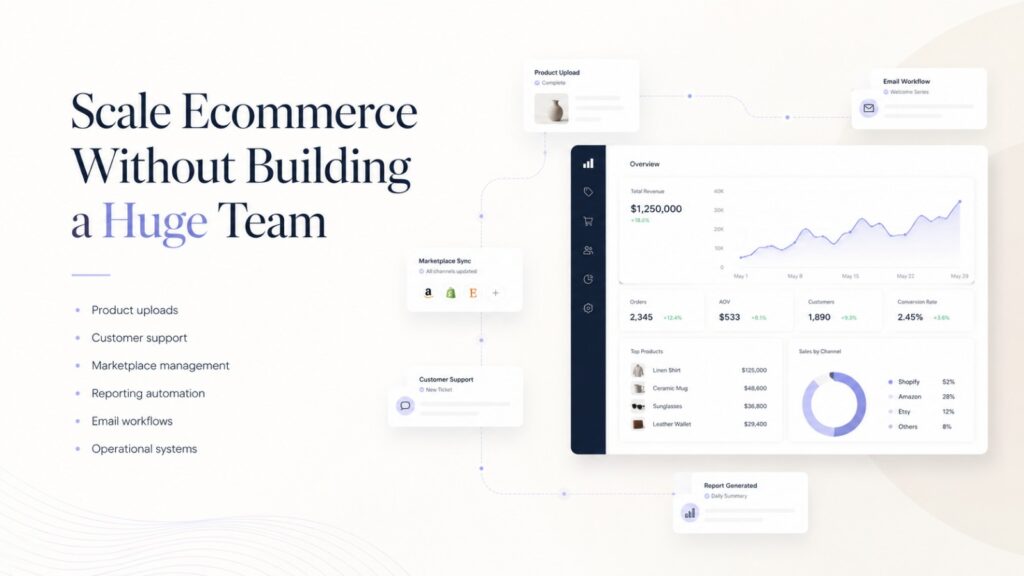
Scaling an ecommerce store to $1 million without a full-time team requires three things working together: a lean operational model that delegates recurring tasks to specialist VAs, automation tools that handle volume without adding headcount, and a multi-channel strategy that grows revenue without proportionally growing your workload. The stores that reach $1M this way do not do more; they delegate more.
And that is really what this entire article comes down to. Not motivation. Not “mindset.” Just operational design.
The part most people misunderstand about scaling
There is a difference between growing and scaling that almost nobody explains properly.
Growing is when revenue goes up, and your workload goes up with it. More orders means more support tickets, more listings, more inventory problems, more ad management, more chaos. You are technically bigger, but the business becomes heavier every month.
Scaling is different. Revenue rises while operational complexity rises much more slowly. Orders double, but your day does not suddenly become twice as stressful because systems and delegation absorb the extra volume.
Most e-commerce businesses grow. Very few actually scale.
You can usually tell the difference by looking at the founder. Growth-focused founders look exhausted. Scaling-focused founders look oddly calm relative to revenue size because they stopped acting like the business’s employee.
One honest thing before we go further, though: not every store reaches $1M, and pretending otherwise helps nobody. A high-margin niche product with repeat buyers scales differently than a low-margin commodity competing on price. Some categories simply have more room than others.
Only a small percentage of solopreneur businesses ever cross seven figures. The operational model in this article works because versions of it appear repeatedly across scaling stores, but results still depend on product-market fit, margins, timing, consistency, and whether the owner actually lets go of work instead of pretending to delegate while micromanaging every task.
That last part matters more than people think.
The problems at $10K/month and $100K/month are completely different
A lot of e-commerce advice falls apart because it treats every business stage like the same situation. Someone making their first $5K per month does not need the same systems as someone processing 300 orders a day.
Each revenue stage creates a different bottleneck. If you solve the wrong one, you stay stuck.
$0 to $10K/month: Everything depends on you
At this stage, the bottleneck is basically everything.
You are the customer support rep, the ad manager, the product uploader, the photographer, the copywriter, and sometimes the person taping boxes at midnight. It is messy, but honestly, it should be. Early-stage ecommerce is not about optimization yet. It is about finding out whether people actually want what you are selling.
This is also the stage where people make expensive mistakes trying to look bigger than they are. Hiring too early. Paying for enterprise tools they barely use. Delegating ads before understanding how ads even work.
The founders who survive this phase usually keep things embarrassingly simple. They learn about the customer deeply. They run their own campaigns at least once. They start documenting repeat tasks even if the SOP is literally a rough Google Doc with screenshots.
You do not need a team yet. You need clarity.
$10K to $30K/month: Your time becomes the ceiling
This is where stores start feeling “successful” externally while becoming internally exhausting.
Revenue is coming in consistently, but operational work starts swallowing the founder’s entire week. Product uploads pile up. Support tickets sit unanswered longer than they should. Ad monitoring becomes reactive instead of proactive.
The biggest trap here is believing nobody can do the tasks as well as you can.
That belief keeps a lot of stores permanently small.
This is usually the point where founders realise the problem is no longer effort. It is the operational bandwidth. The stores that break through this stage typically stop trying to personally manage every backend task and start building support systems around themselves. This breakdown on how e-commerce virtual assistants help small businesses scale faster explains why delegation becomes a growth lever long before most founders expect it to.
This is usually where the first smart delegation decisions happen:
- Product uploads
- Customer support
- Marketplace account monitoring
- Basic reporting
- Repetitive backend tasks
A good Product Uploading VA often buys back 5–8 hours per week almost immediately because catalogue work is repetitive, process-driven, and mentally draining in ways founders underestimate.
And customer support? That becomes emotionally expensive long before it becomes operationally expensive. Reading the same “where is my order?” email 40 times a week slowly destroys your ability to focus on growth.
A survey by The Alternative Board found that business owners spend far more time working on day-to-day operations than on strategic growth activities. That imbalance becomes the core bottleneck at this stage.
$30K to $100K/month: Systems either appear or the business breaks
This is where cracks start showing.
Inventory mistakes become expensive. Support delays hurt reviews. Ads need daily attention. One operational issue can suddenly affect hundreds of customers instead of five.
What surprises people here is that revenue growth often creates less freedom, not more. The store becomes heavier unless systems mature alongside revenue.
This is usually where stores move from “one helpful VA” to an actual operational layer:
- Marketplace VA
- Customer support VA
- Email/SMS VA
- Ads monitoring support
- Reporting assistance
The founder’s role has to change, too.
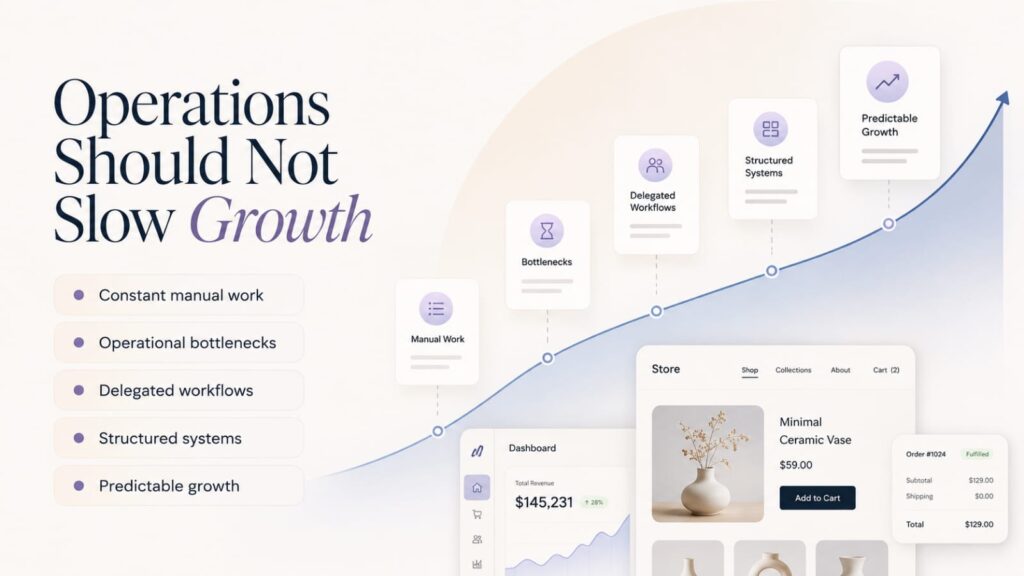
You are no longer supposed to execute tasks all day. You are supposed to make decisions. A lot of operators struggle with this transition because being needed feels productive. But constantly being needed is usually a sign that the business is fragile.
$100K/month and beyond: Operations stop being the main problem
Once operations are stable, the game changes.
At this level, growth usually comes from channel expansion, retention improvements, supplier relationships, product development, and improving customer lifetime value. The business becomes strategic instead of reactive.
The interesting thing is that many lean e-commerce stores at this level still do not have traditional employees. They have specialist VAs, automation systems, contractors, and tightly documented workflows.
Operationally, they often outperform bloated businesses because every person involved has a very specific role instead of wearing seven hats badly.
The six areas you eventually have to stop doing yourself
The stores that scale cleanly are not avoiding work. The work still exists. Listings still need updating. Customers still need help. Ads still need monitoring.
The difference is that the founder stops being the person executing every task.
Product listings become a hidden growth bottleneck
Catalogue management is usually the first thing that should leave the founder’s plate.
Not because it is unimportant, but because it is repetitive enough that someone trained properly can often do it faster and more consistently. A dedicated product uploading VA can handle:
- SEO-focused titles and descriptions
- Variant creation
- SKU management
- Image formatting
- Marketplace formatting requirements
- Shopify and Amazon uploads
One thing people outside of e-commerce rarely realize: unuploaded products are literally trapped revenue.
Some stores sit on supplier files for two weeks because the founder is “too busy” to upload listings. At scale, that becomes incredibly expensive. Stores doing serious volume often add dozens of SKUs every month. Without someone owning catalogue operations, launches slow down quietly.
Customer support starts protecting revenue, not just fixing problems
Founders often treat support like an annoying operational cost until volume increases enough to reveal what support actually does.
It protects trust.
The fastest-growing stores usually answer faster than their competitors. They resolve issues before chargebacks happen. They handle angry customers before reviews spiral publicly.
A trained Customer Support VA typically handles:
- Order tracking requests
- Returns and exchanges
- Pre-sale questions
- Marketplace reviews
- Helpdesk management
- Escalations
SCAYLE’s 2025 US shopper survey found that poor customer experiences, slow sites, checkout friction, and delivery issues continue driving shoppers away from brands at scale. And honestly, most support breakdowns are not caused by bad intentions. They are caused by overloaded founders checking inboxes between ten other responsibilities.
Support volume grows almost linearly with revenue. If you do not separate yourself from it operationally, the business eventually starts controlling your day.
Amazon becomes its own full-time business
People underestimate this constantly.
Running Amazon properly is not “upload listing and wait.” Between account health, A+ Content, keyword optimization, pricing changes, buyer messages, reimbursements, and policy monitoring, Amazon alone can consume an entire workweek.
That is why stores serious about marketplace expansion almost always rely on a dedicated Amazon VA Services structure.
Once Amazon runs properly, adding Walmart Marketplace or TikTok Shop becomes operationally possible without doubling the founder’s workload.
That is an important distinction. Most stores fail at multi-channel expansion because they add channels without adding operational support. Every new marketplace becomes another inbox, another dashboard, another source of problems.
Delegation is what makes diversification sustainable.
Ads do not usually fail dramatically: they decay slowly
One of the more painful ecommerce truths is that ads rarely collapse overnight.
They slowly become less efficient while nobody notices quickly enough.
CTR drops slightly. ROAS softens. CPC creeps upward. Creative fatigue builds quietly. Founders busy with operations miss early warning signs because they are checking campaigns reactively instead of systematically.
A dedicated operational ads role usually handles:
- Daily spend monitoring
- Budget pacing
- Basic optimization
- A/B test tracking
- Reporting
- Creative performance alerts
This matters because ad efficiency compounds aggressively at scale. A small percentage improvement in acquisition costs can completely change cash flow at higher revenue levels.
And no, most founders should not be inside Ads Manager all day once systems mature. They should be reviewing decisions, not micromanaging campaigns hourly.
Email quietly becomes the most profitable channel in the business
The funny thing about e-commerce email is that everyone knows it matters, but many stores still treat it like a side task.
Meanwhile, properly built email systems often become the highest ROI channel in the company.
A dedicated Email and SMS VA usually handles:
- Campaign scheduling
- Segmentation
- Klaviyo flows
- Welcome sequences
- Abandoned cart flows
- Post-purchase automation
- Revenue reporting
The stores that scale sustainably are usually not winning because they constantly find new customers. They win because existing customers keep buying again.
That changes the economics of everything.
Reporting becomes mandatory once intuition stops working
At smaller revenue levels, you can sometimes run the business by instinct because the numbers are simple enough to mentally track.
That stops working eventually.
Once multiple channels, ads, marketplaces, and retention systems are running simultaneously, founders need visibility without spending four hours manually exporting spreadsheets every week.
A reporting-focused VA can pull:
- Revenue trends
- Ad performance
- Support metrics
- Inventory warnings
- Channel comparisons
- Retention performance
This is probably the least glamorous delegation decision and one of the most valuable.
Clear reporting reduces emotional decision-making. And ecommerce founders make surprisingly emotional decisions when they are overwhelmed.
Automation and VAs solve different problems
A lot of people frame automation and VAs as competing solutions. They are not.
Automation handles predictable repetition. VAs handle judgment, nuance, and platform-specific execution.
The best lean ecommerce stores use both aggressively.
A few examples:
- Shopify Flow or Zapier handling order routing and tagging
- Inventory tools syncing stock across marketplaces
- Klaviyo flows generate retention revenue automatically
- AI support triage answering basic questions instantly
- Looker Studio dashboards centralize reporting
Automation removes workload. VAs manage exceptions.
That combination is what allows order volume to double without the founder suddenly working 14-hour days again.
And honestly, this is where a lot of scaling advice becomes unrealistic. People talk about automation as if software magically runs the company by itself. It does not. Someone still needs to manage platforms, interpret context, fix issues, and make decisions.
The operational sweet spot is automation underneath skilled human oversight.
Most stores plateau because they rely on one channel too heavily
You can usually predict which stores feel fragile by looking at their revenue sources.
If 90% of revenue comes from one platform, the business eventually lives in fear of that platform changing something.
A Meta CPM spike hurts more. An Amazon suspension feels catastrophic. A Google update suddenly affects cash flow.
The stores that eventually push toward $1M usually diversify before they are forced to.
That often looks like:
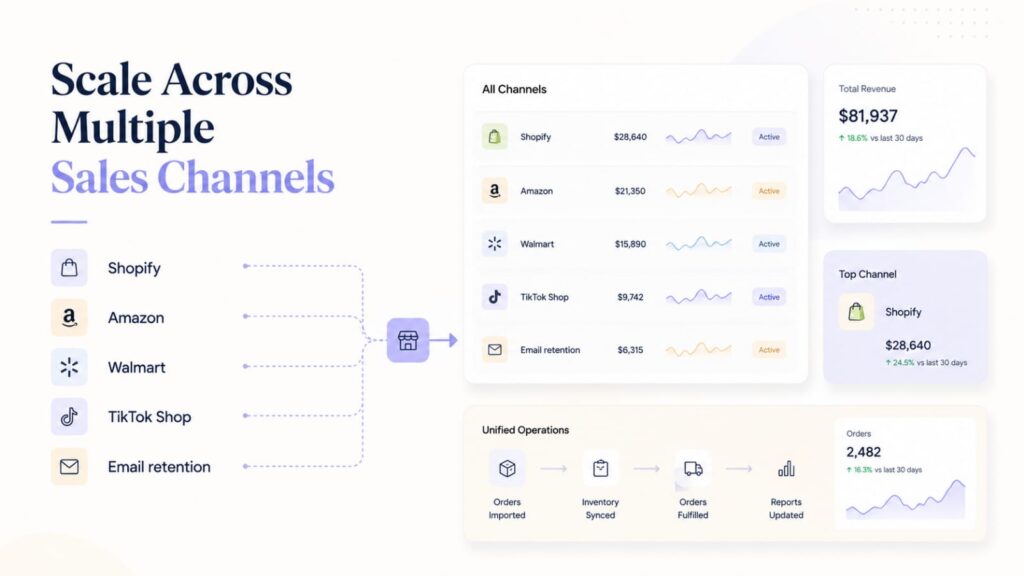
- Shopify or WooCommerce as the owned channel
- Amazon for discovery and volume
- Walmart Marketplace for lower-competition expansion
- TikTok Shop for product-driven discovery
- Email/SMS for retention and LTV
The important part operationally is this: the founder is not personally managing every channel.
Each platform has specialist support behind it. Otherwise, diversification just becomes chaos wearing a growth costume.
What the lean $1M setup actually looks like
People imagine seven-figure ecommerce businesses having giant teams. Sometimes they do. But lean stores usually look surprisingly simple operationally.
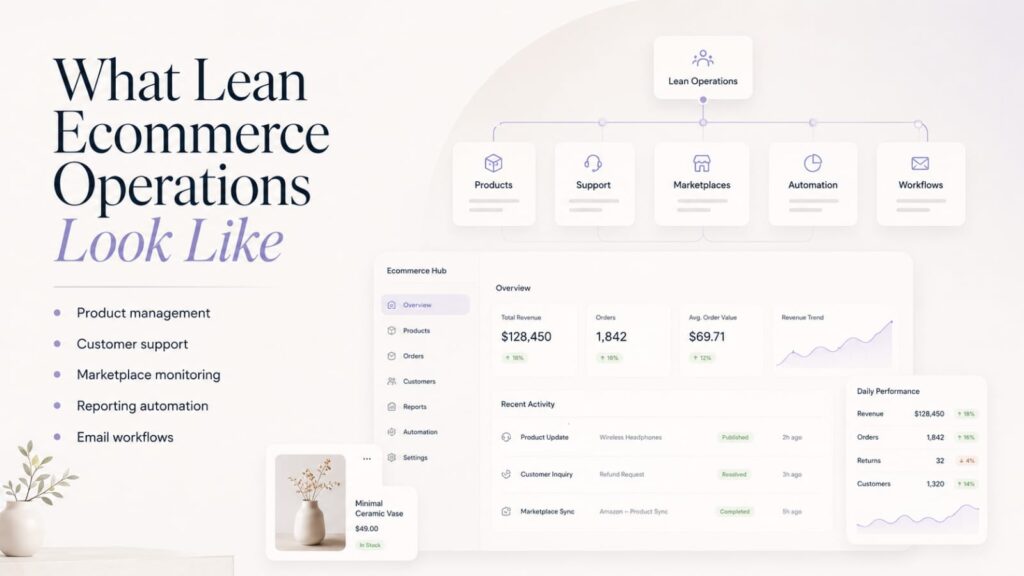
The founder focuses on:
- Supplier relationships
- Margins and pricing
- Expansion decisions
- Product strategy
- Brand direction
- Reviewing KPIs
The operational layer handles:
- Product uploads
- Marketplace management
- Customer support
- Reporting
- Email execution
- Ads monitoring
Automation handles:
- Inventory syncing
- Order tagging
- Reporting dashboards
- Email flow execution
- Basic support triage
The interesting part is not that the workload disappears. It is that the founder stops being the bottleneck.
And financially, this is usually where founders realise how expensive traditional hiring actually is. A lean outsourced operational structure often delivers similar operational coverage without the overhead of building full in-house departments.
That gap matters when margins tighten.
The model only works once your foundation is stable
This approach works best once the store has consistency.
Usually, that means:
- Revenue above roughly $8K–$10K/month
- At least one reliable product
- Repeat operational tasks
- Some level of process clarity
- Basic SOP documentation
If revenue is still wildly inconsistent or products change every week, aggressive delegation usually creates confusion instead of leverage.
The founders who get the most out of VAs are not necessarily the most organized people. They are the people willing to explain their process clearly and stop re-taking tasks every time someone else touches them.
That part sounds small. It is not.
A surprising number of e-commerce founders say they want help while subconsciously protecting chaos because chaos makes them feel indispensable.
The founders who scale stop trying to prove they can do everything themselves
At some point, every e-commerce business hits the same uncomfortable question:
Are you building a scalable company, or are you building a job that only you can perform?
That question decides almost everything that happens next.
The stores that eventually reach $1M without giant teams are rarely run by superhuman founders. Usually, they are run by people who have become ruthless about protecting their attention. They stopped spending their best mental energy on tasks that somebody else could execute 90% as well.
That is the shift.
Not working harder. Not hustling longer. Just finally understanding that growth breaks the moment the founder becomes the system.
If you are starting to feel that ceiling already, book a free consultation with Crew27 and map out which operational tasks should leave your plate first before the business starts, depending entirely on your time to keep growing.
1. Can you really run a $1M ecommerce store without full-time employees?
Yes. Thousands already do. The operational structure usually combines specialist VAs, automation tools, contractors, and streamlined systems instead of traditional employees. The founder focuses on strategic decisions, while execution work is distributed across lean operational support.
2. What is the difference between growth and scaling?
Growth means revenue and workload rise together. Scaling means revenue rises faster than operational complexity. If doubling revenue also doubles stress and founder involvement, the business is growing, not scaling.
3. How many VAs does a scaling store usually need?
Most stores approaching six figures monthly operate effectively with around 2–4 specialist VAs covering support, marketplace operations, catalogue management, and reporting. The exact number depends more on operational complexity than raw revenue.
4. When should you hire your first VA?
Usually, repetitive operational work consistently consumes 15+ hours weekly for many e-commerce stores, which happens somewhere between $8K and $15K per month in revenue.
5. How long does reaching $1M realistically take?
Longer than most YouTube thumbnails suggest.
A store with strong product-market fit can sometimes move from $15K monthly revenue toward $100K monthly revenue within 12–18 months if operations scale properly. But timelines vary massively depending on niche, margins, acquisition costs, competition, and execution quality.
The internet loves compressing timelines because “steady operational scaling over several years” is less exciting than “$1M in 90 days.”
Reality is usually slower and far more sustainable.