

New small ecommerce businesses are entering the market at a record pace in the United States. Digital commerce is growing every year, and it is easier than ever to start an online store. However, it is still as difficult as ever to scale up your online store.
Growth is a complex process.
As your online store grows in terms of orders and revenue, your customer support issues, return orders, inventory updates, and listing updates also grow. What starts as a small and lean online store eventually evolves into a fully fledged online store operation.
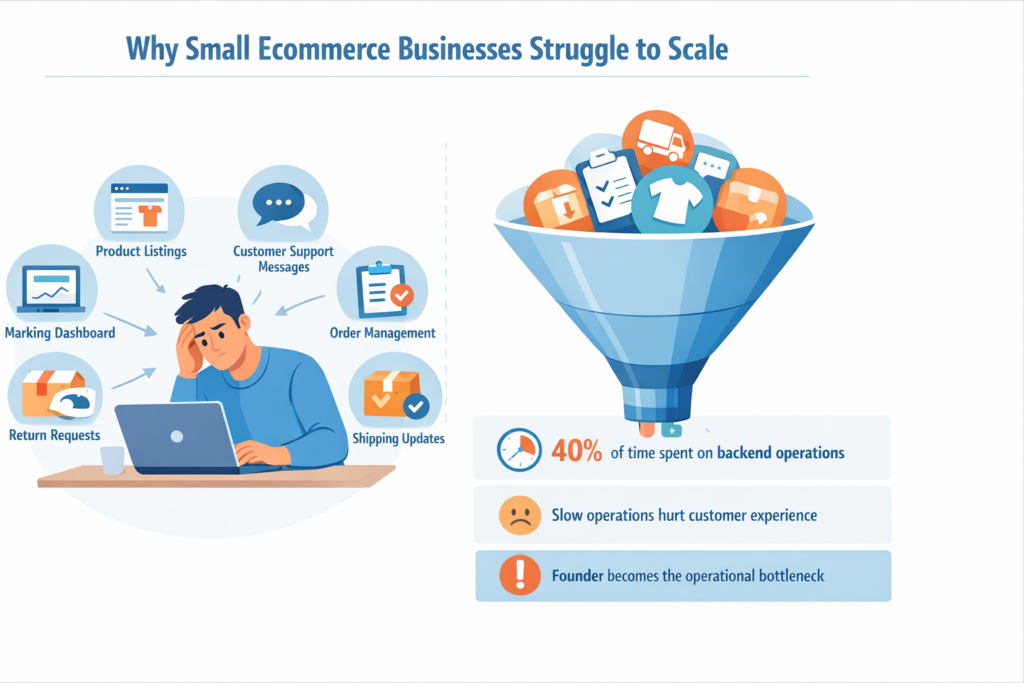
Industry studies have shown that small and mid-scale online stores spend more than 40 percent of their operations on backend operations and not on growth-oriented activities such as marketing and scaling up operations. At the same time, customer experience studies also show that customer experience is directly impacted by your online store’s operations and speed of operations.
The point is that most online stores are not struggling because of a lack of demand or supply chain issues. They are struggling because of their inability to scale up operations.
This is where ecommerce virtual assistants become a key differentiator for online stores.
In this article, you will learn how virtual assistants for e-commerce help small businesses scale faster, reduce operational friction, and create sustainable growth systems.
Key Takeaways
- Small e-commerce businesses often hit growth ceilings due to operational bottlenecks.
- Backend inefficiencies directly affect revenue, retention, and brand reputation.
- E-commerce virtual assistants create operational leverage without increasing fixed payroll overhead.
- Delegating operations allows founders to refocus on strategy and expansion.
- Structured support systems accelerate multi-channel and marketplace growth.
Why Small Ecommerce Businesses Struggle to Scale
The Founder Bottleneck Effect
In early-stage online businesses, the founder does everything. Product upload, customer support, supplier management, ad monitoring, refunds, order tracking, etc. – everything flows through the founder.
This works at low scale. It does not work at high scale.
As the business becomes more complex, decision fatigue sets in. Execution slows down. Strategic thinking becomes reactive rather than proactive. Initiatives are put on the back burner since operational issues require immediate attention.
Operational Complexity Increases Nonlinearly
Order volume does not increase in isolation. Every new sale creates additional operational touchpoints:
- Payment confirmations
- Shipping coordination
- Tracking updates
- Customer inquiries
- Return management
- Inventory reconciliation
When selling on multiple platforms such as Shopify and Amazon, the complexity multiplies further. Marketplace compliance standards, account health metrics, and listing accuracy become critical.
Research consistently shows that customers expect fast responses. Delays in support can significantly reduce purchase confidence and repeat buying behavior. For US consumers, especially, speed and clarity directly influence brand trust.
Operational inefficiency is not just inconvenient. It is expensive.
If backend operations are consuming more time than growth strategy, it may be time to explore structured ecommerce virtual assistant services designed specifically for scaling small businesses.
What Is an Ecommerce Virtual Assistant?
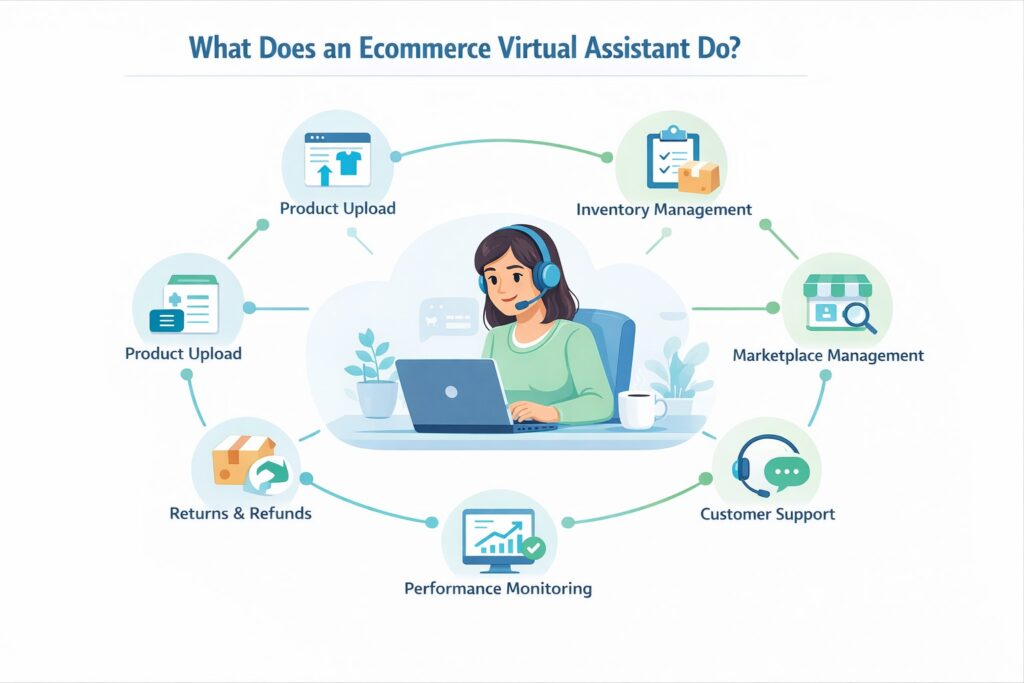
An e-commerce virtual assistant is an expert remote worker who can handle online store activities, including product upload, inventory management, customer service, order management, and online marketplace management. However, unlike regular virtual assistants, an e-commerce virtual assistant has specialized knowledge of online store platforms.
They know platforms like Shopify, Amazon MWS, WooCommerce, Walmart, etc. But, most importantly, they are trained to work within processes. And processes are essential, especially for small businesses, where there can be operational risks but also where there is the need for speed.
7 Ways E-commerce Virtual Assistants Help Small Businesses Scale Faster
1. They Reclaim Founder Time for Revenue Activities
Time is the most limited resource in a growing business.
If a founder is spending time answering support tickets or fixing listings, they are not spending that time building relationships, improving marketing strategies, or exploring growth opportunities.
E-commerce virtual assistants help remove operations from the founder’s plate.
This increases strategic focus and improves growth velocity.
Growth is a function of leadership capacity. Delegation is how we get it.
2. They Improve Customer Response Times
The customer experience is directly linked to profitability.
Studies have proven that faster response times lead to higher customer satisfaction and improved customer retention.
An e-commerce store’s virtual assistant will ensure that customer support is timely and consistent.
Being responsive is not a choice in competitive US markets; it is a requirement.
3. They Reduce Operational Errors
Incorrect product listings, inventory mismatches, and delayed fulfillment create revenue leakage.
An ecommerce management virtual assistant operates through workflows, ensuring operational precision. Consistency improves. Accuracy improves. Complaints from customers lessen.
Operational precision translates into brand credibility.
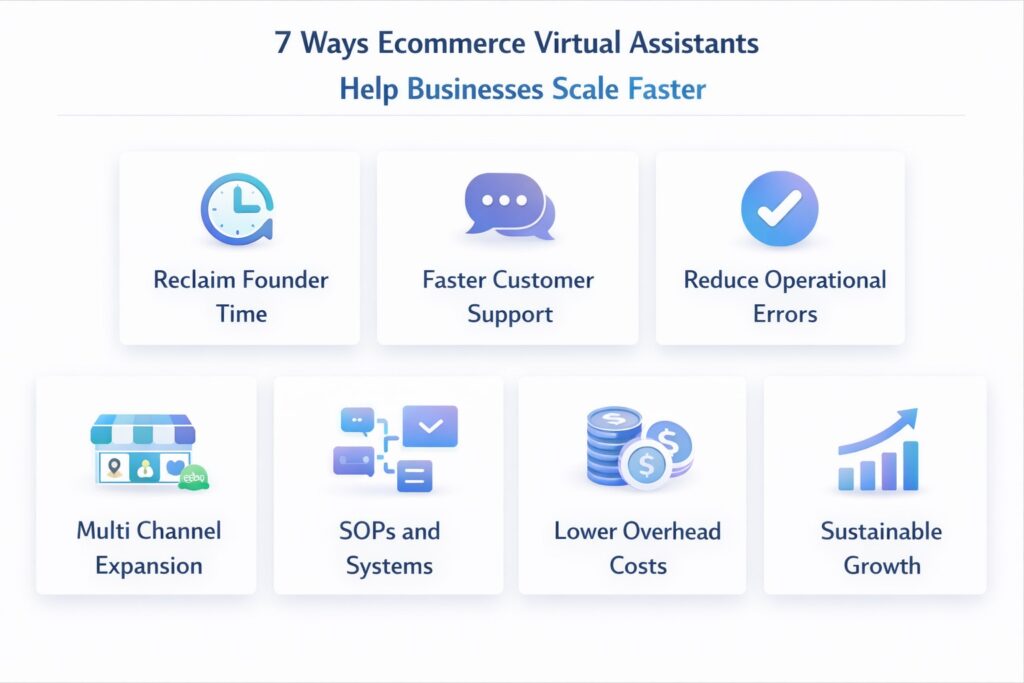
4. They Support Multi-Channel Expansion
Most small businesses get stuck somewhere when they try to scale into new sales channels.
An Amazon ecommerce virtual assistant can assist with Seller Central, account health, and performance monitoring. This minimizes risks while maximizing growth potential.
Expanding into new sales channels requires operational precision. Without operational precision, the business becomes unmanageable.
5. They Implement Systems and SOPs
For businesses, growth is only sustainable through systems.
Ecommerce virtual assistant services include documenting, structuring workflows, and standardizing processes. This turns unmanaged chaos into operational systems.
Businesses that scale are system-driven, not personality-driven.
6. They Reduce Fixed Overhead Compared to In-House Hiring
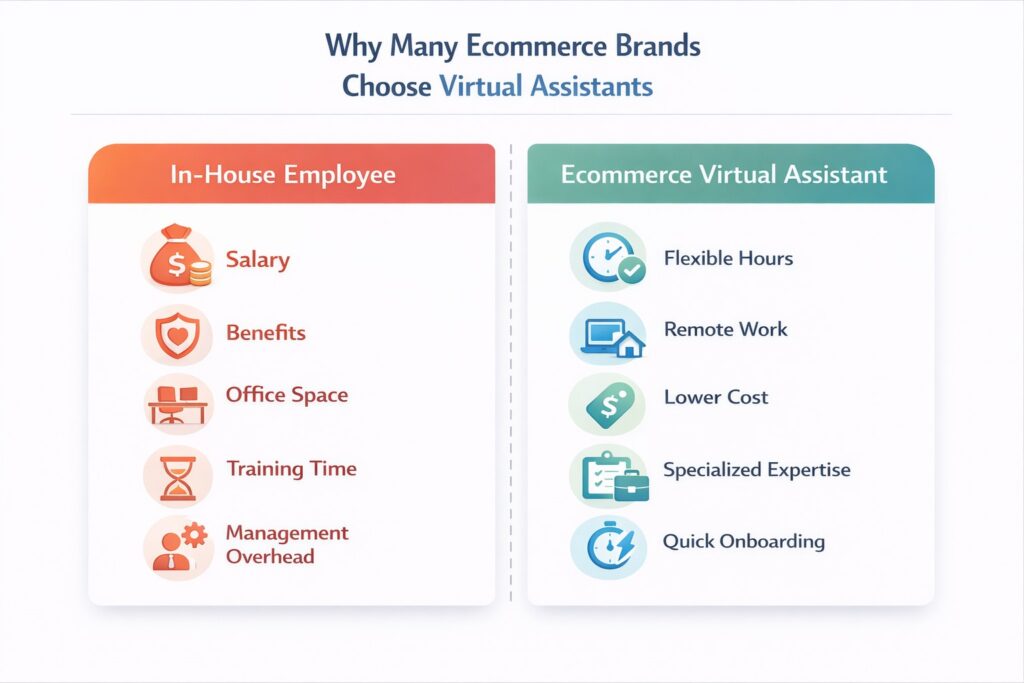
The process of hiring full-time in-house staff in the United States includes providing them with salaries, benefits, training, offices, and management time.
By using the services of an ecommerce virtual assistant, small businesses can access specialized expertise without having to increase their fixed costs in the same way.
7. They Make Growth Sustainable
Burnout is a hidden cost of ecommerce growth.
Being in constant reactive mode is not sustainable, and the quality of decisions and innovation suffers. Having clarity is what ecommerce virtual assistants give small businesses.
Scaling small ecommerce businesses requires more than increased ad spend. It requires operational leverage. Many growing US brands choose to hire ecommerce virtual assistants before bottlenecks slow their momentum.
When Should a Small Business Hire an Ecommerce Virtual Assistant?
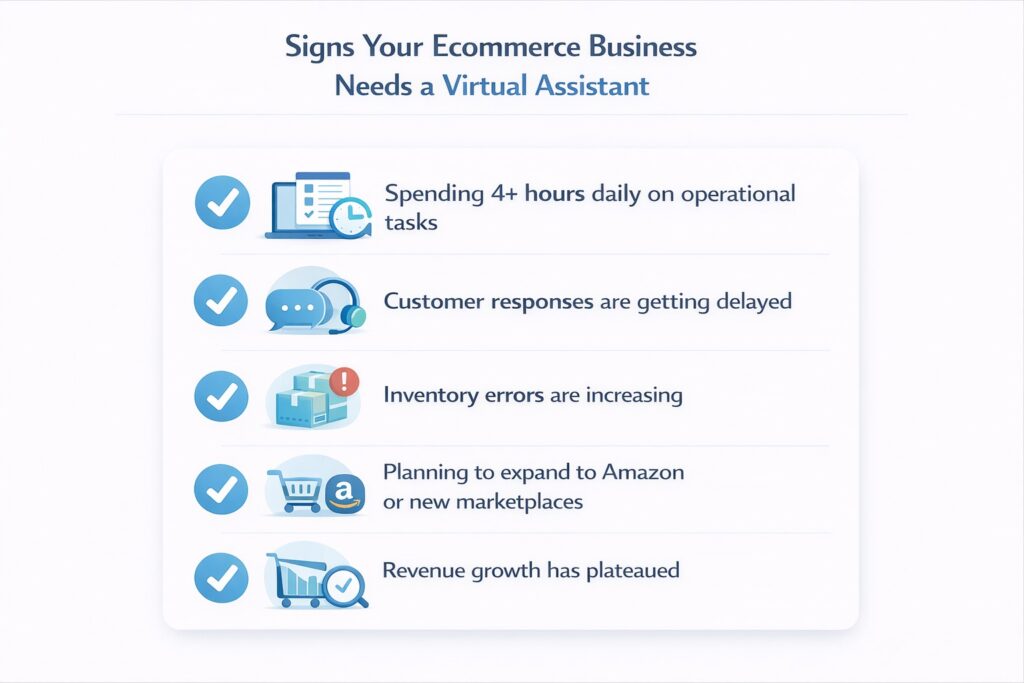
Consider hiring an ecommerce virtual assistant if:
- You spend more than four hours per day on operational tasks.
- Customer response times are increasing.
- Inventory errors are becoming frequent.
- You are planning to expand into new marketplaces.
- Revenue growth has plateaued despite consistent demand.
Waiting too long increases stress and reduces efficiency.
Cost vs ROI: Is Hiring an Ecommerce Virtual Assistant Worth It?
The cost of hiring a virtual ecommerce assistant varies depending on workload and specialization. However, comparing cost alone misses the larger picture.
Consider the opportunity cost of founder time. If strategic work generates revenue but operational work maintains it, then shifting focus toward strategy increases growth potential.
Additionally, compare this to hiring an in-house employee in the United States, which involves significantly higher fixed costs.
From an ROI perspective, ecommerce virtual assistants often pay for themselves by protecting revenue, improving efficiency, and preventing costly operational mistakes.
How to Choose the Best Ecommerce Virtual Assistant in the USA
When selecting ecommerce virtual assistant services, evaluate:
- Platform-specific expertise
- Understanding of US customer expectations
- Structured onboarding systems
- Clear communication standards
- Scalability options
Not all virtual assistants are specialized in ecommerce. Choosing a partner experienced in structured ecommerce support ensures smoother integration.
If your ecommerce business is growing but operations are limiting your speed, structured ecommerce virtual assistant support can provide the leverage needed for your next phase of expansion. Crew27 works with scaling US brands to build reliable operational systems that support sustainable growth.
Common Myths About Ecommerce Virtual Assistants
Myth 1: Only large brands need them.
Small businesses will get the most out of using ecommerce virtual assistants because operational bottlenecks occur earlier in their lifecycle.
Myth 2: It is too expensive.
Outsourcing is more cost-effective than the cost of lost sales and the cost of employing people to work within your business.
Myth 3: I will lose control.
Having a structured approach to delegation will give you more control over your business.
Myth 4: Training will take too long.
Ecommerce virtual assistants with experience will be able to integrate into your business more quickly because they will be familiar with the platforms you are using.
Conclusion: Scaling Is a System, Not a Sprint
Small ecommerce businesses don’t fail because they don’t have the opportunity to grow. They fail because their operational systems are not able to support their growth.
Growing your business faster than the rate of the operational challenges you are experiencing is not achieved by working harder, but by creating support systems that will protect your efficiency, your customer relationships, and your strategic clarity.
E-commerce virtual assistants give you the operational leverage to get your small business away from survival mode and into the world of growing your business.
How do ecommerce virtual assistants help small businesses scale faster?
Ecommerce virtual assistants help small businesses scale faster by managing daily operations such as product uploads, customer support, order processing, and inventory tracking. By reducing operational workload, they allow founders to focus on marketing, expansion, and revenue-generating activities.
When should a small business hire a virtual assistant for e-commerce?
A small business should hire an ecommerce virtual assistant when daily operations begin consuming more time than strategy and growth planning. Signs include delayed customer responses, listing backlogs, inventory errors, and difficulty managing multiple sales channels.
What tasks can I outsource to an ecommerce virtual assistant?
Common tasks to outsource to an ecommerce virtual assistant include product uploads, listing optimization, customer service, order management, inventory updates, returns processing, and marketplace monitoring such as Amazon Seller Central management.
How much does it cost to hire an ecommerce virtual assistant in the USA?
The cost to hire an ecommerce virtual assistant in the USA varies based on experience, hours required, and task complexity. Most ecommerce virtual assistant services offer flexible hourly or monthly pricing depending on business needs.
Is hiring an ecommerce virtual assistant better than hiring in-house staff?
Hiring an ecommerce virtual assistant is often more cost-effective than hiring in-house staff because it reduces payroll expenses, benefits costs, and overhead while still providing specialized ecommerce support.
Can ecommerce virtual assistants manage Amazon and Shopify stores?
Yes, experienced ecommerce virtual assistants can manage platforms like Shopify and Amazon Seller Central, including listing updates, order tracking, customer communication, and account performance monitoring.