

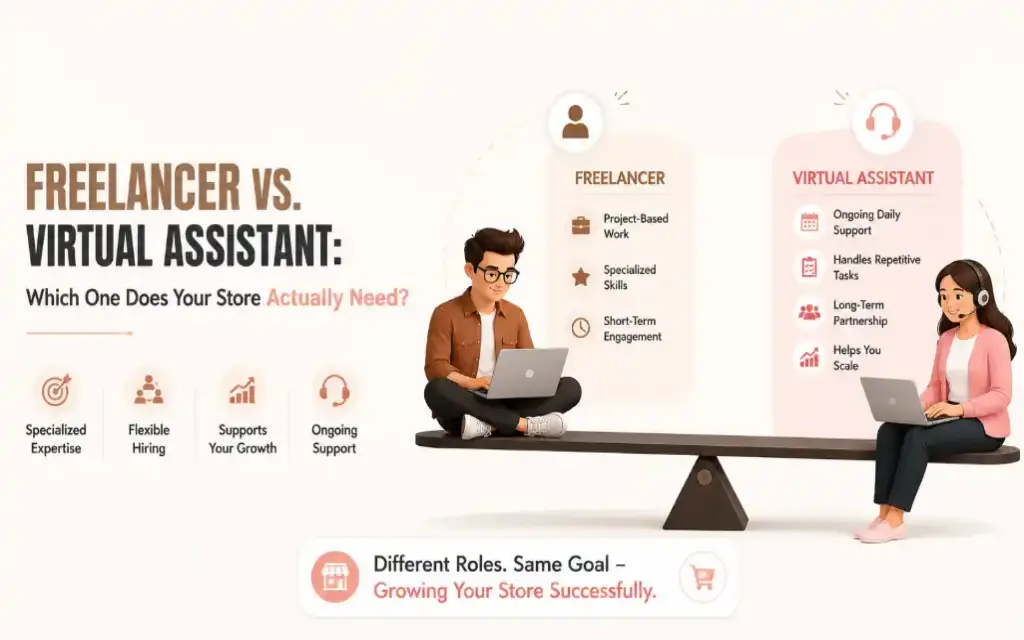

If you need a specific task done, such as designing a logo, taking product photos, or fixing a checkout issue, a freelancer may be the better option. The choice between a freelancer and a virtual assistant depends on the type of support your ecommerce business needs. Freelancers usually work on specific projects with a clear start and finish, while virtual assistants handle ongoing tasks such as customer service, product listing updates, and Amazon PPC management. As a VA works with your business over time, they can become familiar with your products, processes, and customers, which can make day-to-day work easier as your store grows.
The Quick Takeaways
1. Freelancers split their time across multiple clients, which means their schedules aren’t always predictable.
2. Virtual assistants commit to set hours with you each week, which means they actually get to know your products, your tools, and your customers.
3. Stores with repeating work support tickets, listing updates, ad tweaks generally save more going the VA route than cycling through freelancers.
4. The real distinction isn’t the job title. It’s whether you’re paying for a task or paying for a relationship.
5. Either way, a quick paid trial task, a look at real reviews, and a test of how fast someone responds will save you from a bad hire.
There’s no single right answer to “freelancer or virtual assistant” ; it really comes down to what kind of work you’re trying to get off your plate. Here’s how to think it through, plus a few ways to keep from wasting time and money on the wrong hire.
Freelancer or Virtual Assistant: Which One Do You Need?
It’s not the title on their profile. It’s what takes place once the work is finished.
Freelancers sell finished work like a logo, a new checkout process, or product photos for a week. After handing it over and sending the bill, they’re done until you need them again. There’s nothing wrong with that; it’s precisely how the arrangement is designed to function. You get sharp, focused expertise on one problem, and there’s no expectation they’ll stick around for everything else your business needs.
A virtual assistant, on the other hand, takes ownership of a piece of your day-to-day operation: your support inbox, your ad dashboard, the listings that need constant tending and that value builds over time instead of starting from zero each time. In their first month, they’re still learning your product line. By month three, they’re often spotting problems before you notice them yourself.
This is where many sellers end up wasting money. They either pay freelancer rates over and over again to explain their business from scratch each time, or they hire a full-time VA for work that really only needs a specialist for a short project. According to Upwork’s 2026 Future Workforce Index, freelancers now make up 39% of the U.S. workforce, with the heaviest concentration in design, development, and marketing. That means the real challenge for sellers isn’t finding skilled talent for project work, it’s knowing which kind of help actually fits the job.
Side-by-Side: Freelancer vs. Virtual Assistant
| Factor | Freelancer | Virtual Assistant |
| How they work | Project-based, one-off | Ongoing, set hours |
| Client load | Often several clients at once | Usually just a few |
| Knowledge of your business | Starts fresh each project | Builds over time |
| Skill focus | Narrow and specialized | Broad, operational |
| Availability | Depends on the project | Predictable, scheduled |
| Best fit for | Design, dev work, one-time campaigns | Daily ops, support, admin, ad management |
| Management effort | Light ongoing oversight, heavier onboarding each time | More upfront training, less oversight after that |
The pattern here is pretty consistent: freelancers are built for expert output on a defined task, while VAs are built for showing up every day and keeping things running.
Freelancer vs. VA Cost Comparison: What You’ll Actually Pay
This comparison isn’t straightforward, since freelancers and VAs typically address entirely different needs.
Freelancers tend to charge more per hour or per project you’re paying for concentrated expertise, delivered fast. A solid freelance developer or designer in the U.S. might run $40 to $100+ an hour, but you’re only on the hook for the actual hours the project takes.
E-commerce Virtual assistants are often cheaper per hour, especially if you hire one through an agency or from a place where the cost of living is lower. Instead of a single deliverable, that lower rate is for ongoing, part-time or full-time help. Bringing in remote support from abroad can cost a lot less than hiring someone local to handle the same ongoing tasks.
The real question isn’t “who’s cheaper per hour.” It’s “which model actually lowers your total cost for this kind of work.” A freelancer you keep re-hiring for the same recurring task can end up costing more than a VA once you factor in all that repeated onboarding. (If you want a fuller cost breakdown, there’s a separate guide on hiring an Amazon virtual assistant that gets into skills and a full hiring checklist.)
When Should You Hire a Freelancer?
Go the freelancer route when:
● You need a one-time project with a clearly defined deliverable, such as a website redesign, new brand identity, or professional product photography.
● The role requires specialized expertise you won’t need on an ongoing basis, such as a complex app integration.
● You have a clear start and finish, and once the work is handed over, no ongoing support is needed.
● You’re fine paying a higher hourly rate in exchange for speed and specialization.
If the work fits neatly into a project with a clear finish line, freelance platforms are still a great option.
When to Choose a Virtual Assistant for Your Business
Bring on a VA when:
● You’ve got tasks that repeat every week or every day order checks, customer questions, inventory updates.
● You’re spending hours on administrative tasks that should instead be driving business growth.
● You need one consistent person managing things, rather than quality fluctuating with every new freelancer you bring on.
● Your store is scaling and the operational cracks are starting to show often the clearest signal that you need dedicated help, not another one-off gig.
Not sure if you’ve hit that point? There’s a separate breakdown of the step-by-step Guide to Hiring an Ecommerce Virtual Assistant.
Two areas where sellers most often bring in a VA specifically: advertising and customer support. If your ad spend keeps climbing but nobody’s actively managing bids and budget pacing, a dedicated Amazon PPC assistant can keep campaigns from drifting. And if support tickets are piling up faster than you can clear them, handing that off is usually more sustainable than trying to hire in-house.
How to Avoid Hiring the Wrong Person
Freelancer or VA, the risk of ending up with someone who underdelivers is real. A few things that actually help:
● Start with a small, paid trial task. Real work tells you far more than a portfolio ever will.
● Read actual reviews, not just star ratings. Look for specifics on how they communicate, whether they hit deadlines, how they handle revisions when something goes wrong.
● Test how fast they respond before you hire them. Send the same question to a few candidates and compare. Slow or vague replies during hiring are usually a preview of what’s coming later.
● Make sure they actually know ecommerce. A generalist who’s never touched Shopify or Seller Central is going to need a longer ramp-up. Prior ecommerce experience closes that gap fast.
● Put expectations in writing. Hours, tasks, tools, how often you’ll check in, spell it out. Ambiguity is probably the single biggest reason hires go sideways, on either side of this decision.