


Quick Answer:
An Amazon product listing VA is a trained assistant who handles the recurring listing work in Seller Central: variation families, titles and bullets, backend keywords, attribute fixes, and bulk catalog updates. They follow your SOPs and send anything that needs your sign-off for approval before it goes live. Apparel, beauty, and home brands gain the most because their catalogs are variation-heavy and their categories carry strict content rules. Crew27 listing support starts at $8 an hour, with monthly plans from $699.
If you sell apparel, beauty, or home goods on Amazon, you know a listing is never really finished. A new colour can disrupt the entire variation family. A dimension gets changed without you, and your FBA fees move with it. A backend keyword added months ago can be the reason a listing stopped showing up. None of it is hard work, but all of it lands on the founder, usually between supplier calls and packing orders.
You don’t have to keep carrying it. An Amazon product listing VA takes over the repetitive Seller Central work, so your catalog stays accurate while you put your time into product and growth. Here is where apparel, beauty, and home brands lose the most hours, and what a listing VA does about each one.
Apparel: Variation Families Break First
Apparel catalogs run on size and color combinations, so one style can mean dozens of child ASINs. That is where errors pile up. A common one is placing children that differ on more than one variation theme into a family that allows only one. Building families by hand in Seller Central gets unreliable as they grow, which produces wrong themes and orphaned children. Error 8032 appears when a child is still attached to a different parent, and the fix starts with removing the existing relationship.
Titles and sizing add to the load. Apparel titles need to stay under 80 characters to display properly on mobile, so a title copied from your website or another marketplace can run over. Return rates in apparel are commonly put at 25 to 35 percent, driven mostly by fit, color, and quality not matching the listing.
A listing VA builds and maintains the parent-child structure, uses bulk uploads instead of editing children one at a time, and reviews every child against its parent before the file goes up.
Beauty: One Wrong Claim Can Suppress a Listing
Beauty carries tighter rules than most categories because its products overlap with FDA-regulated territory. Many suppressions trace back to copywriting, such as medical-sounding claims, and others to restricted ingredients. Amazon can also ask for invoices, safety documentation, and photos of the ingredient list. Beauty sellers on Amazon’s forums describe restricted-product flags that survived repeated appeals, ingredient photos included.
Backend keywords compound the risk. Some health & beauty listings have been suppressed over search terms the seller added months earlier and forgot. Hidden fields rarely get reread, which is why they need a scheduled review.
An Amazon virtual assistant service does not replace your regulatory judgment. It applies your approved claims language across every listing and checks titles, bullets, and search terms against it before publishing.
Home: Dimensions, Images, and Trigger Words
Home and kitchen listings fail on specifics. Wrong size, fit, or color drives 34 percent of Amazon returns in home decor, by one estimate. Amazon’s systems also revise FBA dimensions on their own, and an inflated measurement raises your fees. Many furniture and home goods pages run on one or two low-resolution images, though shoppers in the category say they want at least three. Copy that implies pesticide or antimicrobial claims can flag even a kitchen or home listing.
A listing VA keeps dimension and weight attributes consistent, coordinates images and alt text to your guidelines, and screens copy for risky phrases before it goes live.
The Problems All Three Categories Share
Backend keywords are the least visible part of Amazon listing optimization, and they sit under a 250-byte limit. Go over it, and Amazon can ignore the entire field, with no error message to tell you. Commas waste bytes, and so does repeating words already in your title.
Suppression is the costlier failure. A suppressed listing earns nothing while your ad spend keeps running, and image problems are its most common cause: a main image that is pure white or a product filling less than 85 percent of the frame.
Your catalog also changes without you. Other sellers and Amazon’s own catalog team can edit titles, images, and bullets on a shared listing, and a single edit can introduce a compliance problem. Add the routine load of attribute updates, bulk edits, and seasonal refreshes, and Seller Central becomes a standing job of its own.
What an Amazon Product Listing VA Takes Off Your Plate
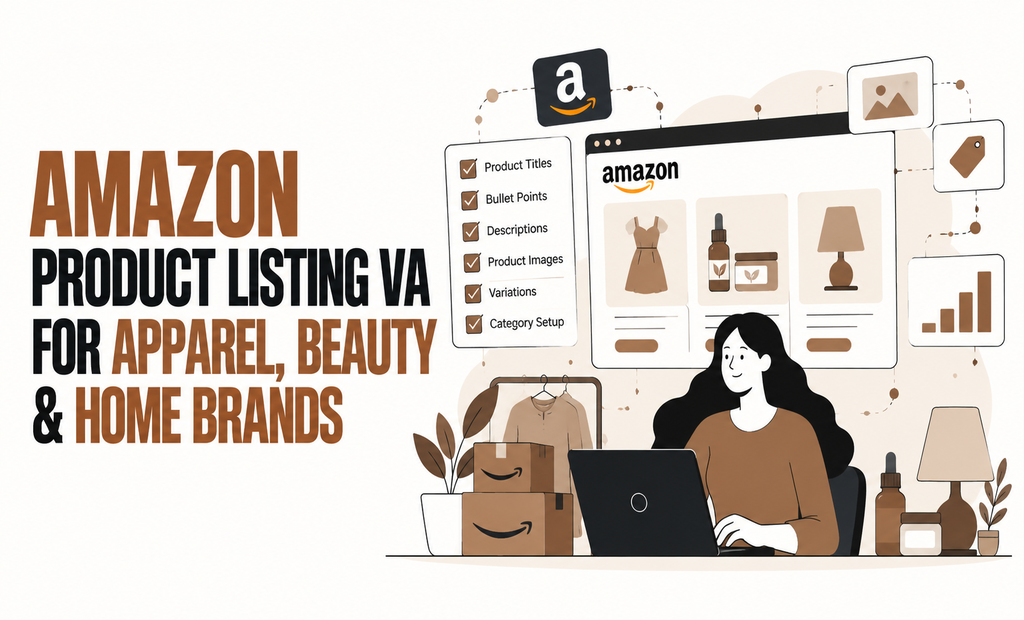
A Crew27 Amazon virtual assistant treats listing upkeep as an ongoing job, not a one-time clean-up. The work covers:
- New listings built from your data, templates, and brand guidelines
- Titles, bullets, and descriptions rewritten in your brand voice
- Backend search terms optimized and kept inside the byte limit
- Parent-child structures built and checked at the child level
- Categories, product types, and attributes updated, with missing fields flagged
- Bulk uploads and catalog updates for large or seasonal changes
- A quality check against your SOPs before anything publishes
You set which changes need your approval, and those reach you before anything publishes. Brands with a backlog can also hand over full Amazon catalog management, not just new listings.
If creating and updating listings is taking too much of your time, explore why product uploading takes so much time and how an e-commerce virtual assistant solves it.
Ready to Hand Off the Listing Work?
Tell Crew27 about your catalog and get matched with a listing VA who works to your templates and approval rules. Contact Crew27 Marketing to talk through your store.