

Traffic usually does not collapse overnight on TikTok Shop. It slides slowly first.
A product that was pulling steady orders suddenly starts slowing down. Affiliate videos stop converting the same way. Search visibility weakens. Livestream numbers flatten out. Most sellers immediately blame the algorithm, the content, or the product itself.
Then the real problem shows up inside Seller Center.
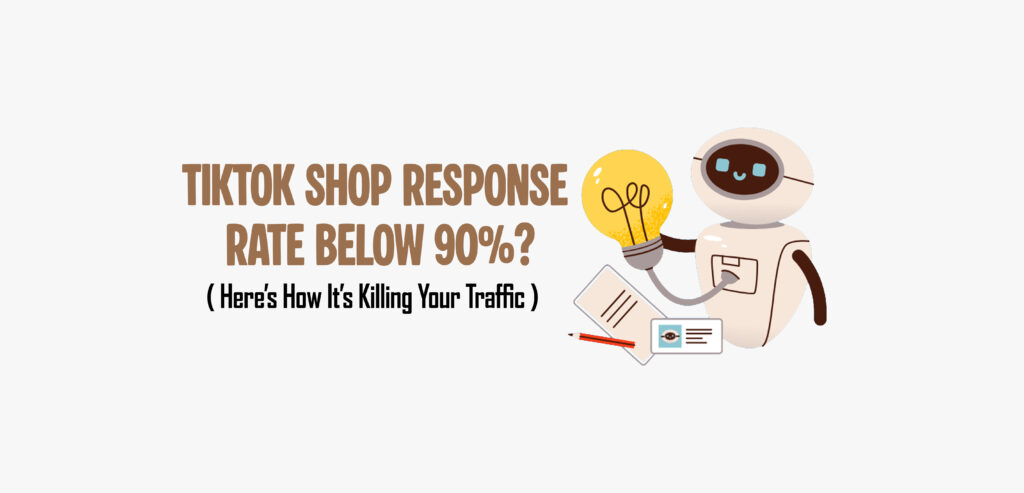
The 24-Hour Response Rate dropped below 90%.
At first glance, that metric looks harmless. Just another operational number buried inside the dashboard. But once it slips too far, TikTok starts treating the shop differently. Visibility drops. Campaign eligibility weakens. Product distribution slows down. And because it happens gradually, most sellers do not connect the traffic decline to the inbox until the damage is already happening.
The frustrating part is how easy it is for this metric to collapse.
A busy weekend. A few unanswered chats. A chatbot handling messages nobody manually followed up on. One viral video is creating more customer questions than the team can realistically manage. TikTok does not care why the replies were missed. The system only sees unanswered buyers.
And once the platform starts questioning how reliable a shop is, traffic gets pulled back fast.
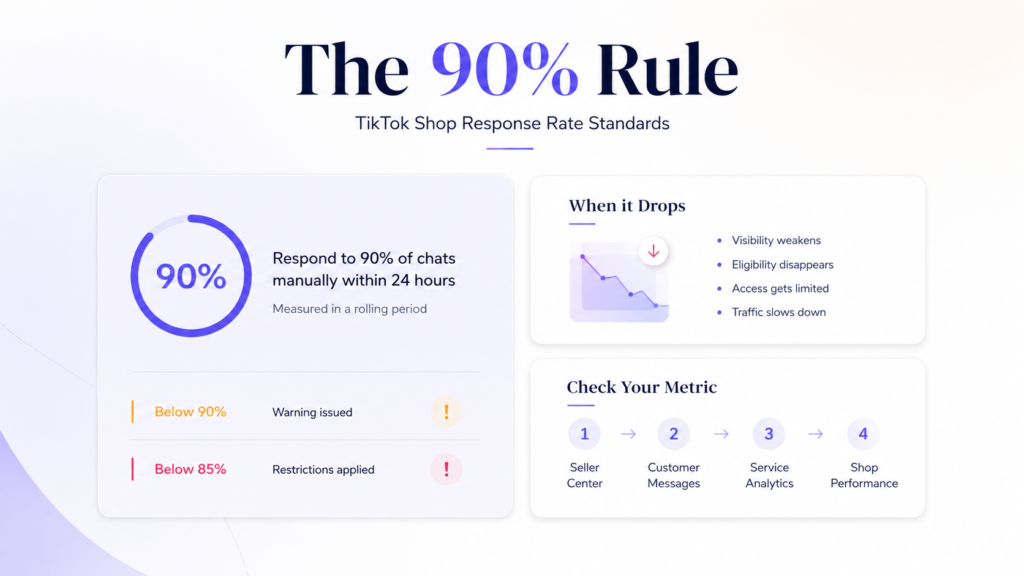
TikTok Shop now requires sellers to maintain a 24-Hour Response Rate of 90% or above. Falling below 90% triggers a warning. Falling below 85% can trigger additional enforcement actions that affect visibility, campaigns, and seller tools. As of 2026, automated replies no longer count toward this metric. Only manual human responses qualify.
Most sellers discover this after the traffic problem has already started.
The 90% rule is stricter than it sounds
TikTok measures how many customer chats receive a manual response within 24 hours. That sounds manageable until message volume starts increasing.
The platform is not asking for perfection. It is asking for consistency.
A shop receiving 100 customer messages in a rolling period needs to manually respond to at least 90 of them within the required timeframe to remain compliant. Once the number falls below that threshold, TikTok issues a formal warning. Drop below 85%, and the consequences stop being informational and start becoming operational.
That distinction matters.
The warning itself is not the real issue. The visibility loss that follows is.
TikTok does not publicly list every enforcement action connected to poor response rates, but sellers usually notice the same pattern when the metric slips too far:
- Product visibility weakens
- Campaign eligibility disappears
- Affiliate access becomes limited
- Flash Deal access gets restricted
- Recommendation: traffic slows down
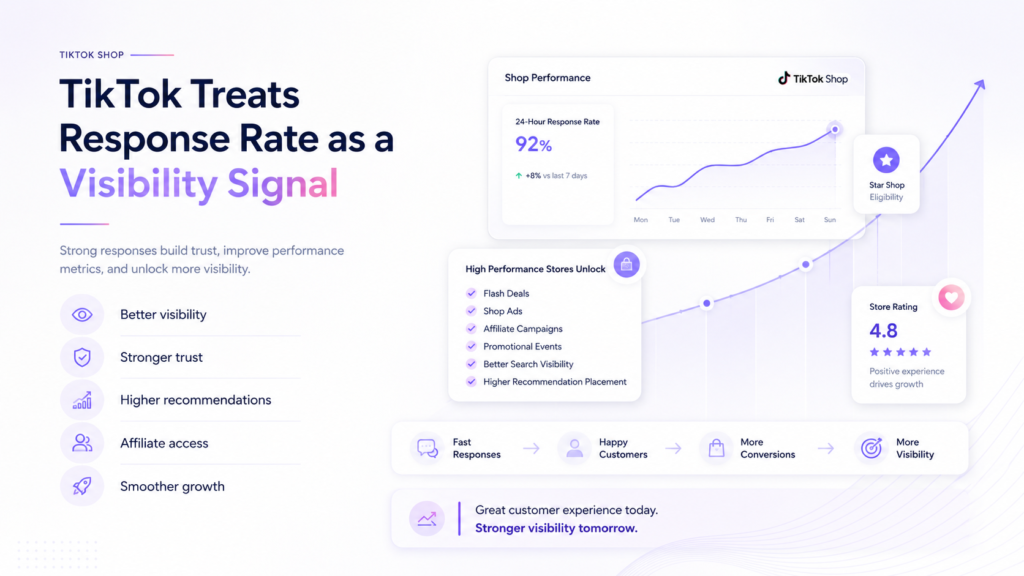
The platform treats response rate as a trust signal. Shops that ignore customers create friction for buyers, and TikTok is heavily focused on buyer retention right now. If customer experience looks unreliable, the algorithm becomes less willing to push those listings aggressively.
Checking the metric takes less than a minute:
Seller Center → Customer Messages → Service Analytics → Shop Performance
That dashboard usually tells the real story immediately. Most sellers sitting at 87% already know exactly what caused it before opening the analytics.
The missed chats are rarely random. They usually cluster around weekends, evenings, or sudden order spikes after a viral video.
The chatbot myth has quietly destroyed a lot of response rates
One of the biggest misconceptions on TikTok Shop right now is the belief that automation protects the response metric.
It does not anymore.
A lot of sellers set up FAQ automation, AI replies, or chatbot flows months ago and assumed the inbox was covered. Customers received instant answers, so operationally, everything looked fine. A buyer asked about shipping, the chatbot replied immediately, and the conversation appeared handled.
TikTok changed that calculation in 2026.
The platform now counts only manual human responses toward the 24-Hour Response Rate. Automated replies, including TikTok’s own recommended AI responses and FAQ flows, no longer satisfy the requirement.
That single policy shift exposed thousands of stores overnight.
A customer can receive an instant automated answer at 9 PM and still count as “unanswered” inside TikTok’s system if no human follows up within the required window.
From the seller’s side, that feels frustrating at first. From TikTok’s side, the logic is simple: automated acknowledgment is not the same as customer support.
The change happened because too many shops were using automation to create the appearance of responsiveness, while buyers were still struggling to get real help once anything complicated happened.
And honestly, the pattern became obvious across the platform.
Some stores had flawless chatbot coverage but terrible actual customer service. Refund requests sat untouched. Shipping problems bounced between canned replies. Customers got trapped in loops that looked efficient operationally but felt terrible from the buyer’s side.
TikTok closed that loophole deliberately.
Bots still help with first contact. They reduce buyer anxiety. They answer repetitive questions instantly. They buy time. But they are no longer enough to protect shop health on their own.
That means every store that is heavily relying on automation now needs actual human inbox coverage behind it.
What actually counts as a valid response?
This part confuses sellers constantly.
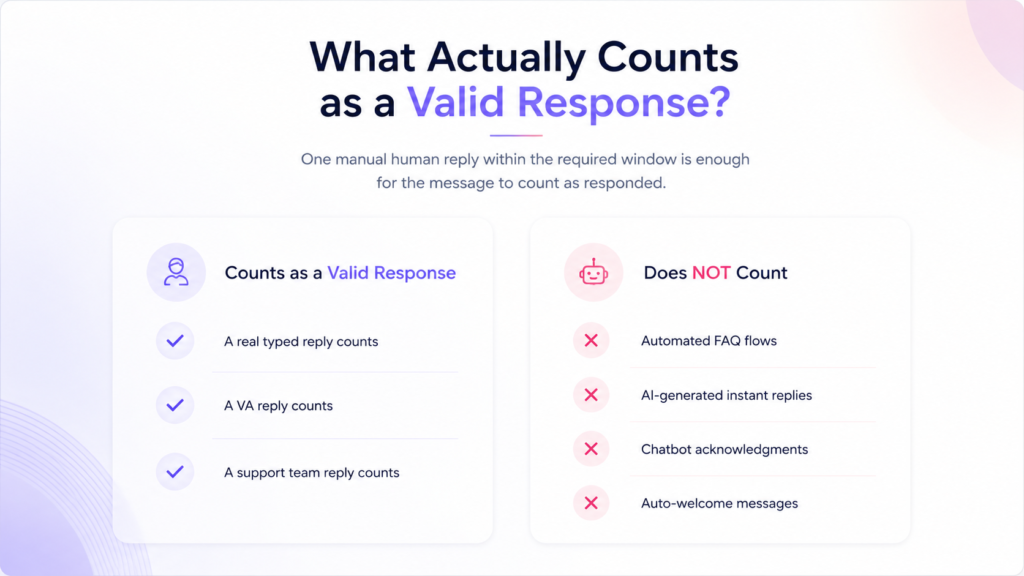
TikTok does not require a perfect customer support conversation to satisfy the metric. One manual human reply inside the required window is enough for the message to count as responded.
That means:
- A real typed reply counts
- A VA reply counts
- A support team reply counts
But these do not:
- Automated FAQ flows
- AI-generated instant replies
- Chatbot acknowledgments
- Auto-welcome messages
The platform is measuring human responsiveness, not automation coverage.
The change happened because too many shops were using automation to create the appearance of responsiveness, while buyers were still struggling to get real help once anything complicated happened.
And honestly, the pattern became obvious across the platform.
Some stores had flawless chatbot coverage but terrible actual customer service. Refund requests sat untouched. Shipping problems bounced between canned replies. Customers got trapped in loops that looked efficient operationally but felt terrible from the buyer’s side.
TikTok closed that loophole deliberately.
Bots still help with first contact. They reduce buyer anxiety. They answer repetitive questions instantly. They buy time. But they are no longer enough to protect shop health on their own.
That means every store that is heavily relying on automation now needs actual human inbox coverage behind it.
The weekend rule catches sellers constantly
Most response rate damage happens between Saturday morning and Monday noon.
Not because sellers are careless. Most e-commerce operations are still structured around weekday workflows, while TikTok customers shop seven days a week.
The platform’s weekend handling rules sound forgiving at first. Messages received from Saturday through Sunday are excluded from the normal 24-hour response window. A lot of sellers stop reading there and assume weekends are safe.
They are not.
TikTok still requires those weekend messages to receive manual replies by Monday, 12 PM local time. Miss that deadline, and those chats count against the response rate exactly like missed weekday messages.
This is where stores quietly damage their own visibility.
Saturday night messages pile up. Sunday becomes busy. Monday morning starts with fulfillment issues, inventory checks, creator communication, and ad monitoring. Customer messages slowly move lower on the priority list until noon passes and the metric takes the hit.
The math becomes brutal surprisingly fast.
A shop receiving 20 weekday messages daily and another 40 messages across the weekend cannot afford to ignore Saturday and Sunday coverage. Those weekend chats represent a huge percentage of total weekly conversations. Missing them creates a gap that the rest of the week often cannot recover from.
This is also why many sellers feel confused when weekday support looks strong, but traffic still drops.
The problem is usually sitting inside the weekend backlog.
Another operational reality experienced sellers notice quickly: viral videos almost always create support spikes outside normal business hours. The exact moment visibility increases is usually the exact moment inbox pressure becomes hardest to manage.
That creates a dangerous cycle:
- More visibility
- More customer questions
- Slower responses
- Lower response rate
- Reduced visibility
A lot of shops unknowingly throttle their own momentum this way.
TikTok treats response rate as a visibility signal
This is the part most sellers underestimate.
The response rate is not sitting inside Seller Center as a random compliance checkbox. It feeds into a larger system TikTok uses to decide which shops deserve more distribution.
TikTok’s ecosystem runs heavily on trust. The platform wants buyers to feel comfortable purchasing inside the app repeatedly. That means customer experience metrics directly influence visibility allocation.
The shops creating friction get pushed down.
The shops creating smooth buying experiences get pushed up.
That is where systems like Shop Performance Score, Account Health Rating, and Store Rating start overlapping operationally. Even when the 24-Hour Response Rate itself is not directly scored in every calculation, the consequences of poor responsiveness still spread into other performance signals that absolutely affect visibility.
Poor communication increases dissatisfaction.
Dissatisfied buyers leave weaker reviews.
Weak reviews reduce conversion rates.
Lower conversion rates weaken distribution.
TikTok may separate these systems inside policy documentation, but operationally, they feed into each other constantly.
And the rewards for maintaining strong shop health are significant.
Higher-performing stores gain access to:
- Flash Deals
- Shop Ads
- Affiliate campaigns
- Promotional events
- Better search visibility
- Higher recommendation placement
- Star Shop eligibility
The reverse is also true.
Stores with weak operational metrics gradually lose access to the exact tools that help generate sales in the first place.
That is why response rate problems rarely stay isolated. They spread into visibility, creator relationships, conversion performance, and revenue surprisingly quickly.
Affiliate creators notice operational weakness fast, too. Creators do not want to promote products tied to poor customer service because refunds, complaints, and buyer frustration eventually damage audience trust on their side as well.
Once creators stop pushing products aggressively, momentum slows even more.
That is usually when sellers realise the inbox was never “just customer support.”
It was part of traffic generation all along.
Traffic problems on TikTok Shop usually start as operational problems first.
Crew27 helps ecommerce brands manage customer support, marketplace operations, and TikTok Shop workflows before small gaps start affecting visibility and sales. Explore all marketplace support services.
Staying above 90% is not the same as operating well
A lot of shops aim for 90% simply because TikTok lists it as the minimum requirement.
That mindset usually creates reactive operations instead of stable ones.
Ninety percent is survival territory. It keeps warnings away. It does not create any meaningful operational advantage.
The stronger TikTok Shops usually operate between 95% and 100% consistently because they treat responsiveness as infrastructure, not damage control.
There is also a second metric many sellers ignore while obsessing over the percentage itself: response time.
A store technically replying within 23 hours still qualifies as compliant. Operationally, that is a weak customer experience. TikTok buyers expect speed because the platform itself moves fast. Long delays create hesitation immediately, especially for impulse purchases.
The strongest-performing shops usually respond within a few hours during active business windows, not because TikTok explicitly demands it, but because conversion rates improve when buyers feel someone is actually present behind the store.
That responsiveness becomes even more important during promotions, viral spikes, and affiliate campaigns where hesitation compounds quickly.
The stores scaling cleanly on TikTok rarely treat customer support as an afterthought.
They treat it as part of conversion optimisation.
Recovering the metric is less complicated than most sellers think
Most sellers expect a complicated recovery process once the response rate falls.
It is actually much simpler than expected.
The difficult part is not strategy. It is consistency.
The first step is to open the analytics and identify exactly where the failures are occurring. Most shops already know the answer before checking:
- Evenings
- Weekends
- Viral spikes
- Understaffed support windows
The next step is building fixed response routines instead of relying on memory.
A morning inbox check and an evening inbox check solve a surprising amount of the problem for smaller stores. That alone usually catches the majority of conversations within the required timeframe.
Then comes the part sellers avoid because it sounds operational instead of exciting: weekend coverage.
The weekend gap has to be solved permanently. Not temporarily. Not emotionally. Permanently.
Otherwise, the same cycle repeats every week.
Another thing experienced sellers learn quickly is that spam and irrelevant chats still need handling. Ignoring them without marking them correctly inside Seller Center still affects the metric. TikTok allows sellers to flag conversations as “no response needed,” but the process has to be completed properly before the response window closes.
Small operational habits matter a lot on TikTok Shop because the platform measures consistency aggressively.
Eventually, most growing shops hand this off to a dedicated VA
There is a point where founders stop being able to manage the inbox personally without sacrificing something else important.
Usually, that point arrives right after growth starts working.
More orders create more customer questions. More affiliate campaigns create more shipping conversations. More visibility creates more operational pressure. The exact moment a store starts scaling is usually the exact moment support systems begin breaking.
That is why serious TikTok Shop sellers eventually move inbox management into dedicated operational support instead of treating it like leftover admin work.
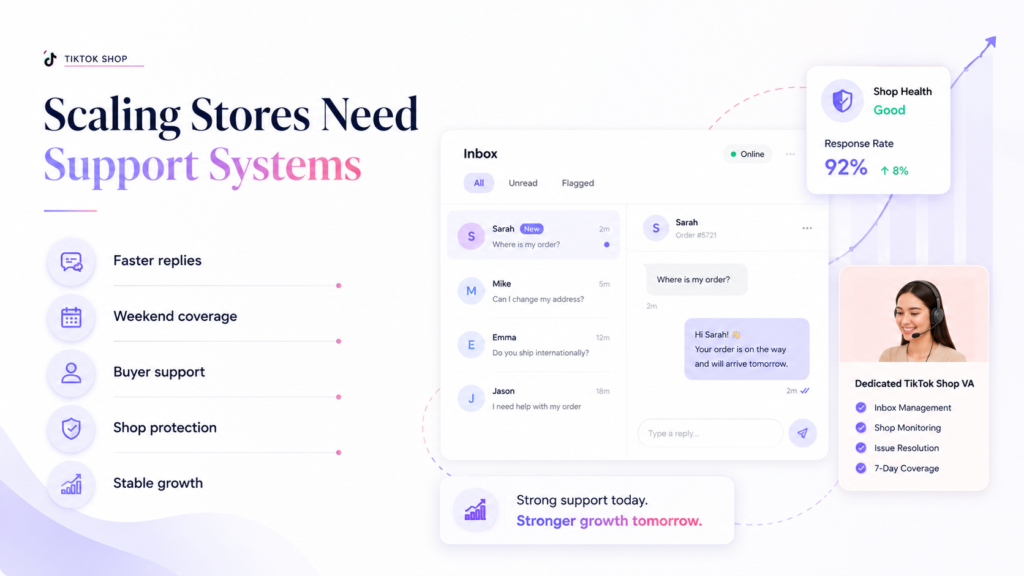
A trained TikTok Shop VA is not just replying to messages.
They are:
- Protecting response rate compliance
- Monitoring Shop Health dashboards
- Handling pre-sale buyer questions
- Managing post-purchase support
- Escalating genuine issues quickly
- Catching weekend deadlines
- Protecting campaign eligibility
- Preventing visibility loss
And honestly, weekend coverage alone changes everything operationally for a lot of stores.
For sellers already struggling with response rate consistency, Crew27’s TikTok Shop VA service offers both weekday-only and full 7-day coverage, depending on inbox volume and operational needs.
Some stores only need weekday support.
Others need full weekend protection because TikTok’s inbox pressure does not stop on Friday evening anymore.
Neither does the algorithm.
Most shops recover faster once the inbox finally has structure
Response rate feels catastrophic while it is falling because traffic loss becomes emotional quickly.
The recovery itself is usually much less dramatic.
Once manual responses become consistent again, the rolling calculation starts improving within days. Stores sitting at 82% or 85% can often recover above 90% surprisingly quickly once coverage gaps disappear.
The important thing is understanding that recovery is operational, not motivational.
Nothing changes because the team “tries harder.” It changes because the inbox finally has structure behind it.
That distinction matters.
TikTok Shop rewards stores that behave like reliable businesses, even when the platform itself feels chaotic. The shops consistently holding visibility are usually not the ones with the flashiest branding or the biggest creator budgets.
A lot of the time, they are simply the ones answering their messages properly while everyone else assumes the chatbot handled it.
What happens if a TikTok Shop response rate falls below 90%?
When a TikTok Shop response rate drops below 90%, the platform issues a formal warning. If the rate falls below 85%, additional enforcement actions may apply, including reduced visibility, restricted campaign access, and limitations on seller tools. Low response rates can also affect customer trust, which signals that influence traffic distribution across the platform.
Do chatbot replies count toward TikTok Shop response rate?
No. As of 2026, TikTok only counts manual human responses toward the 24-Hour Response Rate metric. Automated replies, FAQ flows, and AI-generated responses do not qualify. A human reply must still be sent within the required timeframe for the conversation to count as answered.
How do weekend messages affect TikTok Shop response rate?
Messages received between Saturday and Sunday are excluded from the normal 24-hour response window, but they still need to be answered manually by Monday at 12 PM local time. Missing that Monday deadline can negatively affect the response rate just like a missed weekday message.
How can sellers check their TikTok Shop response rate?
Sellers can check the metric inside Seller Center by going to Customer Messages → Service Analytics → Shop Performance. The dashboard shows the current 24-Hour Response Rate along with late-response and unanswered chat data.