

Why Most TikTok Shop Traffic Problems Are Structural, Not Content Problems
Most TikTok Shop sellers trying to fix their traffic spend their energy on the wrong thing.
They spend hours improving videos, testing hooks, buying better equipment, and chasing the latest trends. Then they post consistently for weeks and wonder why traffic barely changes.
The frustrating part is that the content often isn’t the problem.
A pattern shows up in underperforming TikTok Shops all the time. The videos are usually good enough. Some are actually very good. The issue is that the shop isn’t giving TikTok enough signals to justify wider distribution.
At Crew27 Marketing, we’ve seen stores spend months trying to solve a traffic problem with content when the real issue was somewhere else entirely.
TikTok Shop traffic doesn’t increase simply because a video is interesting. The platform looks for signals that tell it people are engaging and buying. That could be viewers watching until the end, creators actively promoting products, listings that are properly optimised for Shop Tab search, or strong customer experience metrics that build trust with the platform.
What’s interesting is how often traffic improves without any major change to the content itself.
A listing gets optimized. An affiliate program becomes active. A response rate issue gets fixed. Suddenly, the same type of videos starts reaching more people and generating more sales.
That’s why treating TikTok Shop as a content problem is often the wrong approach.
More often, it’s a systems problem disguised as a traffic problem.
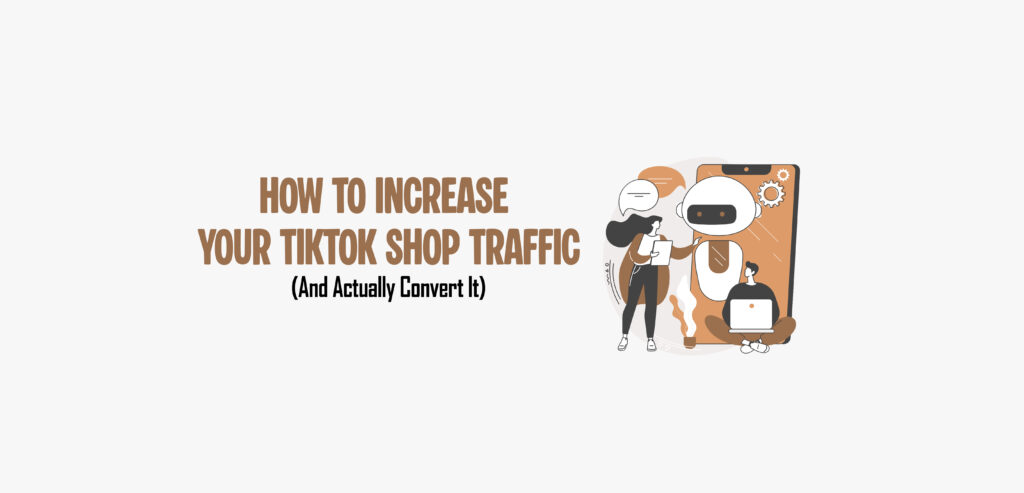
How to Increase TikTok Shop Traffic in 2026
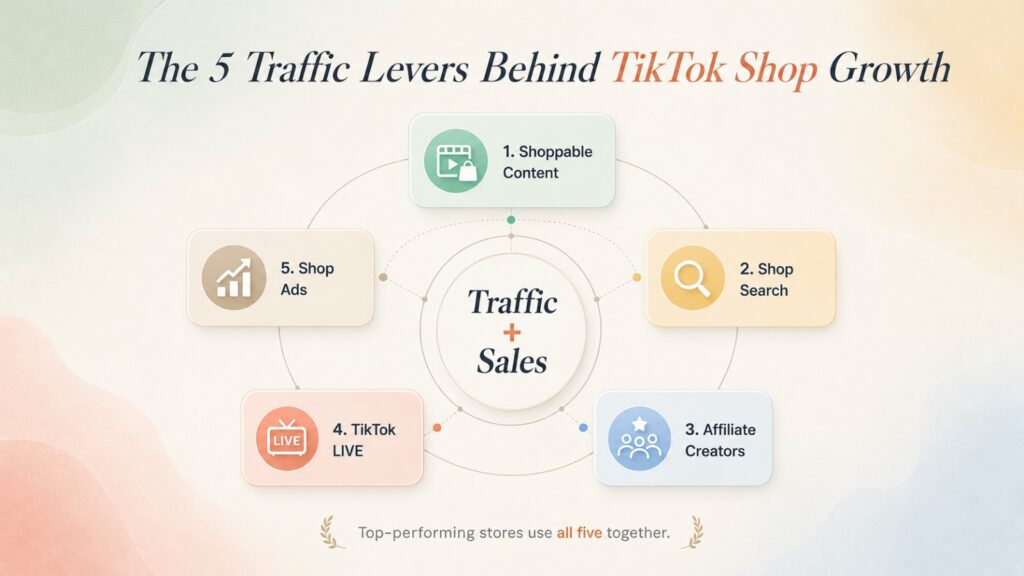
TikTok Shop traffic comes from five primary sources: organic For You Page distribution through shoppable videos, the Shop Tab’s native search engine, affiliate creator content, TikTok Shop LIVE sessions, and paid Shop Ads. Sellers who grow traffic consistently work all five in parallel rather than relying on a single channel.
In this guide, we’ll break down:
- The five traffic levers that actually move the needle on TikTok Shop
- How to optimise listings for the Shop Tab search engine
- Why affiliate creators outperform most paid traffic channels
- How shop health quietly influences visibility and distribution
The goal isn’t just more views. It’s attracting people who are actually ready to buy.
Fix the Foundation First: Your Listing Is Either Attracting or Repelling Traffic
Before changing your content strategy, check your listings.
This sounds obvious, but it’s one of the most overlooked areas in TikTok Shop. Sellers will spend days analysing content performance while product listings haven’t been touched in months. The problem is that TikTok has its own search engine inside the Shop Tab, and that search engine relies heavily on listing quality to decide which products deserve visibility.
A weak listing doesn’t just convert poorly. It often struggles to get discovered in the first place.
Think about how people use TikTok today. A growing number of shoppers aren’t waiting to discover products through their feed. They’re actively searching. They type phrases like “portable blender for gym,” “magnesium spray for sleep,” or “dog hair remover for couch,” and expect relevant products to appear.
If your listing doesn’t help TikTok understand what you’re selling, you’re invisible to some of the highest-intent traffic on the platform.
TikTok Shop Title SEO: The Most Important Field in Your Listing
If there is one field worth spending extra time on, it’s the title.
TikTok’s search engine has become significantly better at understanding natural language. Unlike older e-commerce platforms that relied heavily on exact-match keywords, TikTok increasingly interprets products the way people describe them in real conversations.
That means a title should sound like something a buyer would actually search for.
A simple formula that works well is:
Core product keyword + benefit or specificity + use case
For example:
Magnesium Sleep Spray: Fast Absorbing, For Restless Nights
That title immediately tells TikTok what the product is, what benefit it offers, and who might be looking for it.
Now compare that to:
Magnesium Spray Supplement Sleep Aid Organic Formula Fast Acting
It contains more keywords, but it reads like it was written for a search engine instead of a customer.
One thing that’s become increasingly clear over the past year is that over-optimisation often hurts performance. Listings that sound natural tend to perform better than listings stuffed with every keyword variation imaginable. Many of the same principles discussed in modern TikTok Shop SEO strategy guides still apply today.
Product Videos on Listing Pages Are No Longer Optional
A surprising number of sellers still treat listing videos as a nice-to-have.
They’re not.
When comparing high-performing and low-performing shops, one difference appears repeatedly. Strong stores almost always have product videos attached directly to their listings. Weak stores often rely on static images alone.
The video doesn’t need fancy editing. It doesn’t need transitions or trending music. It simply needs to show the product clearly and demonstrate a visible benefit within the first few seconds.
That’s because TikTok isn’t evaluating the video the way a filmmaker would. It’s evaluating whether buyers understand the product quickly enough to stay interested.
One of the clearest patterns across successful TikTok Shops is that listings with product videos consistently convert better than image-only listings. For many sellers, adding a simple demonstration video is the highest-return optimisation they’ll ever make.
The difference between a store converting at 1% and a store converting at 5% often isn’t a secret marketing tactic. It’s basic fundamentals executed properly.
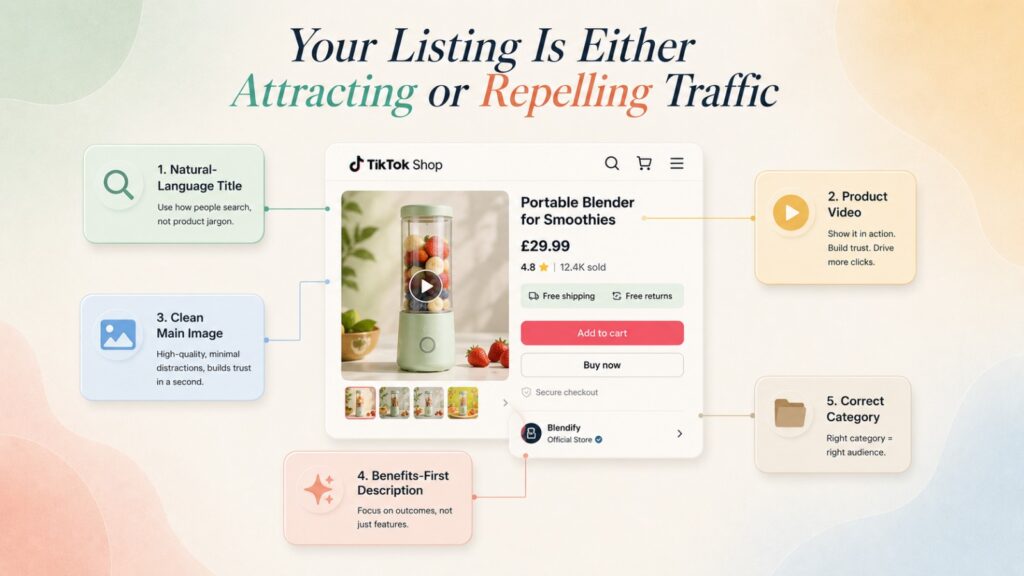
The Five Listing Elements to Audit Before Anything Else
Before creating another content calendar, go through every active listing and check the basics.
- The title uses natural language and reflects how customers actually search
- The primary image is clean, clear, and focused entirely on the product
- At least one product video shows the product being used
- The description leads with a benefit, not a list of specifications
- The product category is correctly assigned
None of these changes is particularly exciting. That’s probably why they’re ignored so often.
But listings are the foundation that everything else sits on. When they’re weak, every traffic strategy becomes harder. When they’re strong, even average content has a better chance of performing.
Once your listings are searchable and conversion-ready, the next challenge is getting TikTok to distribute your content in the first place.
That’s where the first major traffic lever comes in.
Traffic Lever #1: Shoppable Content That the Algorithm Actually Distributes
One of the easiest traps to fall into on TikTok Shop is assuming that good content automatically gets reach.
It doesn’t.
Anyone who has spent enough time managing TikTok Shops has seen this happen. A brand spends hours filming, edits everything perfectly, follows a trend at the right moment, posts with confidence, and gets a few hundred views. Then another creator uploads a simple product demo filmed in their kitchen and somehow generates thousands of views and sales.
The difference usually isn’t production quality.
It’s the audience response.
TikTok’s algorithm doesn’t care how much effort went into creating a video. It cares about what viewers did after seeing it. Did they keep watching? Did they share it? Did they comment? Did they click through to the product?
Those signals determine distribution far more than editing quality ever will.
The Three Signals That Actually Matter
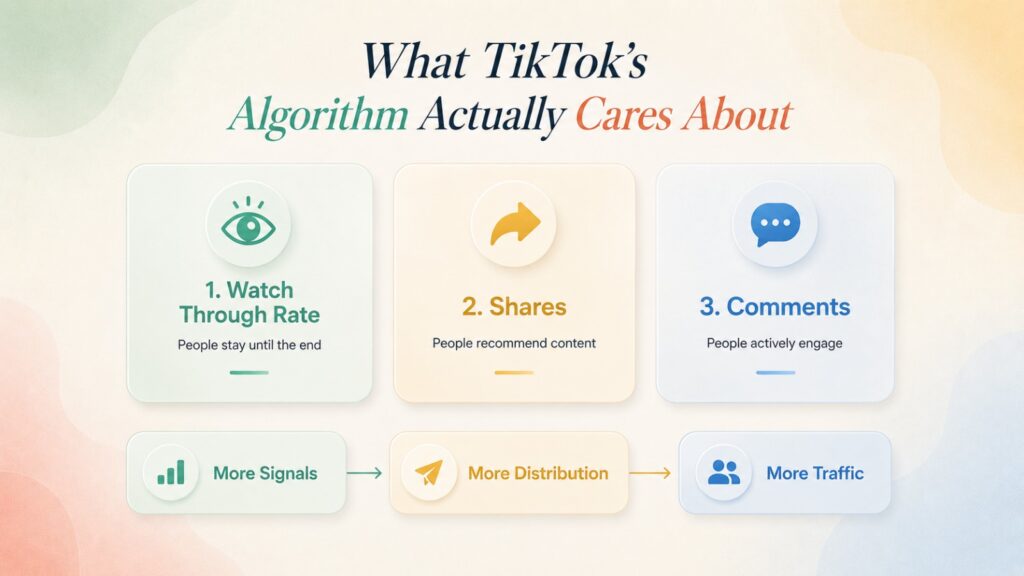
TikTok tracks hundreds of metrics, but when looking at videos that consistently generate reach, three signals show up over and over again.
The first is Watch Through Rate. This measures how many viewers stay until the end of a video. TikTok has repeatedly indicated through its seller education materials that watch time is one of the strongest indicators of content quality because it tells the platform whether viewers found the video interesting enough to keep watching.
The second is Forward Rate, which measures how often viewers share a video. Shares tend to carry more weight than likes because they’re intentional. Someone tapping the share button is effectively telling TikTok that another person should see this content too.
The third is Engagement Rate, particularly comments. An active comment section tells TikTok that the content sparked a reaction rather than being passively consumed. That’s one reason videos with lots of questions, opinions, or discussions often continue receiving reach long after they’re posted.
What’s important is that none of these signals exists without a strong opening.
Most Sellers Start Their Videos in the Wrong Place
A surprising number of TikTok Shop videos open with the product itself.
The creator holds up the item, introduces the brand, explains what it is, and only later gets to the result.
By that point, many viewers are already gone.
The videos that perform best usually take the opposite approach. They show the outcome first and explain the product second.
The viewer immediately understands why they should care, which makes them more willing to stay for the explanation.
The Hook Structure That Still Works in 2026
Most high-performing TikTok Shop videos follow a surprisingly similar pattern.
During the first three seconds, they show the result, transformation, or problem being solved. They don’t waste time introducing the brand or explaining features.
Over the next ten seconds, they demonstrate how the product creates that result. The viewer starts connecting the outcome they saw with the product being shown.
The final section introduces the product link and a direct call to action. One detail many sellers overlook is that verbal calls to action still matter. Simply saying “Shop now” or “Check the product link” often improves conversion rates because it tells interested viewers exactly what to do next.
Consistency Beats Creativity More Often Than People Expect
A lot of brands spend weeks trying to create the perfect TikTok.
Meanwhile, other brands are quietly posting four or five solid videos every week and building momentum.
That’s usually the better strategy.
For most TikTok Shops, four to six posts per week is a realistic baseline. More important than volume, though, is variety.
The accounts that continue growing rarely post the same style of video repeatedly. They mix product demonstrations, before-and-after content, customer questions, creator content, and problem-solution videos. That variety gives TikTok more signals to work with and helps prevent content fatigue.
Once content starts performing, the next challenge is scale.
Because no matter how consistent a brand account becomes, it can only reach so many people on its own.
That’s where affiliate creators completely change the equation.
Traffic Lever #2: The Affiliate Creator Pipeline Most Sellers Never Fully Build
One of the biggest misconceptions about TikTok Shop is that traffic has to come from your own account.
It doesn’t.
Some of the fastest-growing TikTok Shops generate a significant portion of their sales through creators who aren’t employees, influencers under contract, or part of the brand team. They’re affiliate creators earning commission on every sale they generate.
Tarte Cosmetics is one of the most frequently cited examples. A large percentage of its TikTok Shop revenue has been attributed to affiliate creator activity rather than brand-owned content. While most sellers won’t operate at that scale, the underlying lesson still applies.
Creators are often the most powerful distribution channel available inside TikTok Shop.
The reason is simple.
Every creator brings their own audience, their own trust, and their own content style. Instead of relying on one account to generate traffic, you suddenly have dozens or even hundreds of people introducing your product to different groups of buyers.
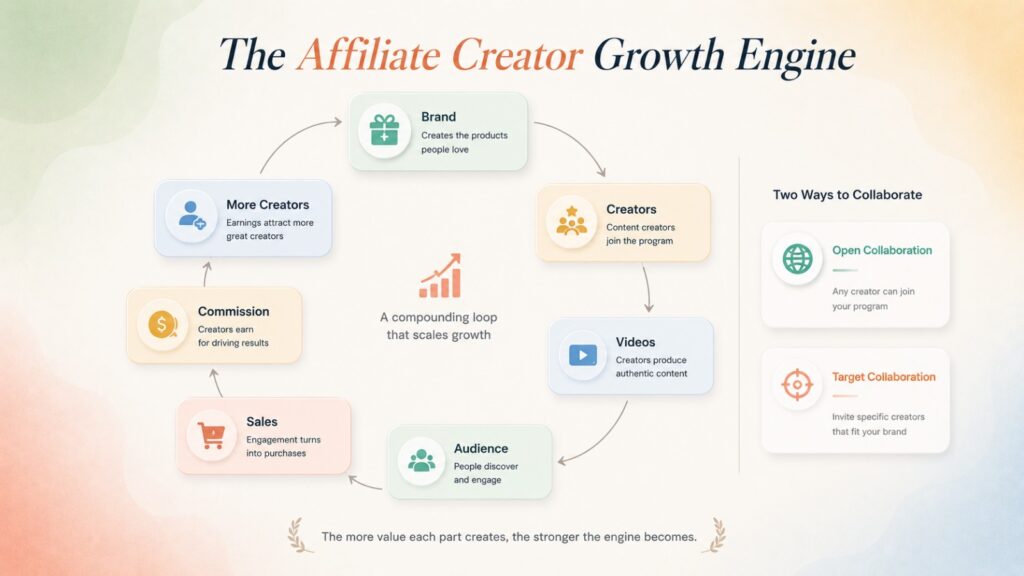
Open Collaboration vs Target Collaboration
Most sellers start with Open Collaboration because it’s easier.
Creators browse available products, request samples, and apply to promote them. You set the commission rate and only pay when sales happen.
Some creators produce excellent content. Others never post. A few create videos that don’t represent the product particularly well.
That’s why many experienced sellers eventually add Target Collaboration alongside Open Collaboration.
Instead of waiting for creators to find the product, they actively approach creators who already create content in the right niche. It takes more work, but the quality of partnerships is usually much higher.
The strongest affiliate programs tend to use both approaches simultaneously. Open Collaboration creates scale. Target Collaboration creates consistency.
The Commission Mistake That Slows Creator Recruitment
Many sellers set commissions based entirely on margin calculations.
Creators are constantly choosing between different products to promote. If one product offers a 6% commission and another offers 15%, the decision becomes fairly straightforward.
That doesn’t mean every product should permanently offer high commissions. A strategy that often works well is using a promotional rate during the first month and then moving to a sustainable baseline later.
A temporary increase creates urgency and gives creators a reason to prioritise your product over competing offers.
The Part Most Sellers Underestimate
Recruiting creators is only the beginning.
Managing them is where the real work starts.
A pattern appears repeatedly with growing brands. They focus heavily on recruiting creators and almost completely ignore relationship management.
In many cases, nothing actually went wrong. Nobody followed up. Nobody shared performance results. Nobody built a relationship beyond the first piece of content.
Creators who feel invested tend to post more often and create better content. Creators who feel forgotten usually move on to the next brand.
The operational reality is that a healthy affiliate program can easily consume ten or more hours every week. Tracking applications, approving creators, sending samples, reviewing performance, and maintaining communication quickly becomes a full-time responsibility.
It’s also one of the first growth functions that starts breaking once the business owner tries to manage everything alone.
And that’s exactly why the next traffic lever becomes so powerful.
Instead of waiting for creators to post content after the fact, you start generating traffic in real time.
Traffic Lever #3: TikTok Shop LIVE Is Probably More Important Than You Think
A lot of sellers treat TikTok LIVE as something they’ll figure out later.
They focus on videos first, affiliate creators second, and then maybe consider LIVE once the store is bigger.
That usually ends up being a missed opportunity.
LIVE shopping is consistently one of the highest-converting formats on TikTok Shop because it combines discovery, engagement, and purchasing into the same experience. Someone can discover a product, ask a question, see a demonstration, and place an order without ever leaving the session.
TikTok knows this. That’s one reason the platform tends to give LIVE sessions additional visibility when they’re generating engagement and product activity in real time.
The first few minutes matter more than most sellers realise.
That’s why announcing your LIVE beforehand is so important. A simple video posted 12 to 24 hours before the session can make a noticeable difference in how the stream performs.
A few practical habits also make a difference:
- Pin the product you’re discussing so viewers can find it instantly.
- Mention offers clearly rather than assuming people will notice them.
- Create LIVE-only deals that give viewers a reason to buy now instead of later.
- Keep answering questions, even if they seem repetitive.
For most sellers, two LIVE sessions per week is a good starting point. The brands that make LIVE a major growth channel often go much further and run shorter sessions several times throughout the week.
Traffic Lever #4: Use Ads to Amplify Winners, Not Rescue Losers
One mistake shows up constantly when sellers decide to invest in TikTok Shop Ads.
Traffic slows down, sales aren’t where they want them to be, and ads become the solution.
The problem is that ads rarely fix weak foundations.
If a product isn’t converting organically or a video isn’t holding attention, paying to push it harder usually just means spending money to get the same disappointing result faster.
The shops that get the best results from TikTok ads tend to follow a different sequence.
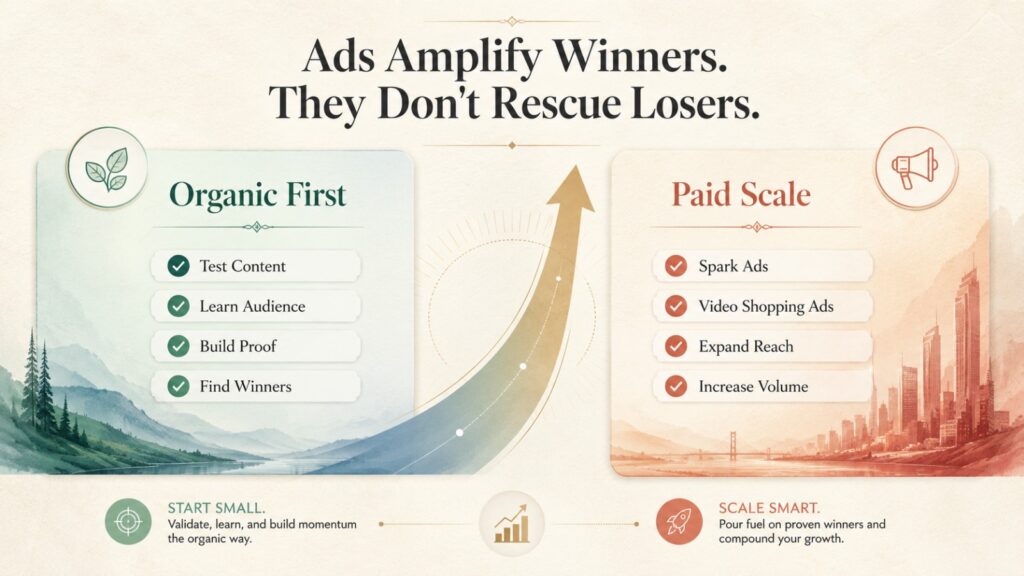
They start with organic content. They watch which videos generate strong watch time, engagement, clicks, and product interest. Then they put advertising budget behind the content that’s already proving it can attract buyers.
That’s where Spark Ads become valuable.
Instead of creating something that feels like a traditional advertisement, Spark Ads allow you to boost content that already exists. The content keeps its native feel, which is important because TikTok users generally respond better to videos that look like TikTok than videos that look like ads.
Once a store has enough data to understand what’s working, Video Shopping Ads can help expand reach further and introduce products to new audiences.
One final thing worth remembering: TikTok can be volatile day to day. Looking at yesterday’s ROAS and making major decisions usually creates more problems than it solves. Weekly trends tell a much clearer story than daily fluctuations.
Traffic Lever #5: The Shop Health Metric That’s Quietly Affecting Your Traffic
Most sellers think traffic and operations are two separate things.
On TikTok Shop, they’re connected much more closely than people realise.
A store can have decent products, decent content, and decent creator activity, yet still struggle to gain traction because TikTok doesn’t fully trust the shopping experience it’s providing customers.
That’s where Shop Performance Score, or SPS, enters the picture.
SPS acts as a trust signal. TikTok uses it to evaluate how reliably a store serves customers after the sale. The stronger the score, the more confidence the platform has in sending additional buyers your way.
It’s influenced by things such as:
- On-time order dispatch
- Negative review rates
- Return rates
- Customer service quality
- After-sales handling
- IM Dissatisfaction Rate
And this is where many traffic problems start revealing themselves.
One metric deserves special attention here: response rate.
A surprising number of sellers don’t realise how quickly response rate issues can affect customer experience metrics. If you haven’t reviewed yours recently, reaks down exactly what TikTok’s 90% response rate benchmark means, why it matters, and what can happen when a shop consistently falls below it.
The uncomfortable truth is that some traffic problems aren’t content problems at all.
They’re customer service problems wearing a content problem disguise.
If you’re unsure whether traffic is being limited by content, listings, creator activity, or shop health, contact us, and we’ll help identify where the bottleneck is before you spend time fixing the wrong thing.
Why Most Sellers Cannot Sustain All Five Levers Simultaneously
At this point, it’s worth stepping back and looking at what this framework actually requires.
Not in theory. In practice.
You’re posting four to six shoppable videos every week and keeping an eye on performance. You’re reviewing creator applications, sending samples, following up with affiliates, and tracking who’s actually generating sales. You’re planning and running LIVE sessions, monitoring ad spend, checking shop health metrics, responding to customer messages, and making sure your response rate stays above 90%, including weekends.
That isn’t a content strategy anymore.
It’s an operations function.
One thing becomes obvious when looking at TikTok Shops that scale consistently. The founder usually isn’t doing all of this themselves. The day-to-day execution is often handled by someone responsible for keeping all the moving parts moving.That’s where a trained TikTok Shop VA becomes valuable.
What Realistic Traffic Growth Actually Looks Like
One reason sellers quit too early is that they expect TikTok Shop traffic to behave like a light switch.
That’s not how it usually works.
TikTok needs time to understand your products, your audience, and the types of content people respond to. Most stores that eventually build steady traffic spend several weeks laying the groundwork before seeing meaningful results.
A realistic timeline for many sellers is somewhere between six and ten weeks of consistent execution. That’s assuming they’re posting regularly, maintaining affiliate activity, keeping listings updated, and running LIVE sessions rather than relying on a single traffic source.
During that period, focus on weekly trends rather than daily fluctuations.
The metrics worth tracking are:
- Organic shop visits
- Product page views from Shop Tab search
- Creator-attributed sales
- LIVE session engagement and product clicks
- Response rate
- Shop Performance Score
One pattern worth remembering is this: if shop visits suddenly fall more than 35% below your recent average and your posting frequency hasn’t changed, don’t immediately assume the content stopped working.
Check the shop’s health first.
A declining SPS or response rate issue can reduce visibility in ways that look exactly like content underperformance from the outside.
A 30-Minute Audit Before You Do Anything Else
Before creating another content calendar, recruiting creators, or increasing ad spend, spend thirty minutes checking the foundations.
These are the conditions that either allow traffic growth or quietly prevent it.
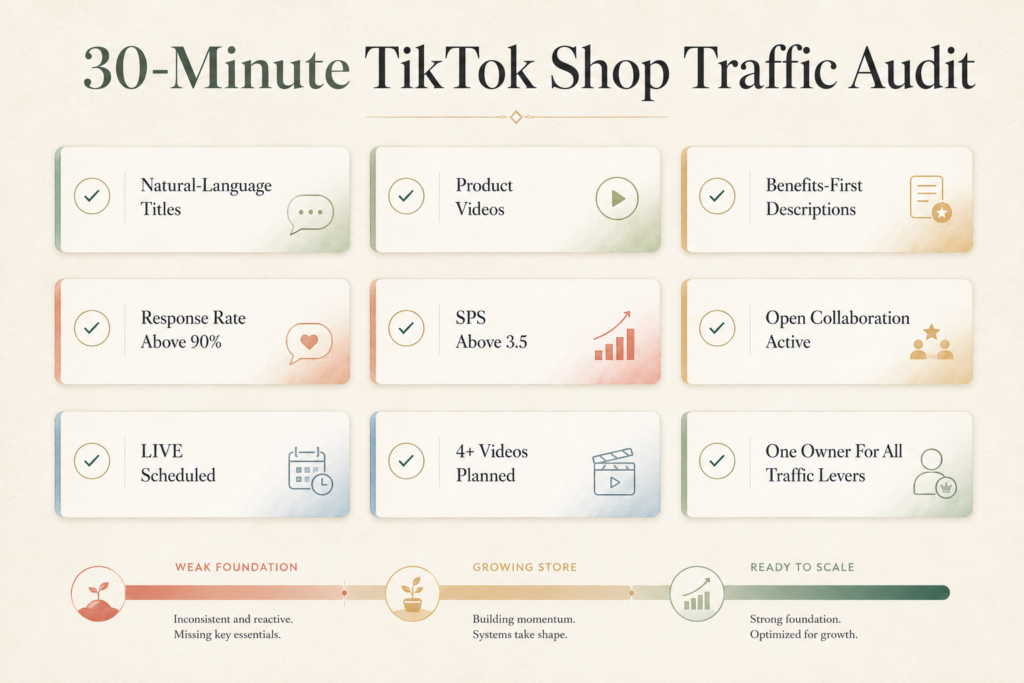
TikTok Shop Traffic Audit Checklist
✓ Every active listing has a natural-language title that matches how customers search
✓ Every active listing includes at least one product video showing a clear benefit
✓ Product descriptions lead with benefits rather than technical specifications
✓ All chatbot and customer service automations are active inside Seller Centre
✓ 24-Hour Response Rate is currently above 90%
✓ Shop Performance Score is above 3.5
✓ Open Collaboration is active with a competitive commission structure
✓ At least one LIVE session is scheduled within the next seven days
✓ A content schedule exists for at least four videos this week
✓ Someone is accountable for all five traffic levers: content, affiliates, LIVE, ads, and shop health
That last point tends to be the hardest one.
Most sellers know what needs to happen.
The real question is who is actually responsible for making sure it happens every week.
Traffic on TikTok Shop Isn’t a Mystery
The shops that consistently grow aren’t discovering secret hacks or chasing algorithm rumours.
They’re doing the fundamentals well.
Their listings are built for search. Their content is designed to hold attention. Their affiliate creators are actively generating sales. Their LIVE sessions create engagement in real time. And their shop health metrics tell TikTok that customers are having a positive experience.
If you want all five traffic levers running without having to manage them personally, TikTok Shop VA Service can help with listing management, creator outreach, affiliate tracking, shop health monitoring, customer communication, and performance reporting.
Not sure which of the five levers is holding your store back? Book a free consultation, and we’ll identify which of the five traffic levers is currently limiting your growth.
How do I get more traffic to my TikTok Shop?
Traffic on TikTok Shop comes from five main sources: shoppable content distributed through the For You Page, visibility inside Shop Tab search, affiliate creator content, TikTok LIVE sessions, and paid Shop Ads. The biggest opportunity for most stores is improving listings and activating an affiliate program because both continue generating traffic long after the initial work is done.
Why is my TikTok Shop not getting views?
Most traffic problems are structural rather than creative. Poorly optimised listings, missing product videos, low Shop Performance Scores, inactive affiliate programs, and weak response rates can all reduce visibility. Before changing your content strategy, review your Shop Health dashboard and listing quality.
Does posting more on TikTok increase shop traffic?
Yes, but only up to a point. Posting four to six times per week generally gives TikTok enough data to understand your audience and improve distribution. Consistency matters far more than occasional bursts of activity. A store that posts steadily for eight weeks usually outperforms a store that posts heavily for one week and disappears the next.
How do I get TikTok creators to promote my products?
Start by activating Open Collaboration inside TikTok Seller Center and offering a commission rate that makes the opportunity attractive. Make sure your listings have strong images, product videos, and positive reviews. Once creators begin generating sales, focus on building direct relationships with your best performers through targeted outreach and custom collaboration offers.
How long does it take to see results from TikTok Shop traffic strategies?
Most sellers start seeing meaningful traction between six and ten weeks of consistent effort. TikTok’s algorithm needs enough engagement and conversion data to understand who should see your products. Stores that combine content, affiliate activity, LIVE sessions, and strong shop health tend to reach that tipping point much faster than stores relying on content alone.