

Growth sounds exciting until the business starts needing more people to keep up with it.
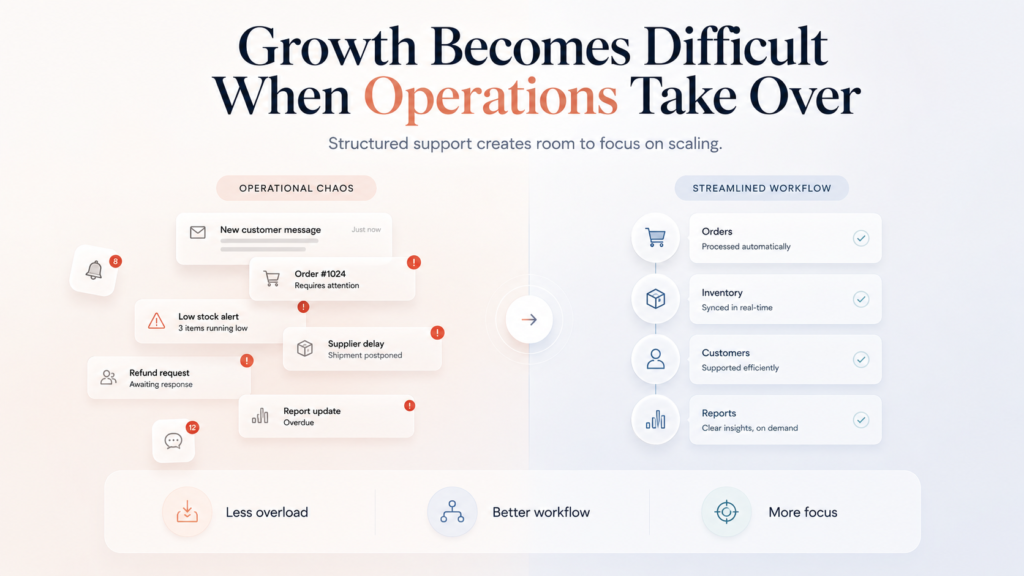
What used to feel manageable suddenly starts becoming operational chaos. Customer support takes longer. Product uploads keep getting delayed. Orders need constant attention. Small backend tasks begin consuming more time than actual growth.
That is usually the point where e-commerce founders start asking a difficult question:
Do you hire a full-time employee or bring in an e-commerce VA?
Most people think this comes down to comparing salary against a monthly retainer.
But the real numbers are much bigger than that.
A full-time ecommerce employee in the US typically costs between $66,000 and $108,000 per year once payroll taxes, benefits, onboarding, equipment, software, and operational overhead are fully included. An e-commerce VA, on the other hand, usually costs between $400 and $2,500 per month, depending on workload and scope.
For stores doing somewhere between $10K and $50K per month in revenue, that difference can easily mean saving $40,000 to $70,000 per year while still getting the operational support the business needs to keep growing.
But cost alone is not the full story.
Some businesses genuinely need in-house hires. Others end up adding expensive overhead too early when operational support is really all they need.
This guide breaks down the real cost behind both options so you can make a smarter decision based on where your store is right now.
Why Most Store Owners Get This Comparison Wrong
The biggest mistake store owners make is comparing a VA’s monthly retainer to an employee’s salary.
Those numbers are not equivalent.
When someone says, “I hired an e-commerce employee for $50,000 a year,” what they usually mean is that $50,000 is the salary on the offer letter.
But the salary is only the starting point.
What actually comes after that is where the real cost begins:
- Employer payroll taxes
- Health insurance contributions
- Paid leave
- Recruitment costs
- Equipment and software
- Training time
- Management oversight
- Productivity ramp-up
By the time everything is included, the true cost of that “$50,000 employee” often lands much closer to $75,000 or even $90,000+ in the first year.
A VA works differently.
Most e-commerce VA arrangements are already close to an all-in cost. You are not covering payroll taxes, insurance, office equipment, or long onboarding cycles. In many cases, the VA is already trained on Shopify, Amazon, WooCommerce, Klaviyo, or customer support systems before they ever start working with your business.
That changes the economics dramatically.
According to the U.S. Bureau of Labor Statistics, private industry employers spend an additional 42.6% on benefits and compensation costs beyond wages alone. In December 2025, employers paid an average of $32.36 per hour in wages and another $13.79 per hour in benefits and legally required compensation costs.
And that is exactly why this comparison deserves a deeper look.
What Does a Full-Time Ecommerce Employee Actually Cost in 2026?
Most e-commerce founders think hiring starts and ends with salary.
It does not.
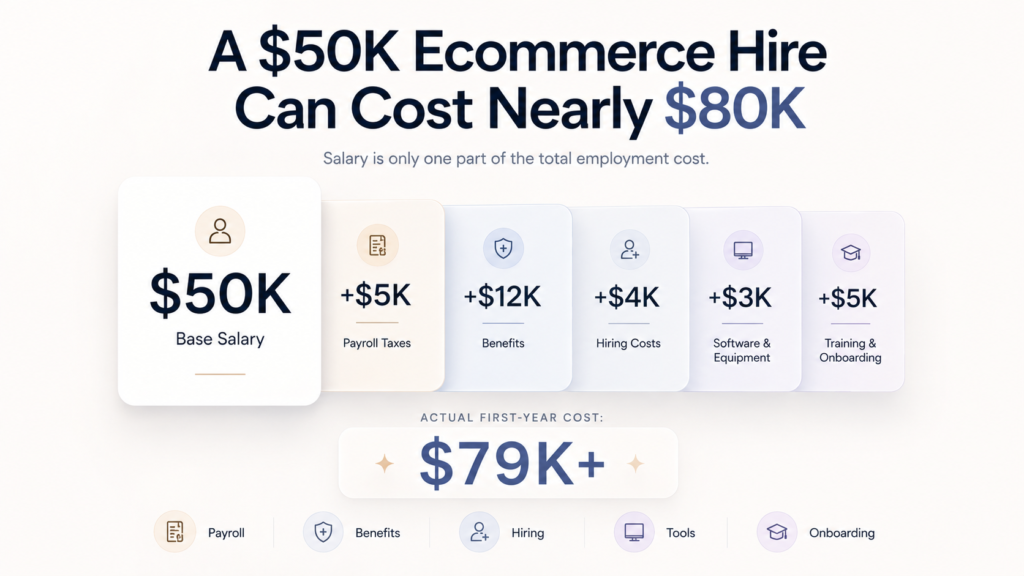
An $50,000 ecommerce employee rarely costs just $50,000. By the time you factor in taxes, benefits, onboarding, software, equipment, and hiring costs, that same employee can easily cost between $76,000 and $94,000 in the first year alone.
And this is exactly where many growing stores get caught off guard.
The salary number feels manageable at first. Then the hidden costs quietly start stacking up month after month.
Let us break down where the money actually goes.
The Salary Is Only the Starting Point
E-commerce hiring costs have climbed steadily over the last few years, especially for people who already understand platforms like Shopify, Amazon, Walmart Marketplace, or Klaviyo.
In 2026, typical US salary ranges look something like this:
- E-commerce Specialist: $54,000 to $94,000 per year
- E-commerce Manager: $58,000 to $96,000 per year
- E-commerce Coordinator or Operations Assistant: $35,000 to $50,000 per year
For this comparison, let us use a $50,000 salary because that is usually where small to mid-sized ecommerce brands begin when hiring operational support.
On paper, that number sounds reasonable.
But salary is just the base layer. The real cost starts once the employee officially joins your business.
Payroll Taxes Add Thousands You Cannot Avoid
The moment someone becomes a full-time employee, your business takes on mandatory employer tax obligations.
These are fixed costs whether the employee performs well or not.
For a $50,000 employee, employers are generally responsible for:
- Social Security contribution (6.2%)
- Medicare contribution (1.45%)
- Federal unemployment taxes (FUTA)
- State unemployment taxes (SUTA)
Together, these payroll-related expenses typically add another $4,000 to $5,500 every year.
And at this point, you still have not touched benefits, hiring costs, or equipment.
This is why many founders underestimate labor costs so quickly. They only calculate salary, not the infrastructure attached to it.
Employee Benefits Quietly Become One of the Biggest Expenses
This is the part that surprises most e-commerce business owners.
Once you start hiring competitively in the US market, employees usually expect some form of benefits package.
That often includes:
- Health insurance contributions
- Paid vacation days
- Sick leave
- Retirement matching
- Workers compensation coverage
Health insurance alone can cost employers anywhere between $7,000 and $15,000 per employee each year, depending on the plan.
Then there is paid time off.
Even when employees are away on vacation or sick leave, payroll still continues.
Retirement matching adds another layer.
A standard 401(k) contribution of 3 to 4% can easily add another $1,500 to $2,000 annually on a $50K salary.
By the end of this stage alone, benefits often increase the real cost of an employee by another $10,000 to $18,000 per year.
And this is exactly why salary rarely tells the full story.
Hiring Costs Start Long Before the Employee Does
Most e-commerce founders only think about payroll after hiring.
But recruitment itself is expensive.
Before your new employee even touches Shopify or replies to a single customer email, you are already spending money on:
- Job board listings
- Resume screening
- Interviews
- Internal management time
- Background checks
- Recruitment agencies
According to the Society for Human Resource Management, the average cost per hire is often estimated at around $4,700.
And that is considered normal.
If you work with a recruiter for specialized e-commerce talent, fees can jump to 15% to 25% of the first-year salary.
For a $50,000 role, that can mean another $7,500 to $12,500 disappears before the employee has even completed onboarding.
New Employees Need Time Before They Become Fully Productive
This is one of the most overlooked costs in hiring.
Even strong employees do not walk in fully operational on day one.
They need time to understand:
- Your systems
- Your workflows
- Your brand voice
- Your customer expectations
- Your SOPs
- Your internal processes
During those first few months, productivity is naturally slower.
Most e-commerce employees take anywhere from 3 to 6 months to become fully efficient in their role.
Meanwhile, someone on your existing team is spending hours training them, answering questions, reviewing work, and correcting mistakes.
That means productivity drops in two places at the same time:
- The new employee is still ramping up
- Existing team members are temporarily pulled away from their own work
This hidden operational slowdown rarely appears in spreadsheets, but it absolutely affects profitability.
Equipment, Software, and Operational Costs Still Add Up
Even remote employees create overhead.
Most e-commerce hires need:
- A laptop or workstation
- Software subscriptions
- Shopify or Amazon tool access
- Communication tools
- Password managers
- Helpdesk platforms
For many businesses, first-year setup costs easily land between $2,000 and $5,000.
And if office space is involved, those costs rise even higher.
This is another reason why hiring becomes more expensive than founders initially expect.
What a $50K Ecommerce Employee Really Costs
Once everything is added together, the numbers look very different from the original salary offer.
| Cost Category | Estimated Cost |
| Base salary | $50,000 |
| Payroll taxes | $4,000 to $5,500 |
| Benefits and insurance | $10,000 to $18,000 |
| Paid time off | $3,700 |
| Recruitment and hiring | $4,700+ |
| Onboarding and training | $1,500 to $7,000 |
| Equipment and software | $2,000 to $5,000 |
| Total first-year cost | $75,900 to $94,200 |
That is the number most e-commerce brands should actually compare against when evaluating hiring decisions.
Not just the salary.
Because once you see the full picture, the virtual ecommerce assistant model starts making much more sense financially.
How Much Does an E-commerce VA Cost in 2026?
Compared to traditional hiring, e-commerce VA pricing is usually much simpler.
There are fewer hidden layers.
Most ecommerce virtual assistants cost somewhere between $400 and $2,500 per month, depending on workload, experience level, and whether you hire independently or through an agency.
And unlike employee hiring, that number is usually much closer to the final cost you actually pay.
How E-commerce VA Pricing Usually Works
There are generally three ways ecommerce businesses hire VAs.
1. Part-Time E-commerce VA Support
Smaller stores often start here.
If your business mainly needs help with:
- Product uploads
- Order processing
- Customer support
- Inventory updates
Then, part-time support is usually enough.
Typical cost:
- $400 to $1,500 per month
For stores processing moderate order volume, this often removes a huge operational burden without creating heavy fixed payroll costs.
2. Dedicated Full-Time E-commerce VA Through an Agency
This is where many scaling e-commerce brands eventually land.
A dedicated VA for e-commerce through an agency usually costs:
- $1,500 to $2,500 per month
That support often includes:
- Shopify management
- Amazon backend support
- Product uploads
- Customer support
- Marketplace management
- Ads monitoring
- Order handling
The biggest advantage here is speed.
Most agency-trained ecommerce VAs already understand the systems, workflows, and daily operational tasks that ecommerce businesses deal with every day.
That dramatically reduces onboarding time.
3. Freelance Ecommerce VA
Some brands choose freelancers through platforms like Upwork or Fiverr.
Typical rates:
- $8 to $25 per hour
This route can absolutely work.
But it also comes with more management responsibility on your side.
You are usually handling:
- Vetting
- Interviews
- Quality control
- Training
- Reliability issues
Some founders save money this way.
Others spend months replacing freelancers before finding someone dependable.
What You Do NOT Pay for With a VA
This is where the cost difference becomes extremely noticeable.
With an e-commerce VA, businesses usually avoid:
- Employer payroll taxes
- Health insurance costs
- Paid leave expenses
- Recruitment fees
- Equipment purchases
- Office overhead
- Long onboarding periods
- Severance risks
That means the monthly fee is often much closer to the true operational cost.
You are paying for execution support, not employment infrastructure.
The Real Cost of a Dedicated E-commerce VA
Here is what the numbers usually look like for a full-time ecommerce VA setup.
| Cost Category | Estimated Cost |
| Monthly retainer | $18,000 to $30,000 annually |
| Payroll taxes | $0 |
| Benefits | $0 |
| Equipment | $0 |
| Recruitment fees | $0 |
| Onboarding | Minimal |
| Total annual cost | $18,000 to $30,000 |
Compared to a first-year employee cost of $75K to $94K, the gap becomes very difficult to ignore.
For many ecommerce brands, that difference creates enough room to invest more into inventory, paid ads, product expansion, or cash flow stability instead of overhead.
E-commerce VA vs Full-Time Employee: Which One Makes More Sense?
At this point, the decision usually becomes much clearer.
| Comparison Factor | Full-Time Employee | E-commerce VA |
| First-year cost | $75,900 to $94,200 | $18,000 to $30,000 |
| Ongoing annual cost | $67,700 to $77,200 | $18,000 to $30,000 |
| Payroll taxes | Yes | No |
| Benefits | Yes | No |
| Equipment costs | Yes | No |
| Time to productivity | 3 to 6 months | 7 to 14 days |
| Flexibility | Lower | Higher |
| Scaling up or down | Difficult | Easier |
| Recruitment burden | High | Low |
| E-commerce platform training | Usually required | Often pre-trained |
| Best suited for | Leadership and strategy | Operations and execution |
But context still matters.
This is not about saying e-commerce employees are unnecessary.
It is about understanding which type of support actually fits your current stage of business growth.
Because in some situations, hiring internally absolutely makes sense.
When Hiring an In-House E-Commerce Employee Is the Better Move
Not every e-commerce role should be outsourced.
And being honest about that is important.
If you need someone deeply involved in business strategy, leadership, or long-term operational planning, a full-time employee is usually the stronger fit.
That includes roles like:
- Head of Operations
- Growth Director
- Brand Manager
- Senior Leadership Positions
These roles require deep institutional knowledge and long-term ownership.
The same applies if your business handles highly sensitive customer data, compliance-heavy systems, or confidential operational processes.
And for some founders, in-person collaboration is simply part of how they want to build their company culture.
That is completely valid.
But for day-to-day operational work?
That is where e-commerce VAs often deliver far better cost efficiency.
What Can an E-commerce VA Actually Help With?
This is usually where store owners realize how much work they can realistically delegate.
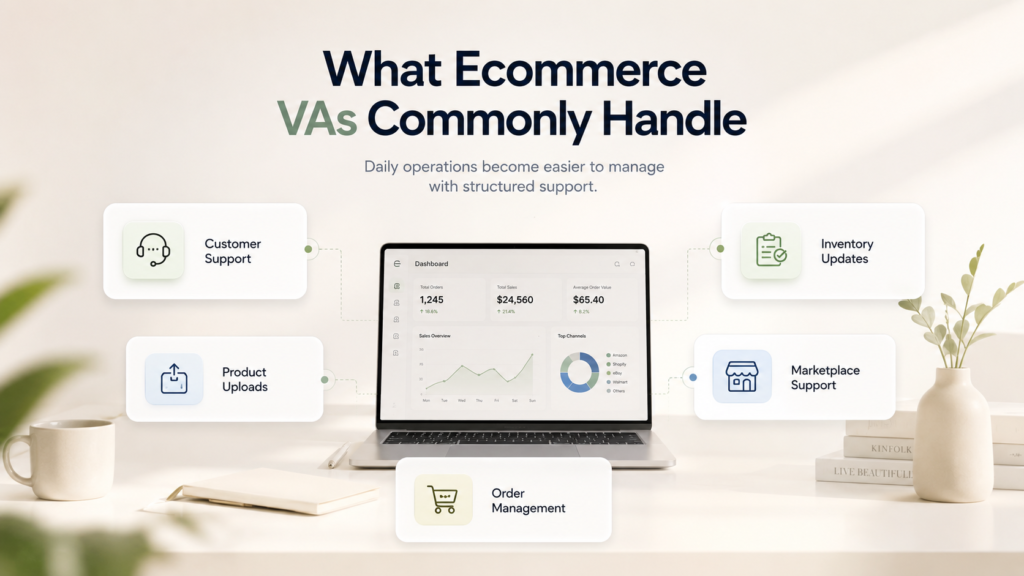
A trained e-commerce VA can handle a surprisingly large portion of daily operations, including:
- Product uploads and listing management
- Shopify and Amazon backend updates
- Customer support tickets
- Returns and refunds
- Order tracking
- Inventory updates
- Marketplace management
- Klaviyo campaign execution
- Basic ads monitoring
- Review management
Customer support outsourcing is another major area where VAs create immediate operational relief.
But there are still boundaries.
An e-commerce VA is usually not the right fit for:
- Pricing strategy
- Supplier negotiations
- Executive leadership
- Brand positioning
- High-level business decisions
And honestly, that separation is often beneficial.
Because the operational tasks a VA handles are usually the exact tasks consuming 20 to 30 hours of the founder’s week every month.
This finally gives the founder space to focus on growth instead of constantly putting out fires.
A More Realistic Scenario Based on Store Size
This decision becomes much easier when viewed through real e-commerce business stages.
Store Doing $10K to $20K Per Month
At this stage, most stores mainly need help with:
- Product uploads
- Customer support
- Order processing
A part-time ecommerce VA costing around $800 to $1,200 per month usually handles this workload comfortably.
Hiring a full-time employee here often creates unnecessary fixed overhead too early.
For smaller stores, the VA route is almost always the more financially sensible option.
Store Doing $25K to $75K Per Month
This is where operations usually become chaotic.
The business suddenly needs:
- Marketplace management
- Consistent customer support
- Inventory coordination
- Ads reporting
- Backend operational help
At this level, many brands move toward a dedicated e-commerce VA or small VA team costing roughly $1,500 to $3,000 monthly.
Trying to build the same operational coverage with internal employees can easily push labor costs above six figures annually.
The economics become difficult to ignore.
Store Doing $150K+ Per Month
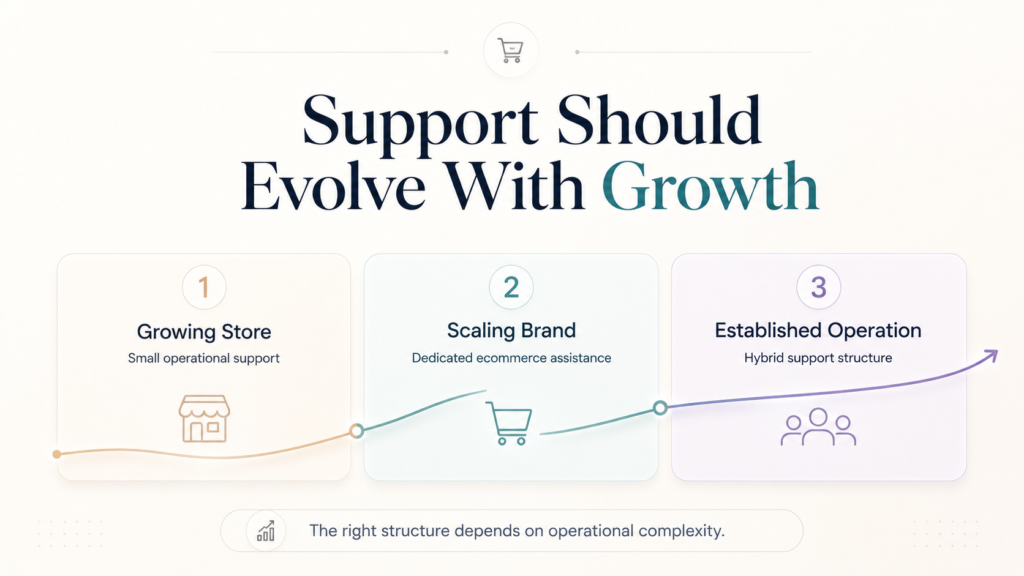
Larger e-commerce businesses often benefit from a hybrid structure.
This is where the smartest setups usually emerge:
- One in-house operations leader
- Multiple VAs handling execution
That combination often delivers better scalability than building a fully internal team from scratch.
The business retains strategic control while dramatically lowering operational overhead.
And financially, the hybrid model still tends to outperform an all-employee structure.
For many growing stores, the biggest challenge is not demand. It is operational overload. This is exactly why more founders are turning toward virtual support systems to scale without dramatically increasing fixed payroll costs. You can read more about that in this guide on how e-commerce virtual assistants help small businesses scale faster.
Final Thoughts
The biggest mistake ecommerce founders make is comparing a VA’s monthly rate to an employee’s salary.
That is not the real comparison.
The real comparison is this:
- A full-time ecommerce employee often costs $76,000 to $94,000 in the first year
- A dedicated ecommerce VA typically costs $18,000 to $30,000 annually
For operational support, those two options can often produce very similar outcomes.
The real question is not whether one option is universally better.
It is about choosing the support structure that makes the most financial and operational sense for the stage your business is currently in.
If you are trying to figure out what kind of support your store actually needs, the best next step is to talk through your workflow, workload, and growth goals with someone who understands ecommerce operations firsthand.
You can book a free consultation with Crew27 and get a clearer picture of what setup makes the most sense for your business right now.
1. Is it cheaper to hire a VA than a full-time employee?
Yes. In most cases, significantly cheaper.
A fully loaded ecommerce employee in the US often costs between $66,000 and $108,000 annually after taxes, benefits, onboarding, and overhead. A dedicated e-commerce VA generally costs between $18,000 and $30,000 annually.
For operational ecommerce tasks, that difference can easily save businesses $40,000 to $70,000 per year.
2. What does a full-time employee actually cost beyond salary?
Beyond salary, businesses also pay for payroll taxes, health insurance, paid leave, retirement contributions, recruitment costs, onboarding, software, and equipment.
A $50,000 employee commonly ends up costing between $75,000 and $94,000 in year one, once everything is included.
3. How much does an e-commerce VA cost per month?
It depends on workload and support level.
Part-time ecommerce VA support generally ranges from $400 to $1,500 monthly. Dedicated full-time ecommerce VA support through an agency typically ranges from $1,500 to $2,500 monthly.
4. When should I hire an employee instead of a VA?
An employee usually makes more sense when the role involves leadership, strategic planning, or deep integration into company operations.
For execution-focused ecommerce work like listings, customer support, and operational management, VAs are usually more cost-effective.
5. Can a VA really do the same work as an e-commerce employee?
For operational execution tasks, yes.
Experienced ecommerce VAs regularly handle listings, customer support, order management, inventory updates, and marketplace operations at a very high level because those systems are already familiar to them.
The biggest difference is not capability.
It is a role scope.