

It is 7:30 AM on a Tuesday.
Before you check your revenue, before you look at ad performance, before you do a single thing that could actually grow your business, you open your inbox.
47 unread emails.
Six people want to know where their order is. Four want to return something. Three are asking about a product you already described in your listing. Two are upset about delivery delays that are completely the courier’s fault, but will land on your plate regardless. One customer sounds genuinely frustrated and needs a careful response. The rest are variations of questions you have answered a hundred times before.
By the time you work through it, it is nearly 10 AM.
Two and a half hours gone. Nothing moved forward.
And here is the thing that really stings. This was not a bad day. This is every day.
If you run a Shopify store and you are past 50 orders a month, you already know exactly what this feels like. The inbox grows with your revenue. More customers mean more questions. More questions mean more time trapped in email instead of building the business you started in the first place.
The good news is that there is a fix. Not a helpdesk app. Not a chatbot. A real, practical solution that removes this from your plate entirely.
This blog covers what the inbox is actually costing you, why the problem gets worse, not better, as you scale, and how store owners are fixing it for good.
Quick Answer: The fix for Shopify support email overload is not a better tool. It is removing the task from the founder entirely. A trained Shopify Customer Support VA handles the repeatable 80 to 90% of all incoming tickets in under 2 hours per response, while escalating only the edge cases that genuinely need you. Most store owners reclaim 20 or more hours per week within the first two weeks of handing this off.
What the Inbox Is Actually Costing You (Beyond the Time)
Most Shopify store owners think of customer support as a cost they have to absorb. Something that comes with the territory. Time-consuming but necessary.
That framing is costing them more than they realise.
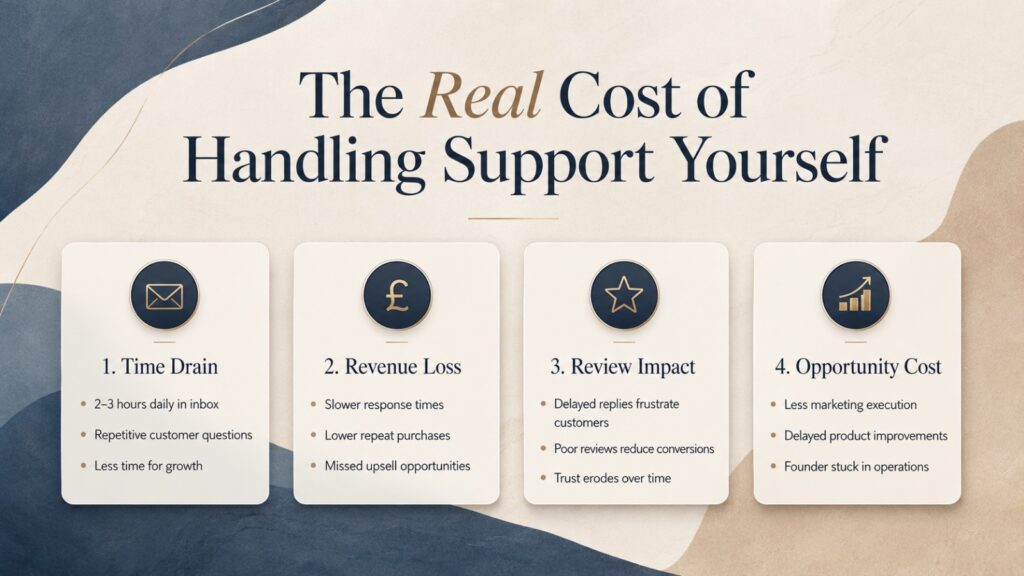
Support response time is not just an operational metric. It connects directly to three things that determine whether your store grows: repeat purchase rate, review quality, and word of mouth. When support is slow or inconsistent, all three decline at the same time.
The data makes this very clear. 93% of customers say they are more likely to make repeat purchases from companies with excellent service. Stores that respond in under an hour achieve a 71% customer retention rate. Stores where response time stretches past 24 hours drop to 48% retention. That is a 23-point difference in how many customers come back, created entirely by how fast you reply to their emails.
Think about what that means in pound terms. If your store does £20,000 a month and your repeat customer rate drops from 71% to 48% because support is slow, you are not just losing time. You are leaving thousands in recurring revenue on the table every single month.
The cost per ticket compounds this further. When you factor in your actual hourly value as a store owner, the average cost of handling each support ticket yourself runs between $2.70 and $5.60. A store managing 500 tickets per month is spending up to $2,800 per month in founder time on support alone, before you account for a single minute of growth work not done.
And then there are reviews. 93% of consumers say online reviews influence their purchasing decisions. One three-star review that mentions slow replies is not a one-time loss. It is a recurring drag on your conversion rate that every future visitor reads before deciding whether to buy.
Time cost. Retention loss. Review damage. Opportunity cost. These four things stack quietly every week you handle the inbox yourself.
What Your Customers Actually Expect in 2026
Before looking at the fix, it is worth understanding exactly what the bar looks like now.
Because the bar has moved.
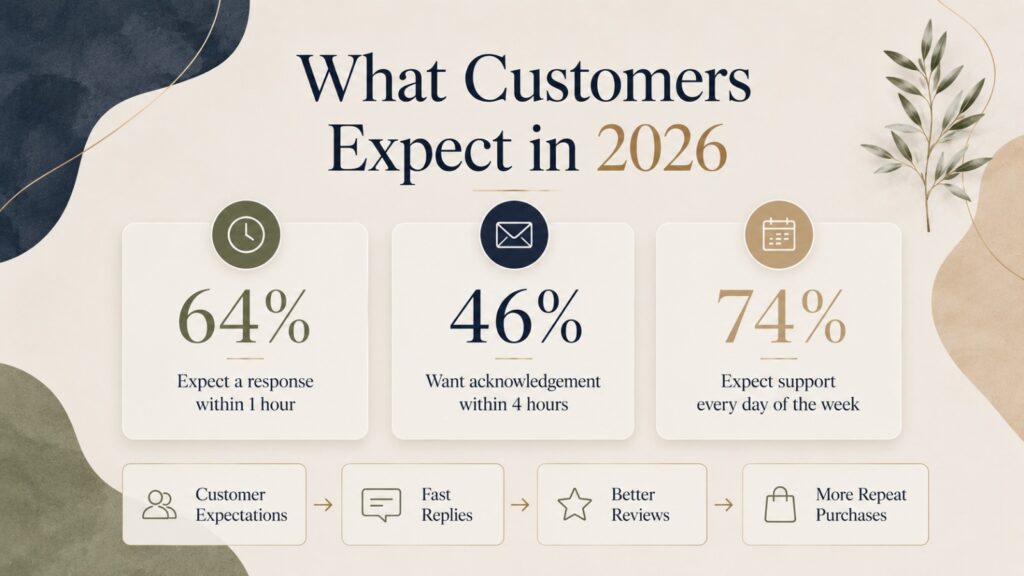
64% of shoppers expect a response within one hour. 46% want at least an acknowledgment in under four hours. 88% of customers say they expect faster responses than they did just one year ago. And 74% expect customer service to be available every day of the week, including weekends. (Source: Salesmate: Customer Service Statistics 2026)
The industry average for e-commerce support response time sits at 4 to 6 hours. Best-in-class teams respond in 30 to 60 minutes.
Most solo-run Shopify stores respond in 12 to 24 hours on weekdays and longer over weekends. Against a customer base that wants a reply within the hour, that gap is the difference between a loyal repeat buyer and a one-time customer who leaves feeling ignored.
This is not a willpower issue. Checking your inbox every hour, seven days a week, including evenings and weekends, is not a sustainable way to run a store. It is a system that works until your order volume makes it impossible. And then it fails visibly.
The 8 Emails That Make Up 80% of Your Inbox
Here is what most store owners realise when they look at their inbox honestly: it is deeply predictable.
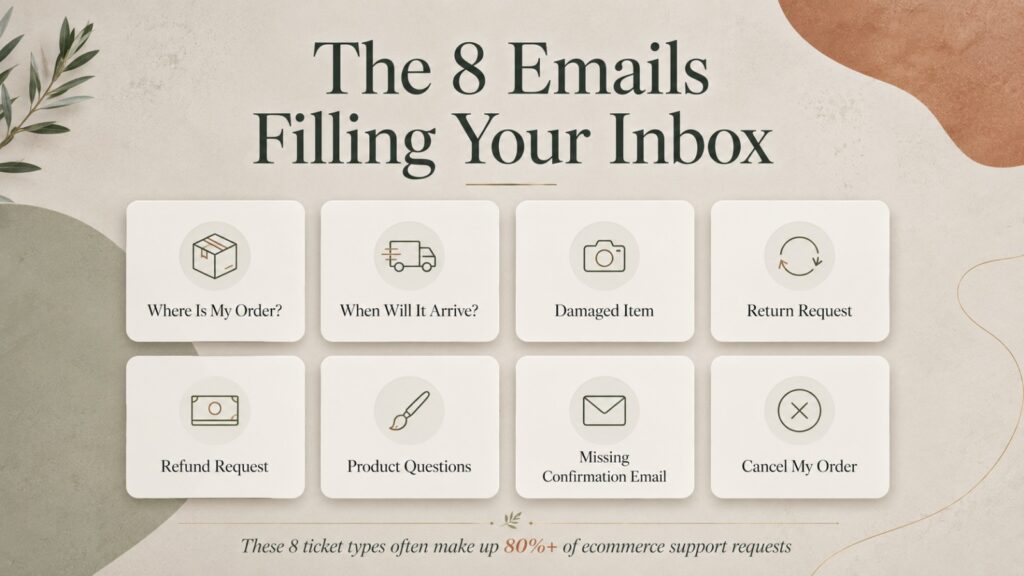
The same eight questions arrive in slightly different words from different customers every single week. Once you can see the pattern clearly, the question stops being “how do I manage this inbox better?” and starts being “why am I personally answering the same questions several hundred times a year?”
Let’s name them.
- “Where is my order?”
The single most common ticket across every ecommerce category. Resolving it requires an order number lookup, a tracking link, and a plain-English status update. No judgment needed. No unique brand knowledge required. A clear process handles this in under 90 seconds. - “When will my order arrive?”
Shipping timeline questions. Requires your standard delivery windows by region and awareness of any current carrier delays. Completely template-able from week one. - “I received the wrong item” or “My item arrived damaged.”
Requires an empathetic opener, a photo request, and your replacement or refund process. The process is fixed. The tone is a style setting, not a strategic decision. - “Can I return this?”
Requires your return policy should be stated clearly, and the steps to initiate a return. If your policy exists in writing, this ticket essentially writes itself. - “I want a refund.”
Requires order verification, confirmation it falls within your policy, and initiating the refund in the Shopify admin. A trained VA with the right access handles this start to finish. - “Does this come in another size or colour?”
Pre-sale product questions. Requires product knowledge that is already documented in your listings. A VA who has read your catalogue handles these in seconds. - “I didn’t receive a confirmation email.”
Requires an order lookup, confirmation that the order was processed correctly, and a manual resend from the Shopify admin. Fully delegatable with basic access. - “I want to cancel my order.”
Requires checking order status and either cancelling it if unfulfilled or guiding the customer through your return process if it has already shipped. Fixed process, zero strategic judgment needed.
None of these eight questions requires you. Not your product intuition, not your founder-level judgment, not your relationships. They require a process, a trained person, and the right tools to look up the information.
That is exactly what a dedicated e-commerce customer support VA is built to handle.
Why This Problem Gets Worse, Not Better, as You Grow
Most store owners assume that as revenue grows, the support problem gets easier to manage. They tell themselves they will hire someone when the time is right. Buy a better tool. Figure it out.
What actually happens is the opposite.
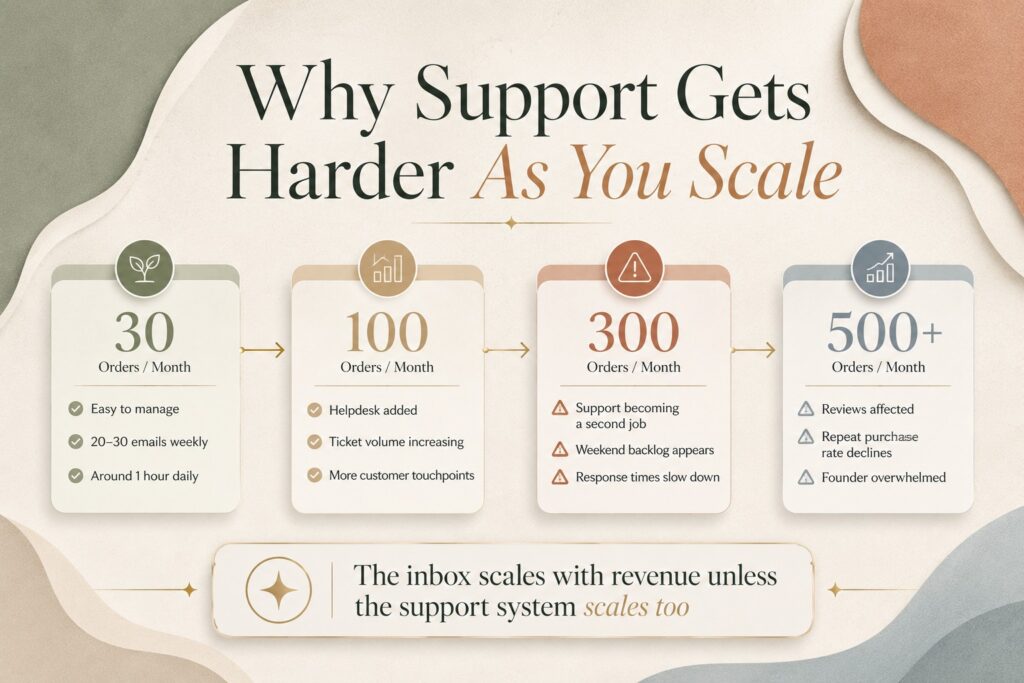
At 30 orders per month, support is manageable. Maybe 20 to 30 emails per week. An hour a day gets through it.
At 100 orders per month, volume doubles or triples. You add a helpdesk app, spend a weekend setting it up, and feel better for two weeks. Then you fall behind again.
At 300 orders per month, the inbox becomes a second job. Return requests pile up. A shipping delay during a busy period doubles your incoming volume overnight. Weekends become indistinguishable from weekdays in terms of pressure.
At 500 or more orders per month, the cost of slow support stops being theoretical. Reviews start reflecting it. Repeat purchase rate slides. Your best acquisition campaign is working against the retention damage your backlog is creating.
The inbox does not wait for you to be ready. It scales with your revenue, whether you have built the right system or not.
What Most Store Owners Try First (And Why It Falls Short)
Before we get to what actually works, it is worth covering the three approaches most store owners attempt, because each one solves part of the problem without solving it.
Helpdesk apps like Gorgias, Freshdesk, or Zendesk.
Genuinely excellent tools. They organise the inbox, add response macros, and speed things up meaningfully. But they do not remove the task from you. A faster inbox is still your inbox. You are still the one reading, thinking, and responding.
Chatbots and AI auto-replies.
Useful for instant acknowledgment and simple FAQ queries. They can handle around 30 to 40% of tickets autonomously in 2026. The remaining 60 to 70% still land with a human who needs to actually think and respond. And they cannot handle a damaged item complaint with empathy, process a return, or resolve any situation that requires account access and judgment at the same time.
Hiring a part-time employee.
Works well at high volume. But it comes with payroll taxes, benefits, equipment costs, onboarding time, and management overhead. For stores below $50,000 to $75,000 per month, the fixed cost of an employee is difficult to justify against the actual volume.
Each of these helps. None of them solves the underlying problem, which is that your inbox requires consistent daily human attention across all seven days of the week, and that attention should not be yours.
The Fix That Actually Works
A trained Shopify Customer Support VA who works inside your existing tools, manages the inbox as their primary job, and handles the predictable 80 to 90% of all tickets without involving you at all.
This is different from the three options above in three specific ways.
First, they are a trained human. They can process returns, write empathetic responses to upset customers, and make small judgment calls within your stated guidelines. They do the things bots cannot.
Second, they work with your helpdesk tools, not instead of them. If you already use Gorgias or Freshdesk, the VA operates inside it. The tool and the person work together. You get the efficiency of automation and the quality of a real person in the same workflow.
Third, the cost structure is completely different from a full-time employee. No payroll taxes on your end. No benefits. No equipment. No ramp-up months where productivity is a fraction of what you are paying for. A trained e-commerce VA is onboarded and operational within 7 to 14 days.
And because they are specifically trained in e-commerce rather than general administration, they already understand what a Shopify order status means, how refunds work in Shopify admin, what a tracking query requires, and how to handle a return request without needing three weeks of training before they are useful.
If you want to understand how the full onboarding process works before you hand anything off, the guide on how to train a Shopify VA to run your store without you covers the exact process from SOP building to independent operation.
What the First 30 Days Actually Look Like
The most common concern before handing off support is: “They will not do it right.” It is worth walking through what the first month actually looks like, because it is far less complicated than most store owners expect.
Week 1: Build the SOP in one session.
You do not need a 30-page manual. You need a one-page document for each of the eight question types. What the question usually looks like. What is the correct answer? What access does the VA need to resolve it? What to escalate to you.
A good VA builds this with you in a single 90-minute session based on their first week of watching your inbox. Most of it writes itself from the patterns already sitting in your sent folder.
Week 2: Supervised handoff.
The VA handles the inbox, and you review responses before they go out. You correct tone where needed. You add to the SOP where gaps appear. By the end of week 2, most responses require no review at all.
Week 3 and beyond: Full handoff.
The VA manages the inbox independently. You receive a daily summary covering tickets handled, issues escalated, and anything unusual flagged. Your personal involvement drops to reviewing the 10 to 20% of tickets that genuinely need you. Edge cases, upset customers requiring a personal response, or refund requests above your standard threshold.
What most Crew27 clients report after 30 days:
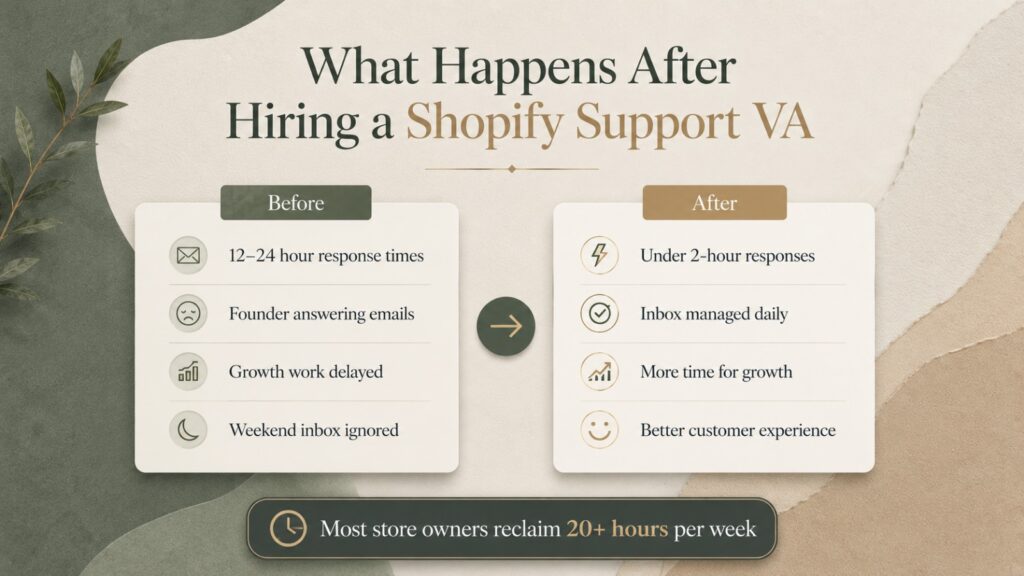
Response time drops from 12 to 24 hours to under 2 hours. The support backlog clears completely. The weekend inbox, which most solo operators were simply ignoring, gets handled every day. And the founder stops thinking about email until the weekly summary arrives.
Are You Ready to Hand This Off?
Not every store is at the right point, and it is worth being honest about that.
You are ready if:
You process 50 or more orders per month, and the inbox takes more than 90 minutes per day. You have caught yourself answering the same email twice in a single week from different customers. You have delayed responding to someone for more than six hours because something else took priority, and you know it happens regularly. You have a returns policy and a shipping policy written down somewhere. That is genuinely all the SOP foundation a VA needs to start.
You might need one more step first if:
Your return and shipping policies are not written down anywhere yet. Write them first. One paragraph each is enough. Without that base, every decision goes back to you, and the handoff does not stick. Your order volume is still under 30 per month. At that stage, invest 30 focused minutes a day in the inbox yourself and build your policies so the handoff is clean when volume grows.
The 47 Emails Are Still There Tomorrow Morning
Remember that inbox at 7:30 AM.
The 47 emails are not going anywhere on their own. They will be there tomorrow. They will be there next Monday. And the week after that, there will be more of them because your store is growing.
The same eight questions are driving almost all of them. Every single one has a clear, documented answer. None of them needs you specifically.
The only decision left is how much longer you want to spend your mornings answering them yourself.
If you are ready to remove your inbox from your daily routine, our Shopify Customer Support VA service is built for exactly this. Reach out to Crew27 today, and we will walk you through how the handoff works, what the first two weeks look like, and what you can realistically expect your mornings to look like by week three. Most clients are matched with a VA within 48 hours.
1. How do I handle Shopify support emails without it consuming my whole day?
Delegate the inbox to a trained e-commerce customer support VA who handles all repeatable tickets as their primary job. With a clear SOP covering your return policy, shipping windows, and common queries, a well-briefed VA reduces your personal involvement to reviewing 10 to 20% of tickets. Most store owners with 50 or more orders per month reclaim 15 to 20 hours per week with this model within the first two weeks.
2. How many customer support emails does a Shopify store get per day?
It varies by order volume and product type. A rough benchmark: stores processing 100 orders per month receive around 30 to 60 support contacts per month. Stores at 500 orders per month typically receive 150 to 300 contacts monthly. Volume spikes significantly during promotions, new product launches, and periods of carrier delays, where incoming tickets can double or triple temporarily.
3. Should I hire a VA for Shopify customer service?
Yes, if your support inbox consistently takes more than 60 to 90 minutes per day and you are processing 50 or more orders monthly. The cost of a trained customer support VA is significantly lower than the time value you recover. Response times typically improve from 12 to 24 hours down to under 2 hours, which directly improves retention rate and repeat purchase behaviour.
4. What is the fastest way to reduce my Shopify support ticket volume?
Two things reduce incoming volume fastest. First, add a detailed order tracking page and proactive shipping update emails. Most “where is my order” tickets disappear when customers can self-serve the answer. Second, build a visible FAQ or returns policy page that answers the eight most common questions before customers email. These two changes can reduce incoming ticket volume by 20 to 30% without changing your inbox management at all.
5. How long does it take to train a VA on my Shopify store?
With a basic SOP covering your return policy, shipping timelines, and common query responses, a trained e-commerce VA is typically handling your inbox independently within 7 to 14 days. Week one involves shadowing and supervised responses. Week two transitions to independent management with daily summaries. Most clients describe feeling confident in the handoff by the end of week two.