

Running an online store often means wearing many hats simultaneously: products, orders, emails from customers, stock management, and more. After a while, you’ll realize you can’t do everything alone, which is when an e-commerce virtual assistant comes into play.
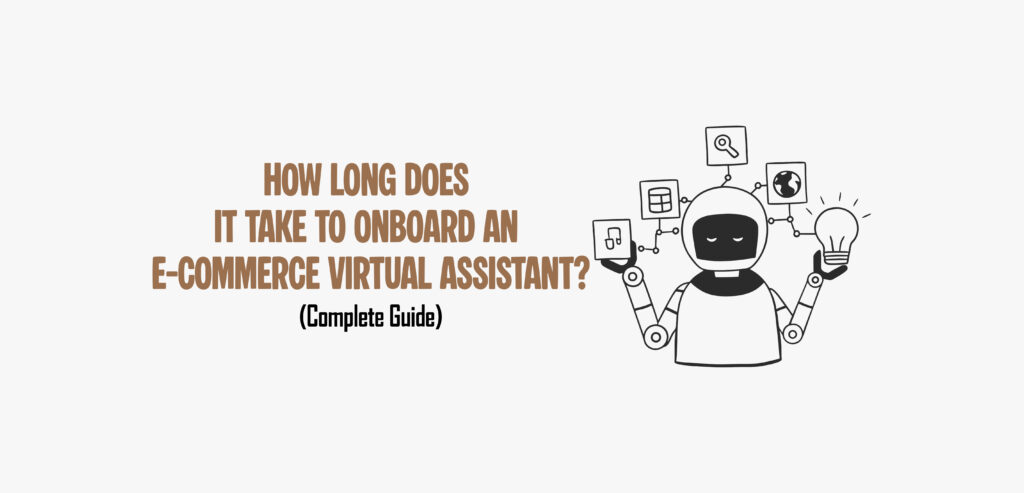
The typical duration for onboarding an e-commerce virtual assistant is 3 to 14 days based on task complexity, existing documentation, and available communication methods.
This can happen faster if you’re ready and organized. If not, it may take more time than anticipated.
In this article, you will learn about:
- The realistic time frame required for onboarding.
- Factors that affect the onboarding speed negatively.
- Process for onboarding an e-commerce VA faster.
What Is an Ecommerce Virtual Assistant?
An e-commerce virtual assistant is a remote expert who assists in managing the day-to-day activities of an online store.
The activities include working on platforms such as Shopify, Amazon, WooCommerce, and performing tasks that take time and effort, enabling you to concentrate on growth.
Usually hired by:
- Shopify store owners
- Amazon sellers
- DTC brands
- E-commerce businesses
Key Tasks They Handle
Most e-commerce virtual assistant services cover a wide range of operational work:
- Product uploads and listing optimization
- Order processing and tracking
- Customer support (email, chat)
- Inventory updates
- Basic SEO for product pages
- Marketplace management (Amazon, eBay)
For example, instead of spending 4–5 hours uploading products, a virtual assistant ecommerce expert can handle it daily without errors.
How Long Does It Take to Onboard an E-commerce Virtual Assistant?
| Stage | Time Required | What Happens |
| Hiring & Selection | 2–5 days | Screening, interviews |
| Documentation Setup | 1–3 days | SOPs, access sharing |
| Training & Handover | 3–7 days | Task walkthroughs |
| First Independent Work | 1–3 days | VA starts executing |
| Full Efficiency | 2–4 weeks | Optimized workflow |
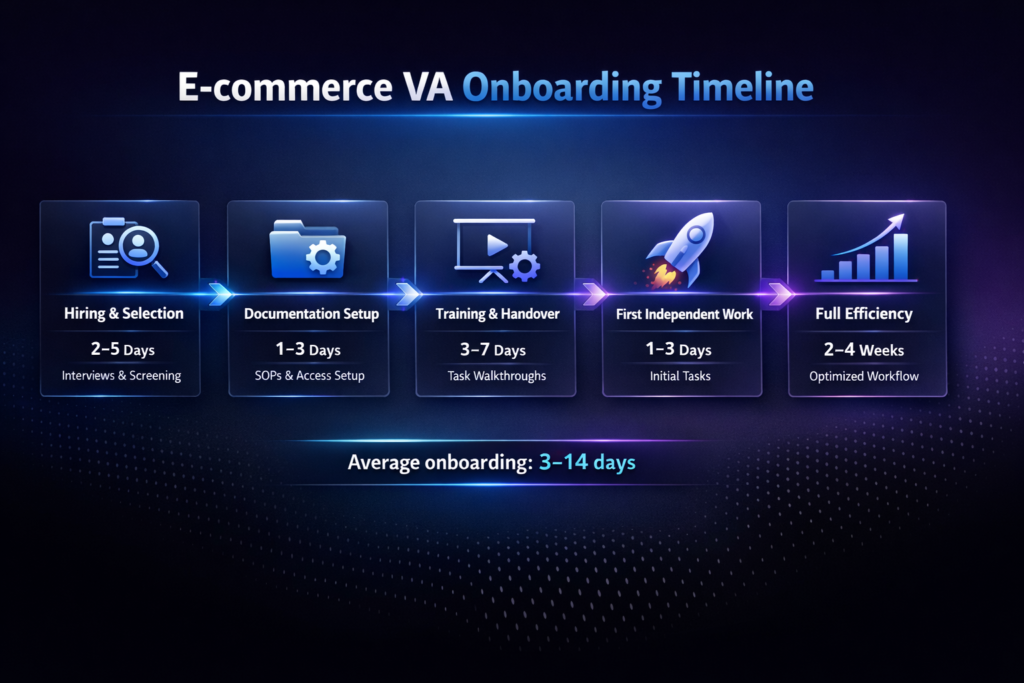
Average onboarding time: 3 to 14 days
Realistic Timeline Based on Business Size
Not all businesses are on board at the same speed. Here’s what actually happens:
Small Ecommerce Stores (3–5 days)
If you run a Shopify store with limited SKUs, onboarding is quick. Tasks are simple, and fewer systems are involved.
Growing Brands (7–10 days)
More products, more orders, and multiple tools. Training takes longer because processes need explanation.
Large E-commerce Businesses (10–14+ days)
Multi-channel sellers (Amazon + Shopify + Walmart) need structured onboarding. More tools, SOPs, and coordination slow things down.
Example:
- A Shopify-only store → faster onboarding
- Amazon seller → needs listing + backend training
- Multi-channel brand → longest onboarding
Factors That Affect E-commerce VA Onboarding Time
1. Task Complexity
Simple tasks like product uploads are easy to delegate.
But advanced work like:
- Running ads
- SEO optimization
- Automation setup
These require more training, increasing onboarding time.
2. Documentation & SOPs (Biggest Factor)
If you already have:
- SOPs
- Checklists
- Video instructions
Your e-commerce virtual assistants can start faster.
If not, onboarding slows down because you’re explaining everything from scratch.
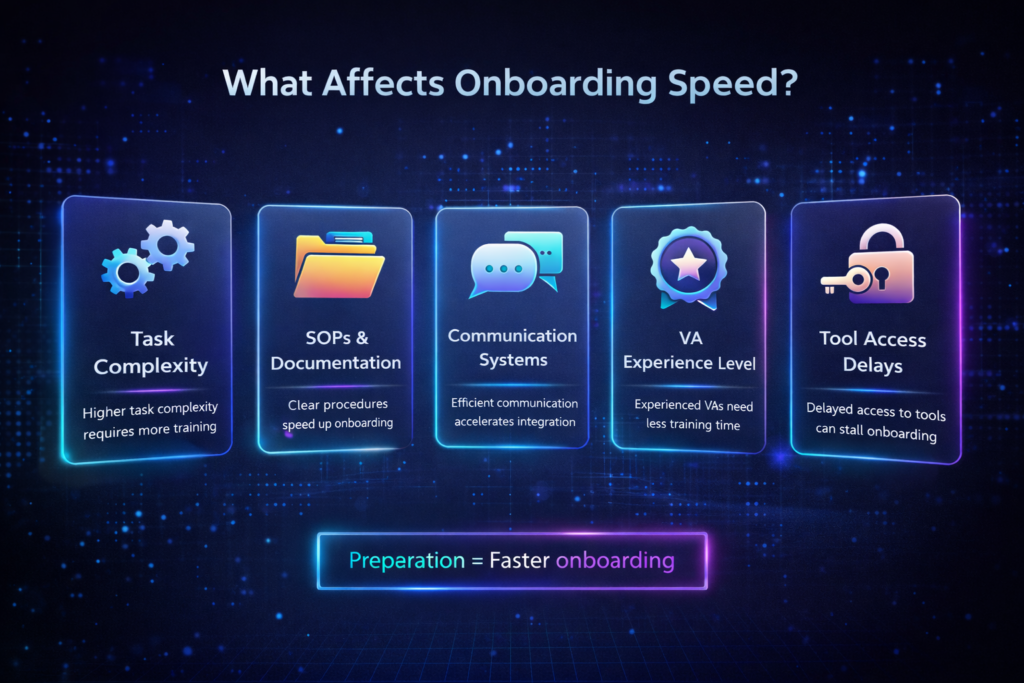
3. Communication Systems
Clear communication speeds everything up.
Using tools like:
- Slack (for daily updates)
- ClickUp or Trello (task tracking)
- Loom (video instructions)
Without these, confusion increases, and delays follow.
4. Experience Level of the VA
Pre-trained virtual assistants for e-commerce businesses already understand platforms like Shopify or Amazon.
They don’t need basic training, which cuts onboarding time significantly.
5. Tools & Platform Access
Access delays are common and often overlooked.
Examples:
- Shopify admin access
- Amazon Seller Central permissions
- Payment or order tools
If access isn’t ready, onboarding pauses.
Step-by-Step E-commerce Virtual Assistant Onboarding Process
Step 1: Define Tasks Clearly
Avoid saying “help with store management.”
Instead, define tasks like:
- Upload 20 products daily
- Respond to customer emails within 24 hours
Clarity reduces confusion from day one.
Step 2: Create SOPs (Standard Operating Procedures)
Use:
- Written guides
- Screen recordings
- Step-by-step instructions
A simple Loom video explaining product uploads can save hours of back-and-forth.
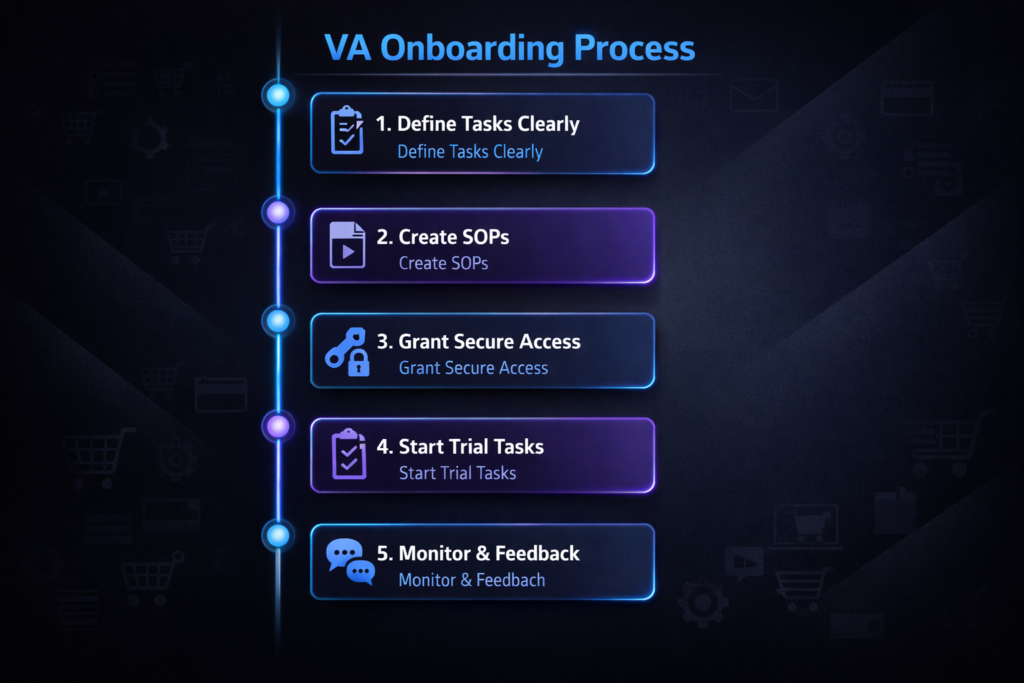
Step 3: Grant Secure Access
Use tools like password managers or restricted permissions.
Never share full access blindly. Start with limited roles and expand gradually.
Step 4: Start With Trial Tasks
Don’t assign everything at once.
Start with:
- Product uploads
- Order updates
This builds confidence and reduces errors.
Step 5: Monitor and Give Feedback
Daily check-ins in the first week are important.
Small corrections early prevent bigger mistakes later.
Common Mistakes That Delay Onboarding
These are the exact reasons most businesses struggle:
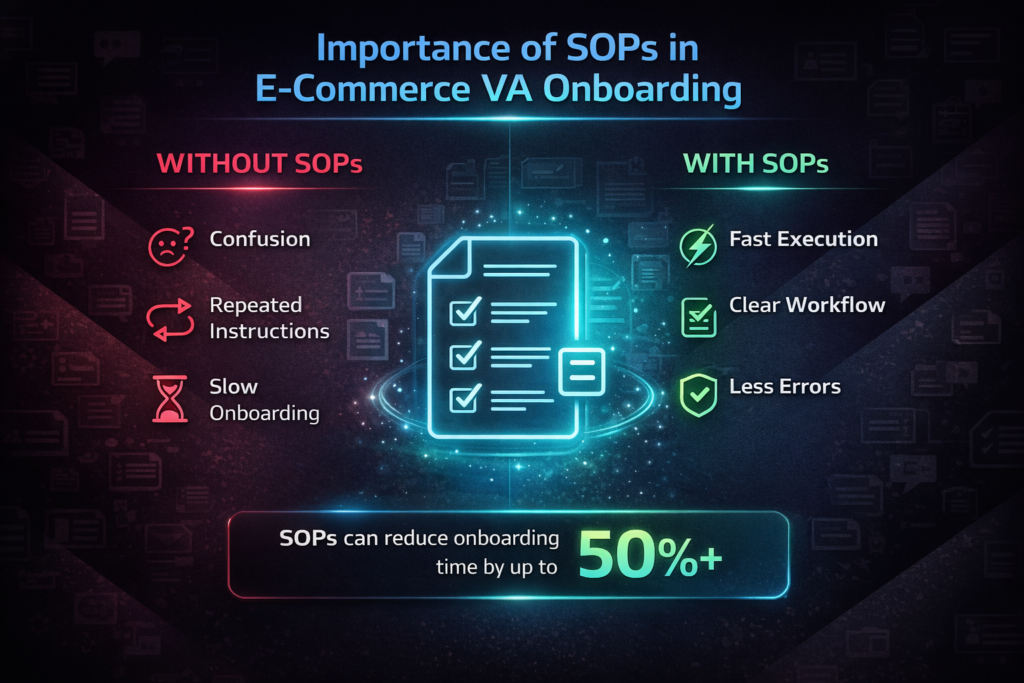
- No training material
Without SOPs, you repeat instructions daily. This wastes time and slows progress. - Hiring without role clarity
If tasks aren’t defined, the VA keeps asking questions, delaying work. - Giving too many tasks at once
Overloading leads to confusion and mistakes. - Poor communication
Unclear instructions create rework and delays.
No feedback loop
Without feedback, mistakes continue and efficiency drops.
How to Speed Up Ecommerce VA Onboarding
If you want faster onboarding, focus on this:
- Create SOPs before hiring
- Use screen recordings instead of long text
- Start with repetitive tasks first
- Assign one point of contact
- Use task management tools
Real Example:
A Shopify store owner recorded a 10-minute Loom video explaining product uploads.
Result:
- VA started working in 2 days
- No repeated explanations
- Faster execution
Benefits of Hiring an E-commerce Virtual Assistant
1. Time Savings
You stop spending hours on repetitive work and focus on growth.
2. Cost Efficiency
Hiring a full-time employee in the US is expensive.
When you hire an e-commerce virtual assistant, you pay only for the work needed.
3. Scalability
As your store grows, you can increase tasks without hiring a full team.
4. Focus on Growth
Instead of handling operations, you can focus on:
- Marketing
- Strategy
- Expansion
This is why many businesses choose to hire a VA for e-commerce early.
When Should You Hire an E-commerce Virtual Assistant?
You should consider hiring a virtual assistant for e-commerce when:
- You’re spending too much time on repetitive tasks
- Orders are increasing and becoming hard to manage
- Customer support is delayed
- You feel burnt out handling everything
At this stage, a VA is not a luxury; it’s a necessity.
Cost vs Time: Is It Worth Hiring an E-commerce VA?
| Factor | DIY | With Ecommerce VA |
| Time spent | High | Low |
| Errors | More | Less |
| Scalability | Limited | High |
| Growth focus | Low | High |
Doing everything yourself may save money short-term, but it limits growth.
Conclusion: What Should You Expect?
Onboarding an e-commerce virtual assistant doesn’t have to be complicated.
- Typical timeline: 3 to 14 days
- Faster if you have SOPs and clear systems
- Slower if processes are unclear
The key is preparation, not just hiring.
If you’re planning to hire e-commerce virtual assistants, focus on setting up systems first. That’s what actually saves time.
Looking to hire an e-commerce virtual assistant without the onboarding hassle? Our trained experts can get started in as little as 48 hours, with ready SOPs and proven workflows.
1. How long does it take to train a virtual assistant for e-commerce?
It usually takes 3 to 14 days, depending on task complexity and available training materials. Pre-trained VAs can start faster.
2. Can an e-commerce virtual assistant start immediately?
Yes, for simple tasks like product uploads or order processing. Complex tasks require proper onboarding and training.
3. What tasks should I assign first to a VA?
Start with:
- Product uploads
- Order processing
- Customer emails
These are repetitive and easy to train.
4. Do e-commerce virtual assistants need technical skills?
Basic knowledge of e-commerce platforms like Shopify or Amazon is required. Advanced skills depend on the role.
5. How do I hire an e-commerce virtual assistant in the USA?
You can hire through:
- Freelance platforms
- Virtual assistant agencies
- Direct hiring
Choose based on your budget and requirements.